


Running inventory for a print shop feels like predicting weather three months out while juggling flaming torches. One week you're drowning in business card orders, the next it's wedding invitations, and somehow you're always out of that specific metallic cardstock when the big order hits.
Most print shops handle inventory two ways: panic ordering when something runs out, or stockpiling everything "just in case" and watching cash evaporate into shelves of dusty paper. Neither works. Both kill margins faster than a broken press on deadline day.
The real problem isn't that print demand is unpredictable—it's that most inventory systems weren't built for how print shops actually operate. They assume steady demand, predictable patterns, and products that don't expire or yellow with age. Print shops deal with seasonal swings, custom jobs, specialty papers that suppliers discontinue without warning, and clients who order 5,000 brochures once then disappear forever.
Why standard reorder formulas break in print shops
Traditional inventory math assumes you're selling widgets with consistent demand. The classic Economic Order Quantity formula looks clean on paper: EOQ = √(2 × Annual Demand × Order Cost / Holding Cost)
Plug in your numbers for standard white copy paper and it might work. Try applying that to holographic foil stock that three clients ordered once for holiday cards? You'll either overstock by thousands or run out exactly when someone needs it urgently.
Print shops face a brutal combination of challenges. Your demand swings wildly based on season—tax forms in March, wedding invitations in spring, holiday cards in fall. Some materials have shelf lives (certain adhesives, specialty coatings), others take up massive space (roll stock, large format media), and many have minimum order quantities that force you to buy way more than needed.
Customer behavior makes it worse. Unlike retail where people buy predictably, print customers cluster orders around events, campaigns, and budgets. A restaurant might order 10,000 menus, then nothing for two years. A real estate agent orders 500 postcards monthly like clockwork, until they switch careers overnight.
Standard formulas ignore all of this. They treat every SKU equally, pretend seasonal patterns don't exist, and assume minimum orders are negotiable. No wonder print shops end up with warehouses full of paper they'll never use and empty shelves for what customers actually want.
Building reorder triggers that match print shop reality
Successful print shops use a simpler approach based on actual consumption patterns. Here's a framework that accounts for variability without requiring a statistics degree:
Eliminate order confusion and delays.
GoInkly helps you manage every print order efficiently from submission to delivery.
- Centralized order tracking
- Production workflow management
- Inventory and supply monitoring
No credit card required
Start with your baseline consumption rate—not theoretical annual demand, but what you actually used in the past 90 days. Divide by days to get daily usage. This becomes your starting point.
For high-turnover items (standard papers, common card stocks), use a basic min/max system with buffers:
-
Minimum stock = (Daily usage × Lead time) + (Daily usage × 7 days buffer)
-
Reorder quantity = 30-45 days of typical usage
-
Maximum stock = Minimum + Reorder quantity
But print shops need to get clever. Add multipliers based on what you know about each material:
Seasonality multiplier: Track which months see spikes. Wedding season might mean 3× normal pearl cardstock usage. Tax season could mean 5× regular bond paper. Build these into your calculations three months ahead.
Custom job buffer: For specialty items used in custom work, keep enough for one typical project plus 20% waste. When stock drops below that threshold, reorder enough for 2-3 typical projects.
Supplier reliability factor: If your paper supplier delivers in 3 days reliably, use that. If they're notorious for "2-week delivery" meaning 3-4 weeks, plan accordingly. One shop literally kept a "BS factor" column in their spreadsheet—lead time multiplied by how much the supplier typically lies about delivery.
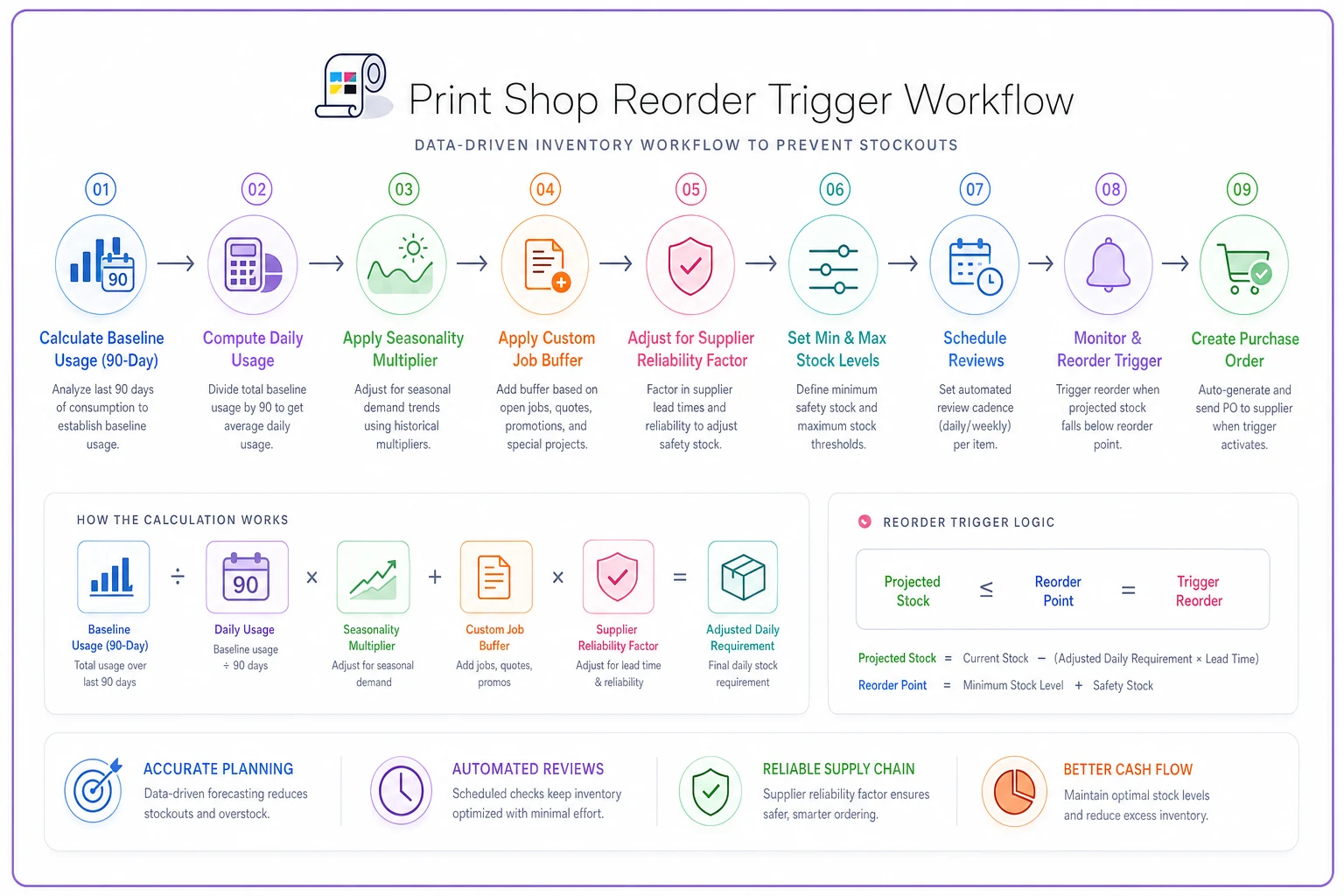
Use this workflow as a checklist when reviewing reorder points.
The spreadsheet system that actually works
Forget fancy inventory software for a minute. A well-built spreadsheet can handle 90% of print shop inventory needs if you structure it right.
| SKU | Item | Daily Use | Lead Days | Min Stock | Current | Reorder? | Order Qty | Seasonal Factor | Next Review |
|---|---|---|---|---|---|---|---|---|---|
| P101 | 80lb White Card | 12 reams | 3 | 48 reams | 52 | No | 180 | 1.0 | Weekly |
| P102 | Pearl Shimmer | 2 reams | 7 | 21 reams | 18 | Yes | 60 | 2.5 (wedding) | Weekly |
| P103 | Kraft Brown | 0.5 reams | 14 | 14 reams | 45 | No | 30 | 0.8 | Monthly |
| S201 | Gold Foil | 200 ft | 21 | 4,200 ft | 3,100 | Yes | 6,000 | 3.0 (holiday) | Bi-weekly |
The magic happens in the formulas behind these cells. Daily use gets calculated from actual job history, not estimates. Seasonal factors automatically adjust based on the month. The reorder flag triggers when current stock approaches minimum levels.
Use the 'Next Review' column to prioritize weekly checks on high-velocity items.
The real power comes from the "Next Review" column. High-velocity items get checked weekly. Slow movers monthly. Seasonal items get increased scrutiny leading up to their peak periods. This prevents both stockouts and the curse of checking everything constantly.
One print shop owner in Michigan built something similar and saw their rush shipping costs drop from $1,800 monthly to under $300. They weren't ordering smarter—they were just ordering before panic set in.
Handling slow-moving and specialty SKUs
Every print shop has them—the dusty reams of neon orange paper someone swore they'd need, the specialty texture stock for that one client who vanished, the metallic ink that seemed like a great idea two years ago. These slow movers tie up cash and space while contributing almost nothing to revenue.
The mistake most shops make is treating these items like regular inventory. They sit on the shelf, getting counted every month, taking up mental space, until someone finally admits defeat and throws them out.
A-items (top 20% of SKUs by usage): Check weekly, keep robust stock, negotiate volume discounts
B-items (middle 50%): Check bi-weekly, maintain moderate buffers, standard ordering
C-items (bottom 30%): Check monthly, minimal stock, consider drop-shipping or special-order-only
For C-items especially, challenge whether you need to stock them at all. Many shops successfully moved to a "catalog model" for specialty items—they can quote them, they know suppliers, but they don't stock them. When orders come in, they add 2-3 days to delivery and order specifically for that job.
Some shops go further with a "dead stock deadline." Any SKU that hasn't moved in 6 months gets a red flag. At 9 months, it goes on sale to regular customers at cost. At 12 months, donate it and take the write-off. This prevents the accumulation of inventory graveyards that plague so many print shops.
Seasonal patterns and planning ahead
Print demand follows surprisingly predictable seasonal patterns once you start tracking them. Most shops react to seasons instead of planning for them. By the time you realize holiday card season has started, you're already behind on specialty paper orders.
January-February: Business cards, letterhead (new year rebranding)
March-April: Tax forms, basic copy paper, nonprofit annual reports
May-June: Wedding season begins, graduation announcements
July-August: Often slower, good time to stock up on fall materials
September-October: School materials, event programs, political campaign materials
November-December: Holiday cards, calendars, year-end marketing pushes
Now work backwards from these patterns. If holiday cards peak in November, and specialty metallic cardstock has a 3-week lead time, you need to place orders by early October. But that's cutting it close. Better to order in mid-September when prices are lower and suppliers aren't slammed.
-
3 months before peak
Review historical usage, identify potential new trends
-
2 months before
Place preliminary orders for confirmed seasonal items
-
1 month before
Final supplemental orders, prep equipment
-
During peak
Daily inventory checks, expedited reorder authority
-
After peak
Clear excess, negotiate returns if possible
One shop in Vermont tracks their seasonal patterns in a simple heat map—months across the top, products down the side, with colors showing demand intensity. Takes 30 minutes to update quarterly, saves thousands in rush orders and stockouts.
The minimum order quantity trap
Print shops deal with a procurement challenge that most businesses never face: minimum order quantities that vastly exceed actual needs. Need 50 sheets of specialty paper? Too bad, minimum order is 500. Want that specific PMS color ink? Sure, but you're buying a gallon.
This creates a brutal inventory paradox. Order the minimum and you're sitting on 9 months of stock for a slow-moving item. Don't order it and you lose the job to a competitor who will.
Co-op ordering: Team up with non-competing print shops to split large orders. Three shops splitting a skid of specialty paper makes the minimums manageable. Some regions have informal "print shop buying groups" that coordinate monthly.
Client commitment programs: For specialty items, require clients to commit to minimum quantities or pay a premium. One shop charges standard rates if clients order at least 60% of a minimum quantity, but adds 40% markup for smaller runs.
Substrate substitution sheets: Build a database of acceptable alternatives for common special requests. Client wants pearl shimmer but you're out? Here are three similar options you do stock. This requires testing and documentation but pays off repeatedly.
The math on minimum orders gets interesting when you factor in true costs. That 500-sheet minimum might seem excessive, but calculate the cost of losing a good client because you couldn't fulfill their order. Sometimes eating the carrying cost makes sense. Sometimes it doesn't.
When variable demand breaks every rule
Some print shops face demand variability that makes standard inventory strategies useless. Event-dependent shops see 70% of annual revenue in three months. Political print shops explode during election years then hibernate. Educational printers are dead in summer, slammed in fall.
For extreme variability, abandon traditional reorder strategies entirely. Instead, build a two-tier system:
Core inventory: Absolute minimum to maintain basic operations. This never changes regardless of demand. Think of it as your "keep the lights on" stock.
Surge inventory: Temporary stock increases aligned with predictable busy periods. Finance this separately, track it separately, and plan to deplete it entirely.
A shop specializing in political campaigns might maintain core inventory of basic papers and inks year-round, then temporarily 10× their stock levels starting 6 months before elections. They finance this surge through a business line of credit, pay it off with campaign revenues, then return to baseline.
Stop trying to find one inventory strategy that handles all situations. Build multiple strategies for different demand patterns and switch between them based on context.
Tracking what matters without drowning in metrics
Inventory metrics can quickly become a full-time job if you track everything possible. Print shops need focused metrics that actually drive decisions:
Stock-out incidents per month: Not theoretical availability, but actual times you couldn't fulfill an order due to missing inventory. Track which items caused problems.
Carrying cost as % of revenue: Total inventory value divided by monthly revenue. Most healthy print shops run 8-12%. Above 15% suggests overstocking, below 5% risks stockouts.
Inventory turns by category: How often you cycle through stock annually. Regular papers should turn 12+ times, specialty items might only turn 2-3 times.
Dead stock value: Total value of items untouched for 6+ months. If this exceeds 5% of total inventory value, you need better purchasing discipline.
Skip complex metrics like fill rates, service levels, and demand variation coefficients unless you have dedicated staff to analyze them. Focus on simple numbers that tell clear stories.
Software solutions without the overhead
Modern print shops increasingly rely on operational software to handle inventory complexity without adding administrative burden. The right platform can track usage patterns, generate reorder suggestions, and flag unusual demand spikes before they become problems.
But the software needs to understand print shop operations, not generic inventory management. It should know that paper has grain direction, that some inks expire, that minimum orders exist, that seasonal patterns matter, and that customer demand clusters around projects rather than spreading evenly.
AI automation particularly helps with pattern recognition that humans miss. An AI-assisted system might notice that every time a local university orders branded folders, they follow up with letterhead orders two weeks later. Or that demand for matte finishes increases 30% whenever glossy stock goes on backorder. These patterns hide in the data but drive real inventory decisions.
The best implementations don't try to fully automate ordering—print materials have too many variables for that. Instead, they surface insights and recommendations while leaving final decisions to operators who understand context. The system might flag that pearl cardstock usage increased 40% month-over-month and suggest reviewing reorder points, but it won't automatically order three pallets without human approval.
Integration matters too. Your inventory system needs to talk to your estimating software, production planning, and accounting. When a job gets quoted, inventory should know. When production schedules change, reorder triggers should adjust. This coordination prevents the islands of information that cause most inventory problems.
Making inventory strategy actually stick
The best inventory strategy means nothing if nobody follows it. Most print shops have tried various systems over the years—spreadsheets, software, manual cards—only to abandon them when things get busy, which is exactly when you need them most.
Monday morning inventory walks: Physically check your top 10 SKUs every Monday. Takes 15 minutes, catches problems before they explode.
Thursday order placement: Batch all non-urgent orders for Thursday afternoon. This gives suppliers Friday to process and potentially deliver before the weekend.
Monthly slow-mover reviews: First Monday of each month, identify three slow-moving items to discount, donate, or toss.
Quarterly strategy adjustment: Every three months, review your seasonal patterns, adjust reorder points, and update supplier lead times based on actual performance.
The discipline matters more than perfection. A simple system followed consistently beats a complex system used sporadically. Start with basic tracking, establish routines, then add complexity only when the basics are habitual.
Inventory strategy serves your business, not the other way around. If managing inventory becomes a full-time job, you've lost the plot. The goal is having what you need when you need it, without tying up cash in stock that yellows on the shelf.
Most print shops can transform their inventory operations with a few key changes: tracking actual usage instead of guessing, building seasonal patterns into ordering, setting different rules for different velocity items, and creating simple triggers that prompt action before crisis hits. Add some basic automation to handle the repetitive parts, and suddenly inventory management becomes a competitive advantage instead of a constant headache.
The shops that thrive don't have perfect inventory systems. They have good-enough systems that match their actual operations, implemented consistently, and adjusted based on real patterns rather than theoretical formulas. That's an inventory reorder strategy that works in the real world of print shop chaos.
Ready to simplify your print shop operations?
Join 500+ print shops using GoInkly to save time, reduce errors, and improve customer satisfaction.