



Three months into running double shifts at a commercial print operation in Denver, the owner showed me their customer complaint log. January: 2 complaints. February: 3 complaints. March: 47 complaints. They'd successfully doubled their capacity but were bleeding customers faster than they could acquire them.
The reality of quality breakdown at multi-shift scale
The pattern was predictable. First shift handled their regular accounts perfectly – same operators who'd been running those jobs for years. When second shift took over at 3 PM, everything collapsed. Color matching went sideways. Registration wandered. Finishing specs got missed. Not because the second shift crew was incompetent, but because the shop had zero operational structure for maintaining standards across shifts.
Most print shops crash into this wall when they try to scale to multi-shift production. They think hiring more operators and running machines longer automatically equals more output at the same quality. Quality variance shoots through the roof, customer trust evaporates, and profitability tanks from rework and rush fixes.
Why expansion fails: the systems gap
Print shops make one fundamental mistake when scaling to multiple shifts – treating it like a staffing problem instead of a systems problem. You hire competent press operators for second shift, maybe promote your best finisher to shift lead, and assume production will just continue.
Eliminate order confusion and delays.
GoInkly helps you manage every print order efficiently from submission to delivery.
- Centralized order tracking
- Production workflow management
- Inventory and supply monitoring
No credit card required
But print production isn't like warehouse fulfillment. Every job has nuances. That pharmaceutical label run needs slightly more cyan density than the proof shows because their brand manager always rejects anything that looks "too green." The monthly magazine cover stock runs better at 72% humidity rather than the standard 65%. Your biggest client hates any visible grain direction on their business cards even though the spec says it's acceptable.
First shift operators carry this knowledge in their heads. They've been running these jobs for years. When second shift walks in cold, they're working from specs and job tickets that capture maybe 60% of what actually matters.
Coordination breakdowns happen constantly. First shift starts a 10,000-piece letterhead run at noon, planning to finish by 3 PM. The press needs a blanket wash at 7,500 pieces, putting them behind schedule. Second shift arrives expecting to jump straight into the envelope run, but now they're finishing letterhead without knowing the customer's specific quality expectations. The job ticket says "match proof" but first shift knows this customer always wants it slightly warmer.
Information gaps compound at every handoff. Maintenance issues discovered but not documented. Substrate quirks noticed but not communicated. Customer preferences known but not written down. Each shift essentially operates as its own print shop, with its own informal standards and workarounds.
The staged roadmap that prevents quality disasters
Shops that succeed at multi-shift scaling follow a staged approach with specific operational checkpoints. You can't flip a switch to 24-hour production and maintain quality.
Stage 1: Standardization foundation (4-6 weeks)
Before you even post job listings for second shift, you need documented standards for your core operations. Not generic "how to run a press" documentation, but specific standards for your shop, your equipment, your typical job mix.
Start with your top 20% of repeat jobs – the ones that generate 80% of your revenue. For each job, document:
-
Exact color densities and Delta E tolerances
-
Specific fountain solution mix ratios
-
Actual running speeds that work (not theoretical maximums)
-
Registration tolerance points
-
Substrate handling quirks
-
Finishing specifications with visual examples
One shop discovered their "standard" setup for 16pt cards actually had three variations depending on which press operator was running it. First shift's lead operator ran slightly more fountain solution. Second press operator bumped the magenta by 0.05 density. Third operator increased gripper margin by 2mm to prevent marking. All three produced acceptable quality, but mixing these approaches created chaos.
They spent three weeks running test jobs to establish actual standards – not what they thought their standards were, but what measurably produced consistent quality. They photographed acceptable vs unacceptable examples. They created density target sheets for each press. They documented which blanket wash sequence actually maintained consistent color through long runs.
Better to have rock-solid standards for your 20 most common jobs than vague guidelines for everything.
Stage 2: Role separation and skill mapping (2-3 weeks)
Multi-shift operations require clearer role definitions than single-shift shops where everyone just "figures it out." Map out exactly what happens during each shift and who's responsible for what.
Traditional single shift: Everyone does everything. Your best press operator also handles customer proofs. Your finisher adjusts color when the operator's at lunch. Flexible but impossible to replicate.
Multi-shift structure needs clear lanes. Press operators run presses. Quality control checks quality. Shift leads handle exceptions. Most small shops have never actually defined these boundaries.
Create a skills matrix for each position:
-
Required skills (must have on every shift)
-
Preferred skills (should have on every shift)
-
Specialist skills (need at least one person per shift)
Every shift needs someone who can:
-
Perform standard color matching to density targets
-
Execute documented makeready procedures
-
Identify common print defects
Every shift should have someone who can:
-
Troubleshoot registration issues
-
Adjust for substrate variations
-
Communicate with customers about quality concerns
Each shift needs at least one person who can:
-
Calibrate color management systems
-
Diagnose mechanical issues
-
Make pricing decisions on change orders
This isn't about limiting people – it's about ensuring every shift has the capabilities to maintain quality independently.
Stage 3: Shift handoff protocols (3-4 weeks)
The 30 minutes between shifts determines whether you maintain quality or lose it. Most shops treat shift change like a relay race – sprint to the handoff, toss the baton, hope for the best.
Build a structured handoff protocol:
Production status board: Not just what's running, but where it actually stands. "Henderson job - 7,500 of 10,000 complete, running 0.05 heavy on cyan per customer preference, substrate curling slightly - increased delivery air."
Quality flag system: Visual markers for jobs requiring special attention. Red flag: customer has specific quality requirements beyond standard. Yellow flag: job running with known variations from standard. Green flag: running to documented standard.
Issue log with required fields:
-
Issue description
-
When discovered
-
Temporary fix applied
-
Permanent fix needed
-
Who needs to know
One shop implemented a simple three-signature handoff sheet. Outgoing operator signs off on job status. Incoming operator signs acknowledging the handoff. Quality control signs confirming standards are documented. Takes 5 minutes but eliminates most miscommunication.
Keep the handoff sheet template consistent across shifts and staple a recent photo of the make-ready to it when notable adjustments are made.
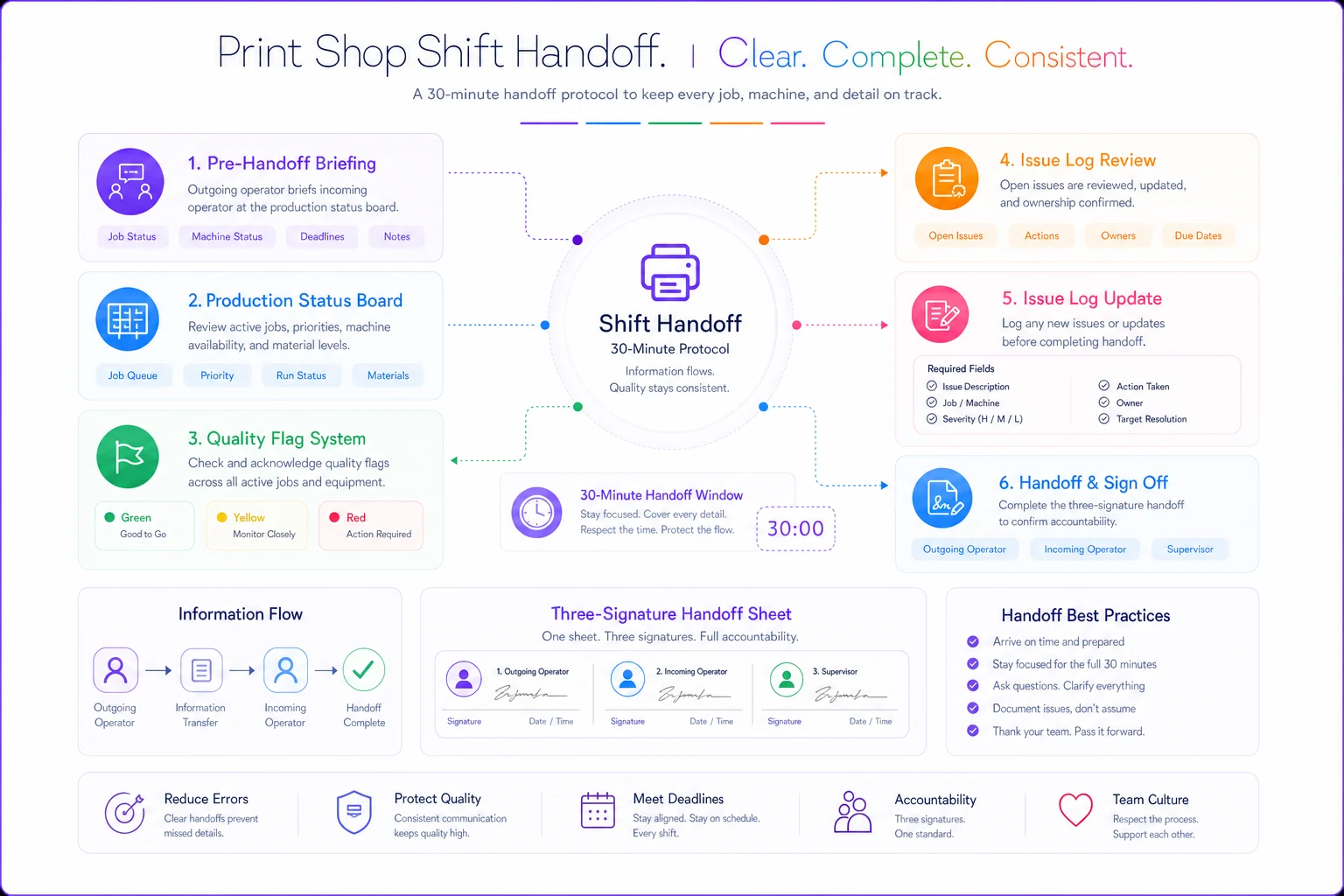
The protocol should be visible and repeatable; it's the process that prevents surprises, not individual memory.
Stage 4: Training progression and certification (6-8 weeks)
You can't throw new second-shift operators into production and expect first-shift quality. Build a progression system that gradually increases responsibility.
Week 1-2: Shadow experienced operators, run non-critical jobs Week 3-4: Run standard jobs with supervision, document questions Week 5-6: Run standard jobs independently, supervised on complex work Week 7-8: Full production responsibility with weekly quality audits
Create job-specific certifications. Not "certified press operator" but "certified to run Henderson monthly newsletter" or "certified for pharmaceutical label compliance." Each certification includes:
-
Minimum supervised runs
-
Quality audit requirements
-
Common issue recognition test
-
Customer requirement acknowledgment
Track certification coverage across shifts. You need at least two people per shift certified on your critical jobs. Otherwise, you're one sick day away from quality problems.
Stage 5: Technology integration and quality gates (Ongoing)
Manual handoffs and paper documentation only scale so far. As you expand shifts, you need technology infrastructure that maintains standards automatically.
Start with basic production tracking that follows jobs across shifts. Not just job status but quality parameters, customer preferences, and deviation notes. A simple shared spreadsheet beats nothing, but structured job tracking software prevents the inevitable "I updated the wrong version" disasters.
Implement quality gates at critical points:
-
Color verification before starting any run over 1,000 pieces
-
Registration check every 500 sheets on critical jobs
-
Finishing audit on first 50 pieces of each bindery run
Automated alerts for deviation matter most. When second shift runs a job outside normal parameters, first shift supervisor gets notified. Not to micromanage but to catch potential issues before they become 47 customer complaints.
AI-powered operational software makes a difference here. Instead of manually tracking hundreds of job specifications and quality requirements, the system maintains institutional knowledge across all shifts. When second shift starts the Henderson job, they see not just the job specs but the accumulated notes from every previous run. "Runs heavy on cyan." "Customer prefers warmer blacks." "Reject rate jumps if humidity drops below 65%."
The software doesn't replace operator judgment – it augments it with the collective experience of every shift. Quality standards become embedded in workflows rather than dependent on individual memory.
Four failure patterns that destroy quality
The hero operator trap: Your best first-shift operator agrees to train second shift but won't actually let go of control. They're texting second shift at 7 PM about job details. Coming in early to "fix" things. This prevents second shift from developing independence and creates resentment. Solution: Clear handoff points and escalation protocols. Once first shift leaves, second shift owns production until the next handoff.
Quality drift: Standards slowly diverge between shifts. First shift's "good enough" becomes slightly different from second shift's "good enough." Six months later, you're essentially running two different print shops. Solution: Weekly cross-shift quality audits. Same jobs, same standards, compare output. Identify and correct drift before customers notice.
Information silos: Each shift develops its own solutions to problems but doesn't share them. Second shift figures out a better makeready sequence for a problematic job. First shift never learns about it. Solution: Mandatory improvement documentation. Any deviation from standard that improves results gets documented and shared.
Skeleton crew disasters: You staff second shift lean to control costs. Then someone calls in sick and quality crumbles because there's no redundancy. Solution: Minimum capability requirements per shift, not just headcount. Every shift needs backup for critical skills.
Case study: 18-month expansion that worked
A label printer outside Milwaukee went from single shift to three shifts over 18 months. They started with 8 employees running one shift, producing roughly 400,000 labels weekly with a 1.5% defect rate.
First expansion attempt (failed): Added second shift without structure. Hired four operators, gave them job tickets, expected similar output. Result: Defect rate jumped to 4.5%, three major customer complaints in the first month, canceled second shift after six weeks.
Second expansion attempt (succeeded): Followed staged approach over 16 weeks.
| Stage | Timeline | Focus |
|---|---|---|
| Standardization | Weeks 1-4 | Documented standards for top 30 repeat jobs |
| Role Definition | Weeks 5-6 | Created skill requirements and responsibilities |
| Training | Weeks 7-10 | Hired and trained second shift with progression |
| Handoffs | Weeks 11-12 | Implemented structured shift protocols |
| Integration | Weeks 13-16 | Gradual production transition with quality gates |
Results after six months:
-
Running two full shifts, 750,000 labels weekly
-
Defect rate at 1.7% (slightly higher than single shift but within acceptable range)
-
Customer complaints
2 total (compared to dozens in first attempt)
-
Productivity per employee increased 18% due to better structure
They added a third shift eight months later using the same framework. Now producing 1.1 million labels weekly with a 1.6% defect rate across all shifts.
The difference wasn't better employees or newer equipment. It was systematic operational structure that maintained quality standards regardless of who was running which shift.
When multi-shift expansion makes sense
Multi-shift production isn't automatically the right growth strategy. Your operational readiness matters more than market demand.
Good candidates for multi-shift:
-
Consistent repeat work that fills at least 60% of capacity
-
Established quality standards with measurable criteria
-
Customer base that values consistency over flexibility
-
Equipment reliable enough for extended operation
-
Margin structure that supports redundant oversight
Poor candidates for multi-shift:
-
Mostly custom one-off jobs requiring constant customer interaction
-
Artistic or craft-focused work where individual style matters
-
Old equipment requiring constant adjustment
-
Tight margins that can't support proper shift overlap
-
Company culture built around single tight-knit team
The calculation isn't just about capacity. Running two shifts with 15% productivity loss due to coordination overhead might still beat single shift with overtime. But running two shifts with quality problems that drive away your best customers is business suicide.
Making quality systematic, not personal
Shops that successfully scale to multi-shift production treat quality maintenance as an operational system, not individual responsibility. Every stage of the scaling roadmap builds systematic quality control that functions regardless of who's working.
Standardization creates measurable targets. Role separation ensures coverage of critical skills. Handoff protocols transfer institutional knowledge. Training progression builds competency systematically. Technology integration catches deviations automatically.
This acknowledges that quality at scale requires different operational structures than quality in a small single-shift shop. You can't maintain quality through purely human memory and relationships when your workforce triples and works around the clock.
The roadmap typically takes 4-6 months to fully implement, depending on your starting point and complexity. That might seem slow compared to just hiring people and running more shifts. But the alternative – scaling quickly then spending months fighting quality problems and winning back lost customers – takes far longer and costs far more.
Ready to simplify your print shop operations?
Join 500+ print shops using GoInkly to save time, reduce errors, and improve customer satisfaction.