

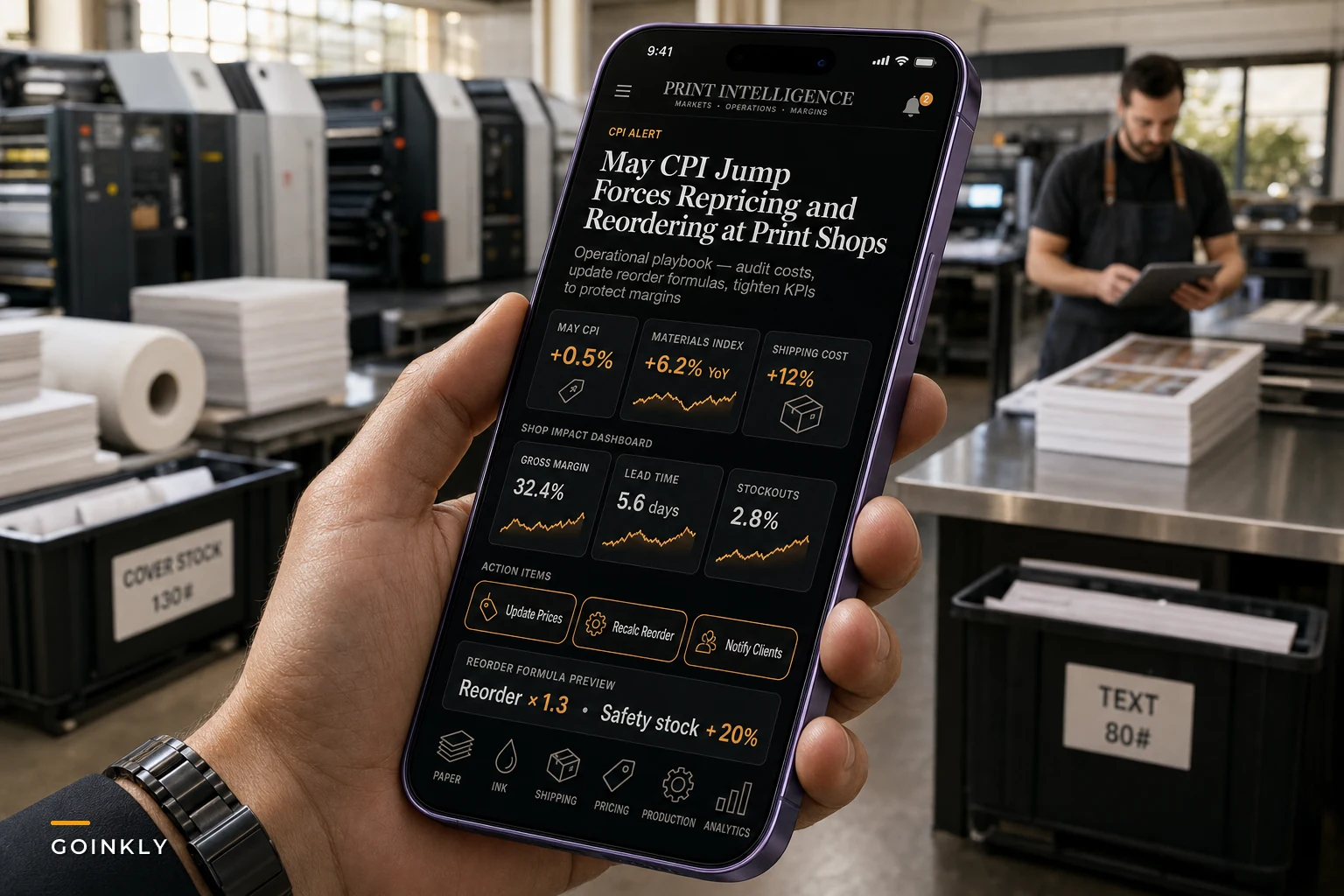

The May CPI numbers from the Bureau of Labor Statistics dropped yesterday morning, and if you're running a print shop, you probably felt that familiar knot in your stomach. Year-over-year inflation hit 4.2%, with monthly numbers showing an acceleration nobody expected. Energy costs, transportation, core services—everything's moving up.
Most print shops are about to get squeezed from three directions at once. The shops that don't adjust their operational controls in the next 30 days are going to bleed margin all summer.
I spent last week talking to print shop owners across the midwest, and the pattern is clear. The ones still using last quarter's pricing are already underwater on jobs they quoted two weeks ago. The ones who haven't touched their reorder points since January are either sitting on too much expensive inventory or running out of stock mid-job because their safety margins don't account for the new lead times.
The Three-Way Squeeze That's About to Hit
First, your direct material costs. Paper mills announced increases effective June 1st, but that's old news. What's catching shops off guard is that ink suppliers are now adding fuel surcharges on top of base price increases. One shop owner in Ohio showed me an invoice—same exact order from April to May, up $340 just in surcharges.
Second, your fixed-price contracts. If you locked in pricing for corporate accounts, school districts, or regular commercial customers back in Q1, you're now fulfilling those orders at negative margins. A shop in Indiana just told me they're losing roughly $80 per thousand on a municipal contract they signed in February.
Third, and this is the killer—your reorder timing is completely off. Reuters reported the transportation cost spike is hitting logistics hard, which means your normal 5-day paper delivery is now 8-12 days. But your reorder points are still calibrated for the old lead times.
Start With Your Top 20 SKUs (Not Your Entire Catalog)
Don't try to reprice everything at once. Pull your sales data from the last 60 days and identify your top 20 moving items—probably some combination of 20lb copy paper, standard cardstocks, your main coated sheets, and whatever specialty stocks you turn regularly.
Eliminate order confusion and delays.
GoInkly helps you manage every print order efficiently from submission to delivery.
- Centralized order tracking
- Production workflow management
- Inventory and supply monitoring
No credit card required
These items represent about 75-80% of your material spend. A shop in Michigan ran this analysis, and their top 18 SKUs accounted for 82% of paper costs but only 8% of their total SKU count.
For each of these items, you need three numbers:
-
Current cost per unit (including the new fuel surcharges)
-
Average weekly usage over the last 8 weeks
-
Actual lead time from your last three orders (not what the supplier promises)
Most shops update prices but keep the same reorder triggers. Your reorder point isn't just about having enough stock. It's about having enough stock at a price that maintains your margins.
The Reorder Formula Nobody's Adjusting Correctly
Your old reorder point calculation probably looked something like: Weekly usage × lead time in weeks + safety stock = reorder point
With volatile pricing and extended lead times, you need to factor in price trajectory. What's working:
(Weekly usage × actual lead time × 1.3) + (safety stock × price volatility factor)
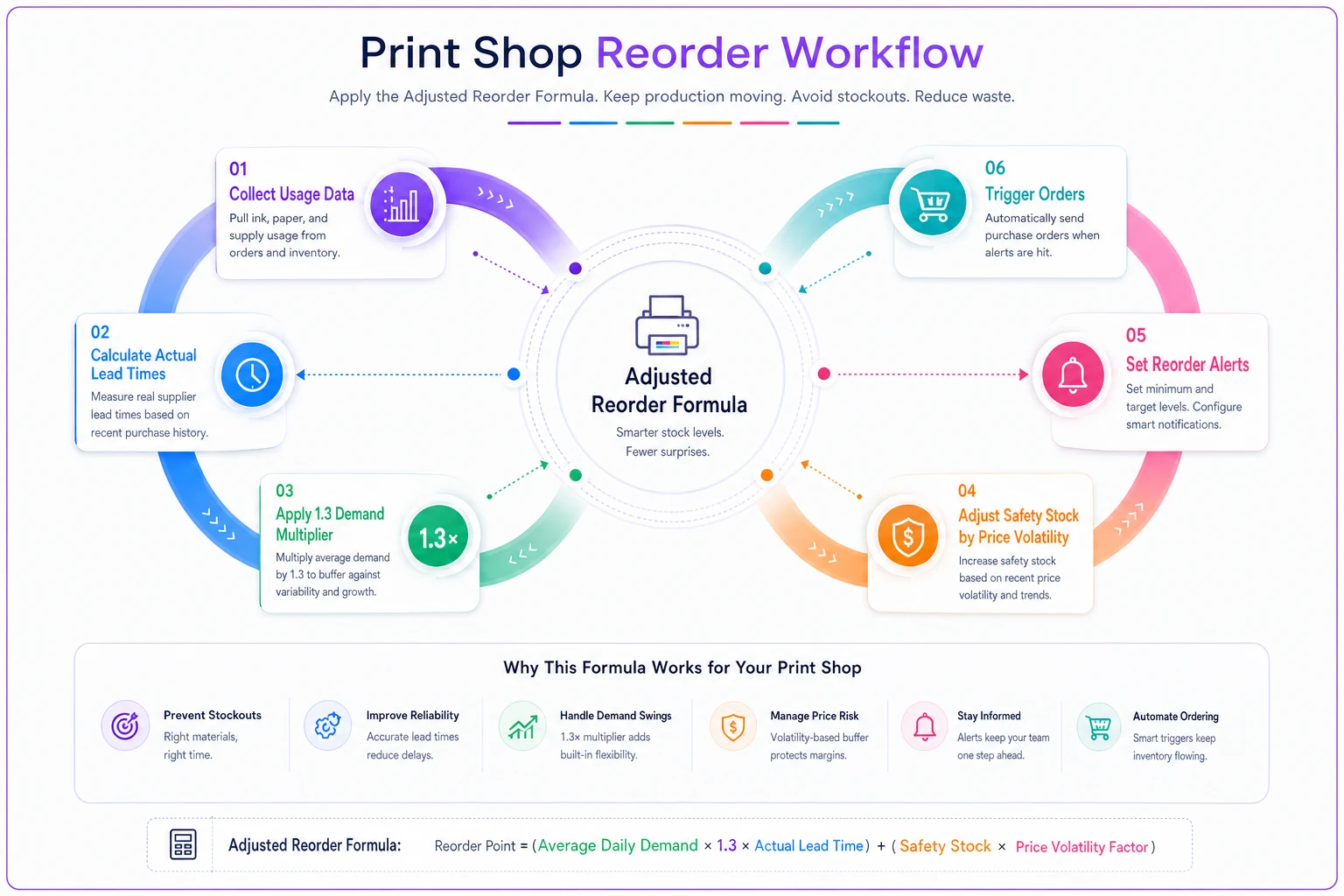
That 1.3 multiplier accounts for the demand spike you'll see as customers rush orders before your price increases hit. The price volatility factor is new—if prices moved more than 3% in the last 30 days, multiply your safety stock by 1.5.
A suburban Chicago shop implemented this adjusted formula three weeks ago. They're carrying about 15% more inventory dollars, but they haven't had to reject a rush order or eat a margin loss on underpriced stock since.
Their tracking shows they avoided roughly $2,100 in lost margins just from better timing on reorders.
Job-Level Controls That Actually Protect Margins
Every quote you send out needs an expiration date. Not 30 days like you've been doing—7 days max, and 72 hours for anything over $2,000.
Set up three pricing tiers in your system:
| Tier | Markup | Application |
|---|---|---|
| Spot pricing | Current cost + 55% | Walk-ins, one-offs |
| Regular customer | Current cost + 42% | Established accounts |
| Contract pricing | Locked rates + adjustment clause | Volume customers |
That material adjustment clause is critical. Language like: "Pricing subject to adjustment if material costs increase more than 5% from quote date. Customer will be notified before production begins."
A shop lost $4,800 last month because they honored a 45-day-old quote for 10,000 tri-folds when their paper cost had jumped 8% since the estimate.
The Production Controls Most Shops Skip
You need waste tracking at the job level, not monthly averages. When material costs spike, that 3% waste rate you've been living with becomes a 3% hit to already compressed margins.
Create a simple waste log—nothing fancy:
-
Job number
-
Material type
-
Sheets/amount wasted
-
Reason (setup, misprint, finishing error, customer change)
A shop in Phoenix started tracking this and discovered their wide-format printer was wasting 8% more material on setup than their offset press. They adjusted their minimum quantities for wide-format jobs and recovered about $1,100 in monthly margin.
Implement hard stops for jobs exceeding material budgets. If a job is quoted at 1,100 sheets allowing for waste, and you're at sheet 1,050 with work remaining, production stops.
Track waste by job weekly so you can spot machine-specific issues and adjust minimums quickly.
No exceptions.
Quick Repricing Checklist for Next Week
Start Monday morning with this sequence:
Raw Material Adjustment:
-
[ ] Pull current costs for top 20 SKUs
-
[ ] Add 8% buffer for items with volatile pricing
-
[ ] Add 4% buffer for stable items
-
[ ] Include all surcharges in base cost calculation
Quote System Updates:
-
[ ] Reduce quote validity to 7 days
-
[ ] Add material adjustment clause to terms
-
[ ] Update markup matrices (increase by 5-7% minimum)
-
[ ] Flag any quotes older than 10 days for review
Reorder Point Calibration:
-
[ ] Calculate actual lead times from last 3 orders
-
[ ] Apply 1.3x multiplier to usage during lead time
-
[ ] Increase safety stock by 50% for volatile-price items
-
[ ] Set reorder alerts 2 days earlier than calculated point
Customer Communication:
-
[ ] Email blast about market conditions (keep it factual)
-
[ ] Call top 10 accounts personally about pricing changes
-
[ ] Offer to lock in rates for 60 days with 50% deposit
-
[ ] Update website pricing disclaimer
Start Monday morning with this sequence:
Managing Customer Pushback Without Losing Accounts
You're going to get pushback.
Show them the math, but keep it simple. "Our paper costs increased 12% since March. We're absorbing 5% and passing through 7%." Customers respect transparency more than vague "market conditions" explanations.
Offer alternatives. Can they switch from 100lb gloss cover to 80lb? Can they reduce quantities and order more frequently? A shop in Denver saved a nonprofit client $400 by suggesting a paper downgrade that looked virtually identical.
Bundle services to mask increases. Instead of raising your business card price from $45 to $52, create a bundle: 500 cards + 100 letterheads for $95. The perceived value increase softens the actual price jump.
Inventory Decisions: Stock Up or Stay Lean?
This is the question right now. Do you buy heavy before the next round of increases, or stay lean and preserve cash?
The answer depends on your cash position and storage capacity. If you can afford to tie up capital and have space, buying a 60-day supply of your top movers makes sense. But only if you can move that inventory.
Calculate your cash conversion cycle: Days inventory held + days receivables outstanding - days payables outstanding
If that number is over 45, you can't afford to stock up regardless of coming price increases. You'll kill your cash flow trying to save 5% on materials.
For deeper insights on setting optimal reorder points when demand is unpredictable, check out my inventory reorder strategy for variable-demand print shops.
The Tech Stack Adjustment Nobody Talks About
Your estimating software probably has old material costs baked in. But the real problem is that most print shops have three different price lists floating around—one in the estimating system, one in QuickBooks, and one in somebody's Excel sheet.
Operational software enhanced with AI automation makes a massive difference here. When material costs update in one place, every quote, every job ticket, and every reorder calculation automatically reflects the new reality. No manual updates across three systems. No missed price changes because someone forgot to update the estimating database.
A consolidated platform that handles quoting, job tracking, inventory management, and reordering eliminates the lag between cost changes and pricing adjustments. Shops using integrated systems are adjusting prices in hours, not weeks. The AI components help flag when costs drift beyond acceptable ranges and suggest optimal reorder points based on current market conditions.
What Happens If You Don't Adjust
July looks like this if you don't make these changes:
You'll be fulfilling orders quoted in May at June's material costs with July's delivery times. Your cash cycle stretches because you're paying suppliers faster than you're collecting from customers. You start expediting orders (at premium shipping costs) because your reorder points are wrong. Your team starts cutting corners on quality control to save material.
By August, you're either turning down profitable work because you can't trust your pricing, or taking unprofitable work because you need the cash flow.
A shop in Tennessee ignored the March CPI warning signs. By May, they were down 18% on gross margin and had to factor their receivables just to make payroll.
Move Fast, But Don't Panic
Shops that thrive during inflationary spikes share three characteristics: they adjust quickly, they communicate clearly, and they track religiously.
You don't need perfect systems. You need good-enough systems that you actually use. A simple spreadsheet tracking your true costs beats sophisticated software you ignore.
Start with the top 20 SKUs. Get your reorder points right. Update your quotes. Communicate with customers.
The May CPI numbers aren't the end of the world, but they are a wake-up call. The shops that answer it will protect their margins through summer. The ones that hit snooze will wonder why they're working harder for less money come September.
Your customers need printing whether inflation is 2% or 6%. Your job is to make sure you can provide it profitably. These controls aren't about gouging anyone—they're about staying in business to serve your community next year and the year after that.
The next 30 days determine your next 6 months. Time to get to work.
Ready to simplify your print shop operations?
Join 500+ print shops using GoInkly to save time, reduce errors, and improve customer satisfaction.