

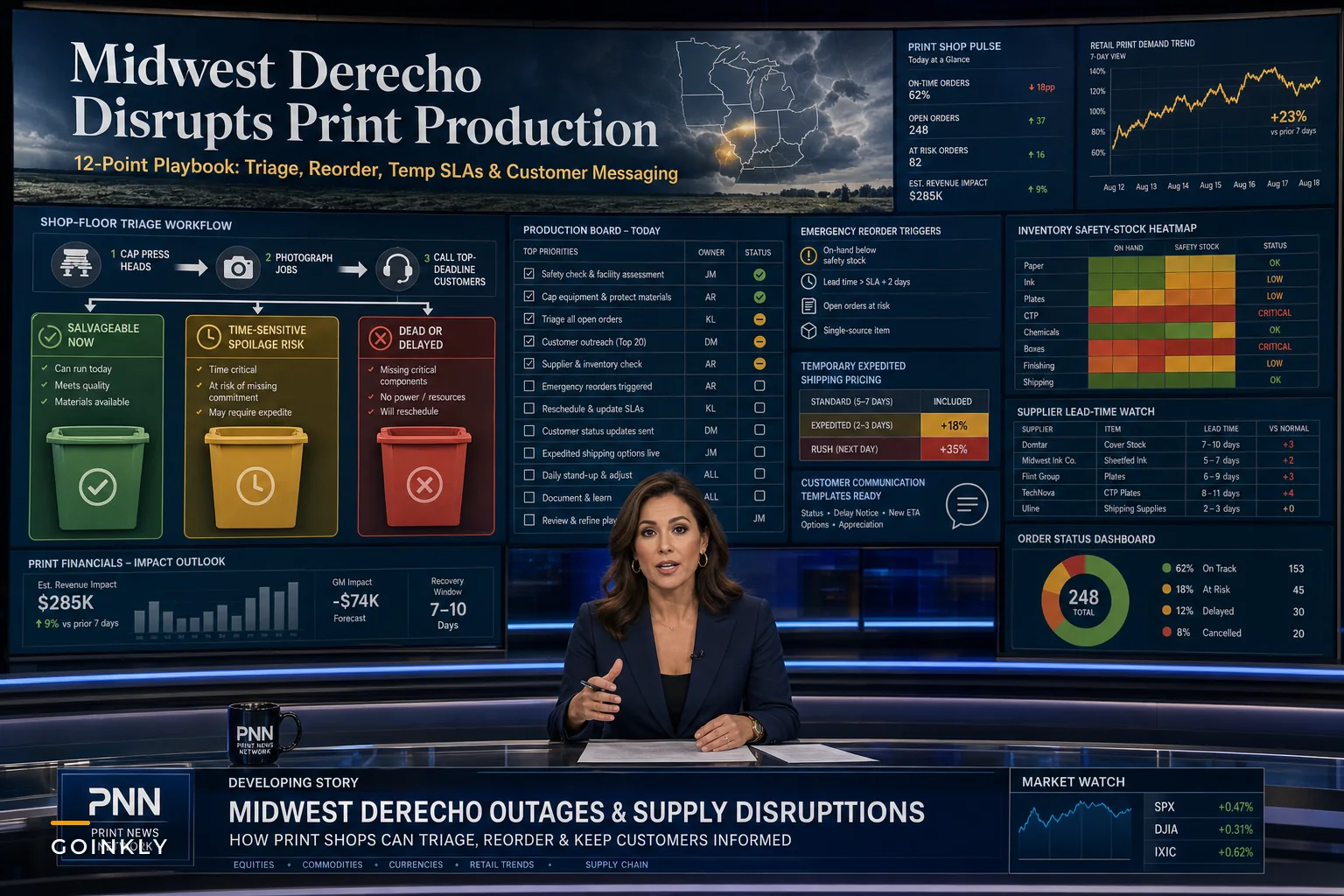

If your presses went dark around midday on August 11th, you're not alone. The derecho that tore across northern Illinois and northwest Indiana produced widespread wind damage and tornadoes, according to the National Weather Service's event summary, and the broader storm system left hundreds of thousands without power across the Midwest — deaths, flooding, and blocked roads reported by the Associated Press.
For most shops the immediate problem isn't the storm itself. It's the 48 hours after. That's when jobs sit half-finished on the press, ink dries where it shouldn't, customers start calling, and the supplier's truck doesn't show. This playbook is built for that window — the first two or three days when your decisions determine whether you lose a few hours or a few weeks.
Skipping the generic "stay safe" advice. You already know that. This is about what actually protects production, cash, and customer relationships when the power's flickering back on and the backlog is staring at you.
Start with triage, not cleanup
The mistake shops make in hour one is jumping straight to cleanup. Broom in hand, sweeping glass, feeling productive. Meanwhile the highest-value decision — what to do with in-progress jobs — goes unmade for hours, and that's exactly when spoilage happens.
Before anything else, walk the floor and sort every open job into three buckets:
-
Salvageable now — jobs that can finish the moment power is stable
-
Time-sensitive spoilage risk — anything with wet ink, jobs mid-lamination, adhesive vinyl left under heat, or substrates sensitive to post-flood humidity
-
Dead or delayed — jobs that already spoiled or depend on materials and equipment that are down
That third bucket matters more than most people realize. If a job is genuinely dead, you want to know within the first hour so you can call the customer while you still control the conversation — not after they've called you three times wondering what's going on.
A real example: a mid-size shop running wide-format signage had around a dozen banners mid-print when the outage hit. The operator's instinct was to leave them and deal with office flooding first. By the time power came back four hours later, half the heads had partially clogged and the loaded media had absorbed enough ambient moisture to cause registration drift. A few hundred dollars in wasted substrate plus reprint labor — all avoidable with a five-minute triage pass and capping the heads before touching anything else.
Cap press heads before sweeping the floor — protecting the heads beats immediate cleanup.
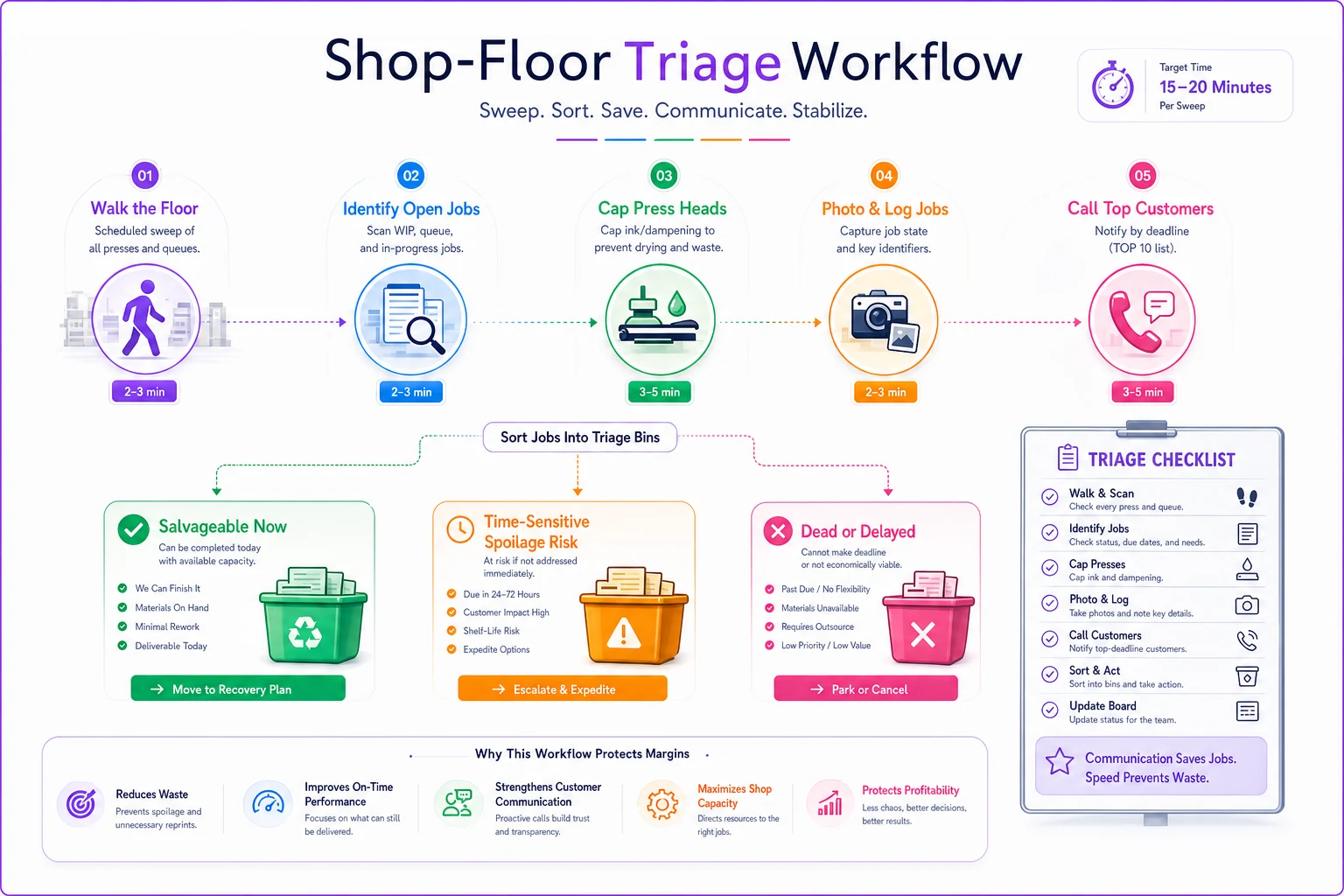
A simple visual of the triage flow can help a distracted crew follow the sequence under pressure.
The 12‑point checklist
Work top to bottom — the order is deliberate. Safety and spoilage first, cash and communication next, recovery last.
Eliminate order confusion and delays.
GoInkly helps you manage every print order efficiently from submission to delivery.
- Centralized order tracking
- Production workflow management
- Inventory and supply monitoring
No credit card required
-
Confirm the building is safe to occupy. Structural, electrical, gas. Nothing below this line matters if the answer is no.
-
Cap, seal, or shut down anything with wet media or ink. Presses, wide-format heads, laminators. Protect the heads before you protect the paperwork.
-
Kill power to sensitive equipment at the breaker. Dirty power on restore — surges and brownouts — kills more equipment than the outage itself. Don't let gear "come back on" uncontrolled.
-
Photograph everything before you move it. Insurance and supplier damage claims both need this. Do it now, timestamped, before cleanup changes the scene.
-
Sort open jobs into the three buckets above. Salvageable / spoilage-risk / dead.
-
Move at-risk inventory off the floor. Specialty paper, coated stock, and boxed consumables wick water fast. A pallet sitting in two inches of floodwater is often a total loss by hour six.
-
Call the top 5–10 deadline jobs first. Not everyone. The customers whose deadlines you're about to miss.
-
Freeze new rush intake until you know your real capacity. Taking on emergency reprints before assessing your own downtime is how you double-book a crippled shop.
-
Contact inbound suppliers to confirm shipment status. Their truck may be stuck too. Find out before you promise anything.
-
Check outbound carrier status for jobs already boxed. Pickups get suspended in disaster zones; a "shipped" order sitting on your dock is still your problem.
-
Reforecast the week's schedule around confirmed downtime. Rebuild the board with real numbers, not optimism.
-
Log every storm-related cost as it happens. Expedited freight, spoiled stock, overtime — capture it in real time or you'll never reconstruct it for insurance.
Print this. Tape it near the production board. When the power's out and everyone's rattled, a physical list beats memory every time.
Protecting equipment during a dirty restart
The outage rarely does the real damage. The restore does.
When utility power comes back after a major storm, it often comes back messy — voltage sags, momentary surges, sometimes several on-off cycles within a few minutes as crews stabilize the grid. Presses, RIP servers, and finishing equipment with sensitive electronics are far more vulnerable to that than to the clean outage that preceded it.
-
Leave sensitive equipment off at the breaker until power has been stable for at least 15–20 minutes
-
Bring gear back one machine at a time — this limits inrush current and lets you catch a problem before it cascades
-
Boot your network and RIP/server layer first, confirm it's stable, then production hardware
-
If you run a UPS on your servers, check its logs — it may have recorded exactly how ugly the power event was, which matters for both diagnostics and warranty conversations
For anything under warranty or service contract, a controlled restart also protects you in a dispute. "We shut down cleanly and restarted per procedure" is a much stronger position than "we lost power and turned everything back on."
The inventory problem nobody sees coming
Immediate stockouts aren't usually the issue. Most shops have enough on hand to get through a few days. The real hit lands two to three weeks out, when supplier delays finally reach you — and they all arrive at once, right as you're trying to burn through the storm backlog.
Here's how it works. Your specialty paper vendor also lost power. Their regional distribution hub is routing around blocked roads. The freight carrier is prioritizing other zones. None of that shows up on your shelf today. It shows up when your next reorder — placed on a normal lead-time assumption — lands four to nine days late, stacked on top of everyone else's delayed orders competing for the same recovering supply.
| Item type | Normal lead time | Realistic post-storm lead time | What to do now |
|---|---|---|---|
| Standard house stock | 2–4 days | 5–9 days | Reorder early, accept slight overstock |
| Specialty / coated paper | 1–2 weeks | 3–5 weeks | Confirm allocation directly with rep |
| Inks & toners | 3–7 days | 1–3 weeks | Check substitute-compatible SKUs |
| Plates / press consumables | 1–2 weeks | 2–4 weeks | Pull forward next cycle's order |
The shops that ride this out best are the ones that already knew their real lead times before the storm — not the marketing lead time on the vendor's website, the actual delivery pattern. If you don't have that data, this is when it costs you. Building a supplier scorecard that profiles true lead times and sets safety stock for inks, plates and specialty paper is the difference between reordering with confidence and guessing. After a disruption like this, that kind of visibility tells you which suppliers to trust with your recovery orders and which ones will quietly leave you short.
One practical move right now: call your two or three most critical reps directly and ask about allocation, not just availability. When supply is tight, vendors ration. Shops that ask early tend to get positioned ahead of shops that wait for the backorder email.
Customer communication that actually holds up
Missed deadlines don't cost you customers. Surprise missed deadlines do.
The most damaging thing after a storm is silence followed by a broken promise. A customer who hears from you proactively — "we took storm damage, your job is shifted to Thursday, here's the plan" — will almost always stay. The one who finds out on the original due date, when they call to check, is the one who starts shopping around.
-
First customers with a deadline in the next 72 hours that you now can't hit
-
Second high-volume repeat accounts, even if their deadline is comfortable — they'll appreciate the heads-up and remember it
-
Third everyone else, via a single batch update
For that third group, a short honest message covers a lot of ground: what happened, what it means for timelines, and when they'll hear from you next. That last part — when they'll hear from you next — prevents most of the follow-up calls that would otherwise eat your recovery week.
When to hold off on a specific promise: if you can't confirm your own power stability or supplier timelines yet, don't invent a date to sound reassuring. "We were hit by the storm, we're assessing now, and I'll have a firm new date for you by tomorrow afternoon" is more credible than a Thursday you're going to blow. Print buyers deal with production realities all the time. They forgive weather. They don't forgive being misled.
A real recovery scenario
A family-run commercial shop — offset plus some digital, maybe eight people — took a direct hit: around six hours of outage, some roof water intrusion over the finishing area, and a soaked pallet of coated stock.
Their first instinct was cleanup, and they lost most of the first afternoon to it. What turned things around was stopping to rebuild the schedule board from scratch the next morning. They pulled every open job, sorted by real deadline, and found only about a third were genuinely urgent. That let them call roughly a dozen customers proactively that day rather than fielding fifty panic calls across the week.
The soaked pallet was a real loss — somewhere in the low four figures between spoiled stock and rush reorder freight. But because they called their paper rep the morning after and asked about allocation rather than just placing a standard reorder, they got repositioned and had replacement stock in about a week instead of the three-plus weeks other regional shops were quoting.
They lost roughly a day and a half of real production and one spoiled pallet, but kept every deadline-critical customer. A shop two towns over with similar damage but no triage discipline lost close to two weeks and, from what reps mentioned, a couple of accounts that quietly moved work elsewhere. Same storm. Very different outcome. The difference was almost entirely sequencing and communication, not the severity of the damage.
When speed helps and when it hurts you
Not every fast decision is a good one after a disruption.
Move fast on: equipment protection, spoilage triage, deadline-customer calls, and confirming supplier allocation. These are all time-decaying — waiting only makes them worse.
Slow down on: accepting new rush work, promising firm new dates, and making expensive expedited-freight decisions. In the chaos it feels responsible to say yes to the emergency reprint or overnight the replacement stock. Sometimes it is. But shops routinely overpay for expedited freight in the panic window when a slightly slower option would've been fine, or take on rush jobs that push an already-damaged schedule past the breaking point.
If you don't have a clear picture of your real capacity for the next week — confirmed downtime, confirmed staffing, confirmed materials — you're not in a position to make intake promises yet. Freeze intake, get the picture, then reopen. A day of "we'll confirm tomorrow" beats a week of overcommitted chaos.
Building the muscle before the next one
Derechos aren't rare anymore, and neither are the multi-day outages that follow them. The shops that recover cleanly aren't lucky — they've usually done a few unglamorous things ahead of time: mapped their true supplier lead times, kept a printed triage checklist, and centralized order and inventory data so that rebuilding the schedule after a hit takes an hour instead of a lost day.
That last part is where a lot of shops quietly struggle. When job status lives partly in one person's head, partly on sticky notes, and partly in a spreadsheet, a storm exposes it instantly — because the one person who knows where everything stands might be the one who can't get to the shop. Having order status, deadlines, and inventory in one place your whole team can reach turns a scramble into a checklist.
You don't need to solve all of that this week. This week is about triage, protecting your gear, protecting your cash, and keeping your customers informed. Work the twelve points in order, make the calls in order of consequence, and resist the urge to sweep glass before you cap the heads. The cleanup can wait an hour. Your presses and your deadline customers can't.
Ready to simplify your print shop operations?
Join 500+ print shops using GoInkly to save time, reduce errors, and improve customer satisfaction.