

Three weeks ago, a commercial print shop in Denver lost a $47,000 pharmaceutical packaging contract because their metallic ink supplier extended lead times from 8 days to 23 days without warning. The shop had been buying from this vendor for six years. No formal tracking, no backup supplier qualified for that specific PMS metallic, no documented lead-time history. Just a phone call saying "sorry, it'll be three weeks now."
This happens constantly. Not because owners are careless, but because consumables vendor management feels deceptively simple when everything's working. You order cyan when cyan gets low. The sales rep brings donuts every quarter. Everything works until it doesn't.
The problem isn't finding suppliers. Most print shops treat vendor relationships like they're buying office supplies instead of managing critical production inputs that can shut down a $300/hour press. When your primary ink vendor hits a production snag or your specialty paper mill has "temporary allocation issues," you discover real fast that your vendor strategy was really just hoping nothing would go wrong.
Why print consumables break every standard procurement model
Print consumables create a procurement nightmare that general manufacturing playbooks can't solve. Your average manufacturer might track 50 SKUs across 3-4 suppliers. A mid-sized commercial print shop? You're looking at 200+ unique consumables across 8-12 vendors, each with completely different characteristics.
Take fountain solution concentrate. A packaging printer running UV inks needs a totally different formulation than a shop doing traditional sheetfed work. Switch vendors without testing? You'll spend days recalibrating color, dealing with toning issues, maybe even damaging rollers. That's a $4,000 mistake waiting to happen, not counting the lost production time.
Specialty papers create even bigger headaches. That 24pt SBS board your biggest client loves? Only two mills produce it to the exact caliper and brightness they specify. One mill has a 14-day lead time. The other takes 35 days but offers volume discounts at 10,000 sheets. Miss that detail and you're air-freighting paper at 3x the cost.
Plus, print work is unpredictable. Your biggest client might place their usual monthly order, then suddenly need rush reprints because of a regulatory change. Now that "adequate" inventory becomes a stockout, and your "reliable" vendor becomes the reason you're losing sleep.
Treating all suppliers equally falls apart here. A delay on standard process cyan from your primary vendor? Annoying but manageable - grab some from a secondary supplier. A delay on that custom metallic bronze your craft brewery client uses for limited edition labels? That's a relationship-ending problem with no easy fix.
Building your vendor criticality matrix (not all suppliers deserve equal attention)
Segment your vendors by operational impact, not spend. That fountain solution vendor who gets $800/month might seem insignificant next to your $45,000/month paper supplier. But if switching fountain solution means two days of press downtime for testing, they're operationally critical.
Eliminate order confusion and delays.
GoInkly helps you manage every print order efficiently from submission to delivery.
- Centralized order tracking
- Production workflow management
- Inventory and supply monitoring
No credit card required
Map every consumable vendor into one of four categories:
-
Critical/Non-Substitutable Custom mixed inks, specialty substrates with client specifications, proprietary chemistry for specific equipment. These need primary and backup suppliers, even if the backup costs more.
-
Critical/Substitutable Standard process inks, common paper weights, standard plates. You need multiple qualified vendors, but switching is relatively painless.
-
Important/Specialized Specific brand preferences that don't stop production. Maybe you prefer Kodak plates but could run Fuji in a pinch.
-
Commodity/Flexible Rags, cleaning solvents, standard packaging supplies. Price shop freely.
Keep a short dashboard showing non-substitutable items and their qualified backups so decision-makers can act fast during shortages.
Most shops discover something interesting when they do this mapping. That specialty coated stock representing 3% of total paper spend? It's actually supporting 18% of revenue through high-margin marketing collateral work. Meanwhile, you're spending hours negotiating prices on commodity 20lb bond that any vendor can supply overnight.
The lead-time profiling system that actually prevents stockouts
Forget the generic "2-3 week safety stock" rule. Real lead times in print vary wildly based on factors nobody talks about.
Standard cyan ink from your primary vendor typically shows up in 5 business days. Except in Q4 when everyone's printing holiday campaigns - then it's 9 days. That metallic gold? 12 days normally, but 19 days if you order less than 5kg because it triggers a custom batch run. Your coated 100lb text weight arrives in 7 days from the regional warehouse, unless you need more than 10,000 sheets, which ships from the mill at 21 days.
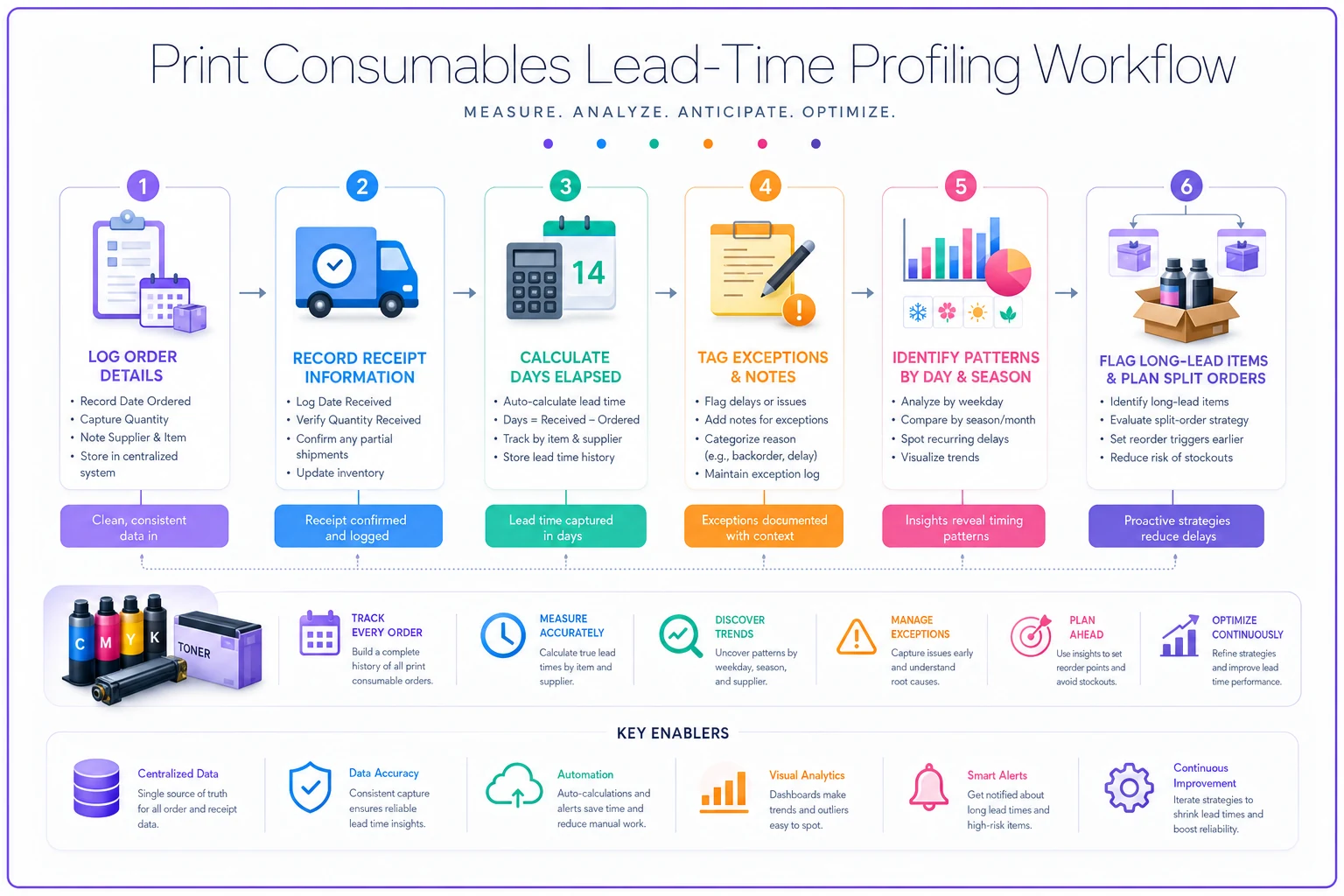
Track actual lead times, not promised ones. Create a simple spreadsheet with columns for: Date Ordered, Quantity, Date Received, Days Elapsed, and Notes. After 90 days, you'll see patterns vendors never mention. Like how orders placed on Thursdays consistently arrive two days later because they miss the weekly truck route. Or how that "reliable" vendor actually delivers 15% of orders late during your busy season.
Here's a simple workflow to implement lead-time profiling in your shop.
One print shop in Phoenix discovered their main ink supplier had two completely different fulfillment channels. Orders under $2,000 shipped from a local warehouse in 4 days. Orders over $2,000 came from a regional distribution center in 11 days. They started splitting large orders and cut their average lead time by 40%.
Some vendors run lean inventory models that work great until demand spikes. Others stockpile everything but charge premium prices. Neither approach is wrong, but you need to know which one you're dealing with so you can plan accordingly.
Safety stock rules that match print shop reality
Generic safety stock formulas assume predictable demand and consistent lead times. In printing, neither exists. A pharmaceutical client might order 50,000 inserts monthly like clockwork. Your local restaurant orders 500 menus, then nothing for eight months, then suddenly needs 3,000 for a grand opening.
For critical consumables with variable demand:
Calculate your maximum weekly usage over the past 12 weeks (not average, maximum). Multiply by your vendor's maximum observed lead time in weeks (not promised, observed). Add one week buffer for critical items, two weeks for custom products. That's your safety stock level.
Example: You use between 2kg and 8kg of process magenta weekly. Your vendor's lead time ranges from 5 to 12 business days. Maximum usage (8kg) x maximum lead time (2.4 weeks) = 19.2kg, plus one week buffer (8kg) = roughly 27kg safety stock.
Adjust these levels based on criticality and substitutability. That specialty metallic ink only one vendor supplies? Keep 4 weeks of safety stock even if the math says 2 weeks. Standard black ink available from six vendors? You can run tighter, maybe 1.5 weeks.
Watch for seasonal patterns too. Track your consumable usage patterns against job types. Many shops need 30% more adhesive vinyl in spring for outdoor signage season but can reduce paper stock by 20% in August when corporate clients are on vacation.
The key is balancing carrying costs against stockout risk. Sitting on $15,000 worth of specialty inks feels expensive until you lose a $40,000 job because you couldn't source a specific color in time.
The consignment conversation (when it makes sense and when you're getting played)
Vendors love pushing consignment programs, especially for plates and expensive specialty papers. "Let us manage your inventory," they say. "You only pay when you use it." Sounds great until you realize what's actually happening.
Good consignment deals exist, but most aren't what they seem. A quality consignment program should give you: preset minimum/maximum levels you control, weekly reconciliation, competitive pricing locked for 6-12 months, and no penalty for switching vendors. What most shops get: vendor-controlled stock levels, monthly reconciliation with discrepancies, "market pricing" that creeps up 3% quarterly, and contract terms that make leaving expensive.
Consignment makes sense for three specific situations:
-
High-value, slow-moving specialties That $400/roll metallic foil you use twice a year? Perfect for consignment. You avoid tying up cash in inventory that barely moves.
-
Plates with predictable usage If you're burning 100-150 plates weekly with low variation, consignment can work. The vendor can accurately predict needs and you get consistent supply.
-
Testing new products Trying a new synthetic paper for outdoor signage? Consignment lets you test without committing to a full case purchase.
Watch for these red flags: vendors pushing consignment for commodity items you can source anywhere, requirements to consign your entire category (all inks, all papers), or payment terms worse than your standard net-30 accounts. One shop found their consignment "savings" disappeared when they realized the vendor was charging 8% above market rates, betting they wouldn't price-check inventory they didn't "own."
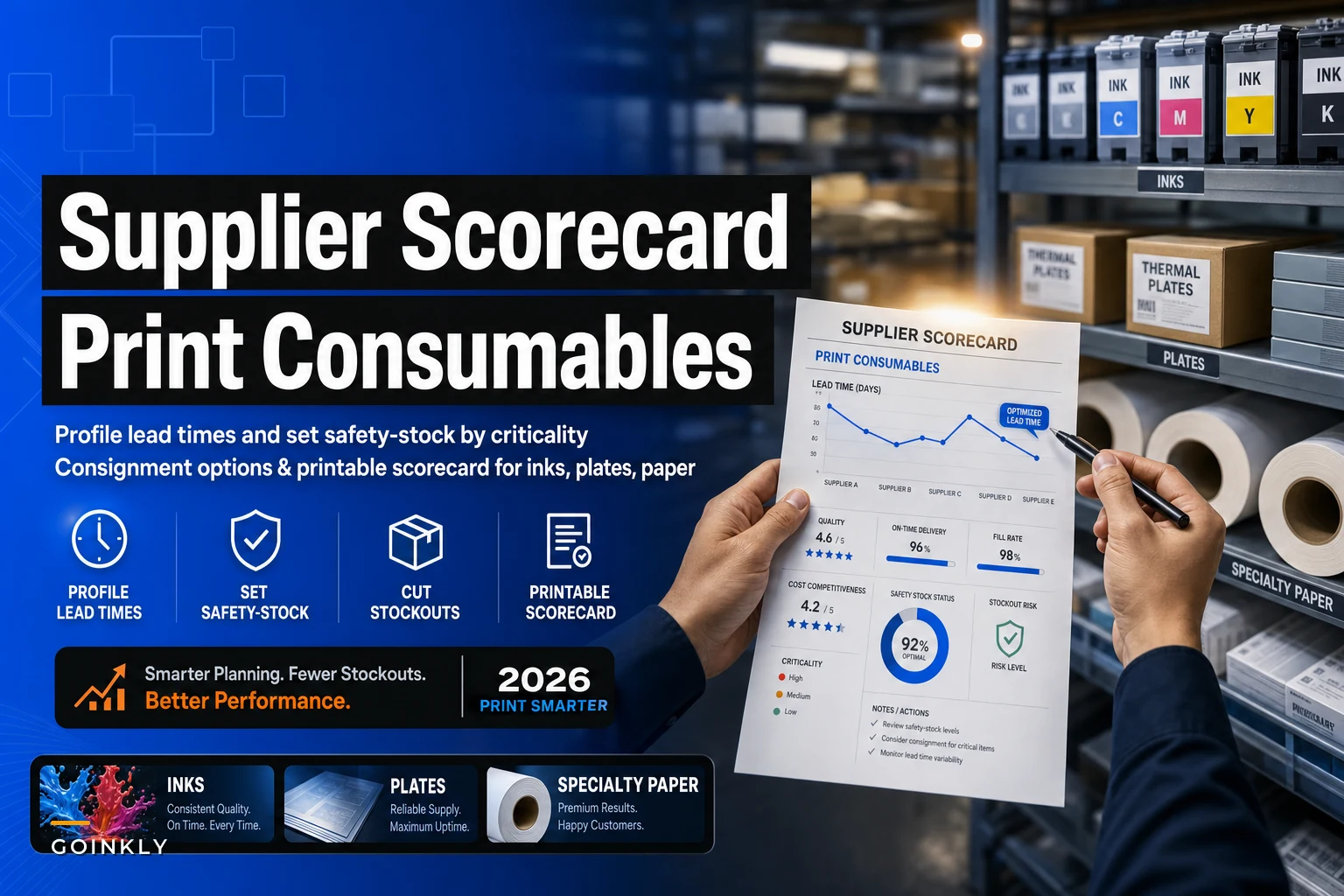
Your printable supplier scorecard (the one-page tracker that changes everything)
Here's the supplier scorecard that actually drives vendor accountability:
| **Metric** | **Weight** | **How to Calculate** | **Red Flag Threshold** |
|---|---|---|---|
| On-Time Delivery Rate | 30% | (Orders on promised date / Total orders) x 100 | Below 85% |
| Lead Time Consistency | 20% | Standard deviation of actual lead times in days | Varies by more than 3 days |
| Quality Acceptance | 20% | (Orders accepted without issue / Total orders) x 100 | Below 95% |
| Pricing Stability | 15% | Number of price changes per quarter | More than 1 per quarter |
| Communication Score | 10% | Average response time to issues in hours | Over 24 hours |
| Emergency Support | 5% | Successfully fulfilled rush orders / Rush requests | Below 75% |
Track this monthly, not quarterly. Print shops operate on tight timelines - a vendor performing poorly in January can't wait until April for a review.
Add notes for context. That paper vendor showing 78% on-time delivery might be suffering from mill strikes beyond their control. The ink supplier at 94% on-time might be padding their lead times to look good on paper while actually being slower than competitors.
Weight these scores based on your operation. A trade printer doing lots of rush work might weight Emergency Support at 15% and drop Pricing Stability to 5%. A publication printer with predictable monthly runs might focus entirely on consistency metrics.
When to fire a vendor (even if they bring good donuts)
The hardest conversation in print shops isn't about pricing or quality - it's ending relationships with vendors who've become operational liabilities. That sales rep who's been calling on your shop for eight years, knows your staff by name, always remembers your birthday? They might also be costing you $30,000 annually in hidden inefficiencies.
Set clear thresholds. Any vendor below 75% on your weighted scorecard for two consecutive months triggers a formal review. Below 70%? Start qualifying replacements immediately. Below 65%? You're actively losing money keeping them.
Document everything. When you sit down with an underperforming vendor, bring data, not feelings. "Your lead times varied from 4 to 18 days over the past quarter, causing us to expedite ship three jobs at a combined cost of $2,400" carries more weight than "delivery has been inconsistent."
Give vendors one chance to fix specific issues with measurable targets. "We need 90% on-time delivery over the next 30 days" is actionable. "We need better service" is useless. If they hit the target, reset the relationship. If they miss, switch vendors without guilt.
The emotional attachment to long-term vendors can be expensive. That ink supplier who helped you out five years ago when you were struggling? If they're now consistently late and unresponsive, keeping them around isn't loyalty - it's bad business.
The quarterly vendor review that takes 30 minutes and saves thousands
Skip the lengthy business reviews vendors love scheduling. You don't need PowerPoints about their "commitment to excellence." You need answers to five questions:
-
What's changing with lead times in the next quarter?
-
Which products might face availability issues?
-
What price changes are coming and when?
-
How can we reduce our combined operational friction?
-
What are three other shops like mine ordering that I'm not?
That last question reveals opportunities most shops miss. Maybe similar shops are switching to a synthetic paper that runs 30% faster on digital presses. Or buying a different fountain solution that extends wash-up intervals. Vendors see patterns across dozens of shops - use that intelligence.
Schedule these reviews for the 15th of the quarter, not month-end when everyone's slammed. Keep them under 30 minutes by sending your scorecard data ahead of time. If a vendor can't answer these five questions concisely, that tells you something important about their operation.
Document commitments in writing. "We'll try to improve lead times" means nothing. "We'll maintain 7-day lead times for orders under 50kg, published on our website by March 1st" is enforceable.
Building your vendor redundancy without doubling costs
The scariest sentence in printing: "We're the only supplier who makes that." Whether it's a specific metallic ink, a proprietary substrate, or a specialized coating, single-source dependencies will eventually burn you.
Smart redundancy doesn't mean qualifying backup vendors for all 200+ consumables you stock. Focus on the 20-30 items that would shut down production or lose specific clients. For everything else, maintain a list of potential vendors with basic contact information and capabilities.
Run quarterly "qualification runs" where you test alternative products during slow periods. Order one batch of plates from a secondary supplier. Test them on real jobs (with client permission for non-critical work). Document color matching, run length, registration hold, and any press adjustments needed. After four quarters, you'll have qualified alternatives for critical consumables without disrupting production.
Price these backup relationships strategically. Your secondary vendor might charge 10% more per unit, but if they can guarantee 48-hour delivery when your primary vendor is backordered, that premium becomes insurance. One shop negotiates "standby agreements" - slightly higher prices but guaranteed availability for emergency orders up to preset monthly quantities.
Cross-training helps too. If only one person knows how to source that specialty substrate, you're vulnerable when they're out sick during a crisis. Make sure at least two people know the backup vendors and alternative product specifications for critical items.
The hidden automation opportunity in vendor management
Most print shops track vendor performance in scattered spreadsheets, emails, and sticky notes. Modern operational platforms designed for print shops can centralize this chaos into usable intelligence.
Right now you manually check inventory, email three vendors for quotes, update a spreadsheet (maybe), create a PO in your accounting system, track delivery in your head, and eventually reconcile invoices against orders. Each consumable order touches 4-5 different systems and relies on someone remembering to update records.
AI-powered operational software changes this workflow completely. The system tracks consumption patterns, alerts when inventory approaches reorder points based on actual vendor lead times, automatically requests quotes from qualified vendors, and scores vendor performance without manual calculation. When that ink vendor suddenly extends lead times, the system adjusts safety stock recommendations immediately.
The real value isn't replacing human judgment - it's augmenting it. You still decide which vendors to qualify and what service levels to accept. But instead of spending hours updating spreadsheets and chasing delivery confirmations, you focus on strategic decisions like negotiating volume agreements or qualifying new products.
Some shops resist automating vendor management because they think personal relationships matter more than data. Both matter. Having solid performance data makes those vendor conversations more productive, not less personal.
Making this work in your shop starting Monday
Start with one category. Pick either plates, inks, or your highest-volume paper. Build the criticality matrix for just that category. Track actual lead times for 30 days. Create a simple scorecard with 3-5 metrics that matter for your operation. Don't try to revolutionize everything at once.
Stop accepting "that's how print vendors work" as an excuse for poor performance. The same vendors delivering to you in three weeks are delivering to other shops in five days. The difference? Those shops track performance, set expectations, and hold vendors accountable with data.
Most vendor problems aren't malicious - they're systemic. Suppliers serve shops that track nothing the same way they serve shops that track everything, because from their perspective, there's no difference. Start tracking, and you'll be amazed how quickly vendor behavior improves.
The print shop in Denver I mentioned at the start? They implemented this system six months ago. Last month, when their primary plate vendor had a production issue, they switched to their qualified backup in four hours. No drama, no expedited shipping, no lost jobs. Their competitors scrambling for plates probably wondered how they got so lucky.
Your consumables vendors are either enablers or bottlenecks for your operation. A systematic supplier scorecard makes sure they know which one they are, and more importantly, ensures you're never caught off guard when that critical metallic ink suddenly becomes "temporarily unavailable." Because in printing, temporarily unavailable usually means your client is temporarily shopping other vendors too.
Your consumables vendors are either enablers or bottlenecks for your operation. A systematic supplier scorecard makes sure they know which one they are, and more importantly, ensures you're never caught off guard when that critical metallic ink suddenly becomes "temporarily unavailable." Because in printing, temporarily unavailable usually means your client is temporarily shopping other vendors too.
Ready to simplify your print shop operations?
Join 500+ print shops using GoInkly to save time, reduce errors, and improve customer satisfaction.