

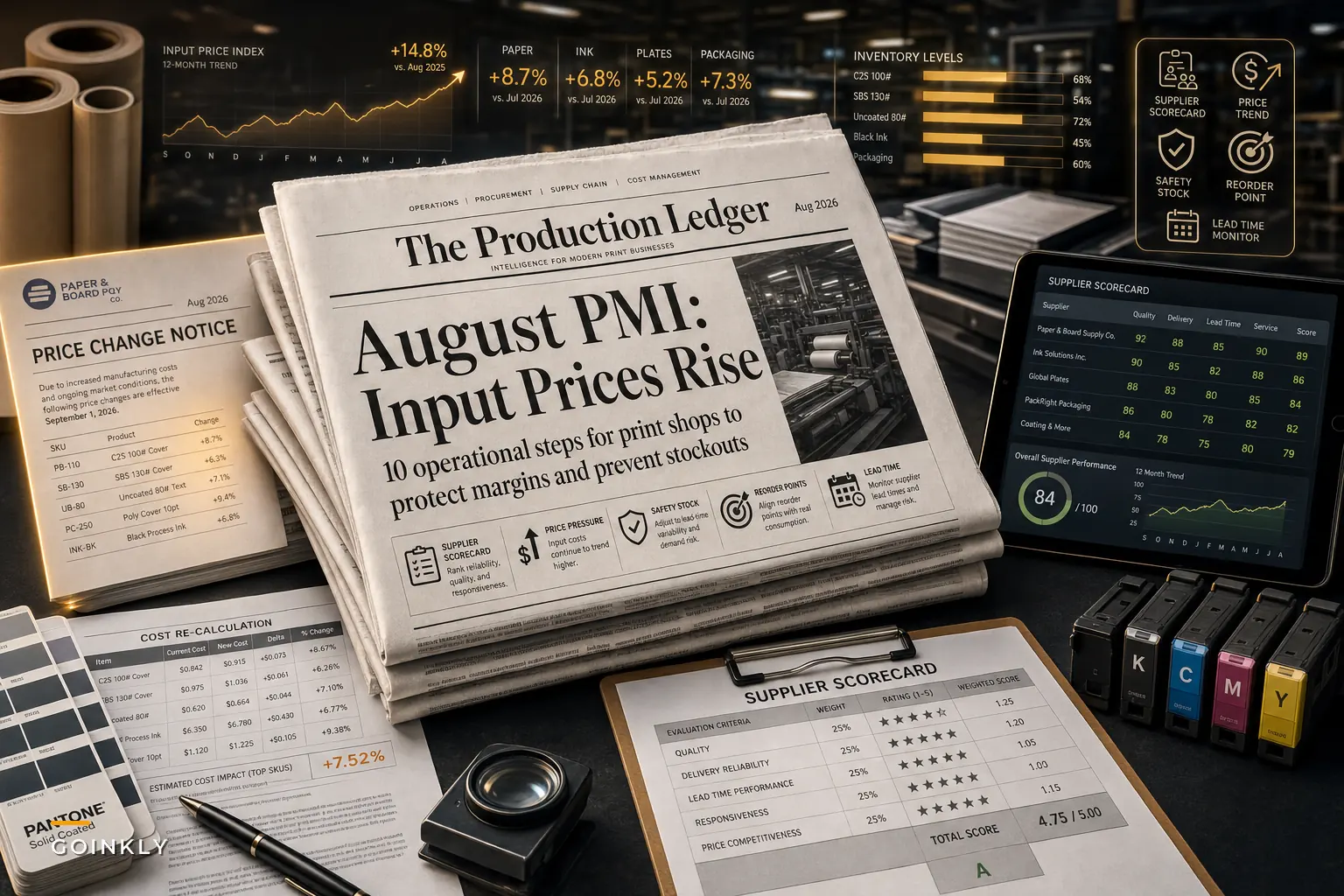

The latest numbers landed at the start of September, and if you handle purchasing for a print shop, they probably didn't surprise you. According to Reuters reporting on the August PMI, U.S. factory activity cooled last month while input prices — materials, freight, supplier costs — stayed stubbornly high. The S&P Global press release tells a similar story: manufacturers are still passing higher costs downstream even as demand softens.
For a print shop, that combination is the tricky one. When activity slows and prices stay up, suppliers aren't fighting to keep you happy on price, but they're not necessarily faster on delivery either. You get squeezed from both directions — cost pressure on the buy side, and lead-time uncertainty that makes confident quoting a lot harder.
This isn't a "the sky is falling" post. It's a checklist of what to actually adjust in your shop over the next few weeks. Some of these you can do in an afternoon. A couple take real discipline.
First, understand what "elevated input prices" actually does to your quotes
Paper and ink price increases don't hit your margin evenly. They hit hardest on the jobs you quoted weeks ago and haven't produced yet — the backlog.
A typical example: you win a 25,000-piece brochure job in mid-August, quote it based on August paper pricing, and it doesn't hit the press until late September. If your coated stock went up 6–8% in that window, and paper is 40% of that job's cost, you just gave away 2–3 points of margin without touching a thing. Multiply that across a full backlog and it compounds faster than most owners expect.
The underlying problem isn't really the price increase itself. It's that most shops quote against current cost and produce against future cost, and nobody reconciles the gap. When prices were flat, that gap didn't matter much. Right now it does.
So the first job isn't hunting for cheaper suppliers. It's tightening the loop between what you buy, what it costs, and what you charge — before the next round of increases shows up.
The 10 operational steps
1. Re-cost your top 20 recurring jobs first
Eliminate order confusion and delays.
GoInkly helps you manage every print order efficiently from submission to delivery.
- Centralized order tracking
- Production workflow management
- Inventory and supply monitoring
No credit card required
Don't try to reprice everything at once. Pull the jobs that make up the bulk of your volume — usually 15 to 25 SKUs cover 70%+ of production in a small shop — and re-cost those against today's actual invoice prices, not last quarter's standard costs.
The mistake shops make here is trusting the "material cost" field in their system without checking it against the last two or three supplier invoices. Standard costs drift. In a rising market they drift against you.
2. Put a quote expiration date on everything
If you don't already, add an explicit validity window to quotes — 14 or 21 days is reasonable right now. This isn't about nickel-and-diming customers. It's about not being contractually stuck at a price when your stock cost jumped 7% between the estimate and the PO.
Most B2B print buyers understand this. What they don't like is a surprise. A line that reads "Pricing valid 21 days; material surcharges may apply on paper stocks after that window" does more to protect you than most owners realize.
3. Rebuild your safety stock math around lead-time variability, not just cost
When lead times get bouncy, your old reorder points lie to you. A reorder point built on a steady 5-day lead time falls apart when that same supplier is randomly delivering in 5 days one month and 12 the next.
The fix is to base safety stock on lead-time variability, not average lead time. If a paper you depend on now swings between 5 and 14 days, plan around the 14 — at least for anything you can't afford to stock out on. This is exactly where a structured supplier scorecard for print consumables earns its keep, because you can't set intelligent safety stock without tracking how each supplier actually performs over time.
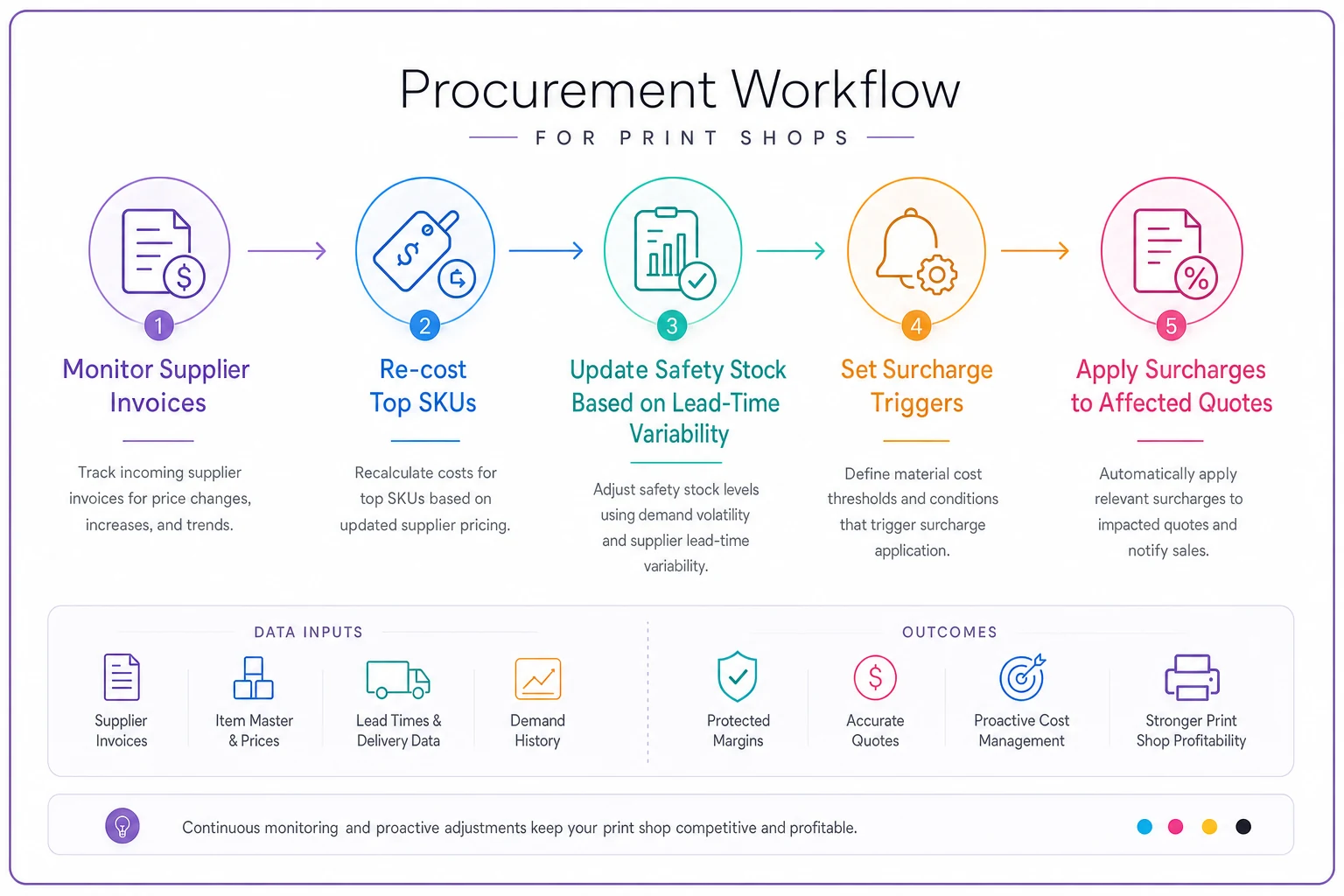
When lead times spike, calculate safety stock in days of coverage for your highest-volume SKUs rather than as a flat unit buffer.
Here's a quick workflow of the re-cost → safety stock → surcharge process.
4. Split single-source consumables into primary + backup
Look at anything you buy from exactly one supplier. In a tight market, single-source is where stockouts turn into missed deadlines. You don't have to move volume — you just need a qualified second source with a known price and a test order already run.
The pattern that comes up repeatedly: shops discover their single-source dependency the day the supplier says "that stock is on allocation, 6 weeks out." By then you're improvising, and improvising on substrate is how you blow a color match.
5. Track input-price movement, not just current price
A single price snapshot tells you nothing about where things are heading. What you want is direction and speed. Set up a simple monthly log — even a spreadsheet — capturing per-unit cost on your top consumables.
| Consumable | Jun cost/unit | Aug cost/unit | Change | Trend |
|---|---|---|---|---|
| Coated text stock (per M) | $41 | $44 | +7.3% | Rising |
| Process ink set | $118 | $122 | +3.4% | Slow rise |
| Uncoated cover (per M) | $53 | $53 | flat | Stable |
| Plates (per box) | $96 | $101 | +5.2% | Rising |
| Laminate film (roll) | $72 | $79 | +9.7% | Rising fast |
The value here isn't the table itself — it's spotting the laminate film line. Nearly 10% in one quarter means you reprice anything laminate-heavy now, not after you've eaten three months of it.
6. Build a material surcharge trigger instead of full repricing
Constantly rebuilding your whole price list is exhausting and confuses customers. A cleaner approach: set a threshold — say, when a key input rises more than 8% from your baseline — that triggers a defined surcharge on affected job types only.
This keeps your published pricing stable while still protecting margin on the jobs actually hit by the increase. It's also far easier to explain to a customer: "coated stock is up, so there's a temporary paper surcharge on that line" reads better than a mysterious across-the-board bump.
7. Renegotiate on volume commitment, not just price
In a softening-demand market, suppliers care about predictable volume more than almost anything else. You may not win a straight price cut, but you can often win price stability — a locked rate for 90 days — in exchange for committing to a monthly minimum you were buying anyway.
That certainty is worth more than a small discount right now. A locked 90-day rate on your two biggest stocks lets you quote your backlog without guessing what paper will cost when the job runs.
8. Audit which quotes convert — and reprice the losers differently
Rising costs are a good excuse to look at your quote-to-win data. If certain job types win at 80% and others at 20%, you've probably been leaving money on the table on the high-conversion work and chasing low-conversion volume at thin margins.
Raise prices where you win easily. That's where cost increases can be absorbed without losing the customer. On competitive jobs, protect margin by tightening spec rather than just cutting price.
9. Tighten your receiving check on price and quantity
When suppliers are under cost pressure, invoice errors and quiet price changes go up — not always intentional, just busy. But a stock that ships at a "new" price you never agreed to, caught three weeks later, is money gone.
-
Pull the purchase order before signing off on the delivery.
-
Compare the invoiced unit price to the PO price — line by line if it's a large order.
-
Verify the quantity matches what was ordered and what actually arrived.
-
Flag any discrepancy immediately, before stock is put away.
-
Log the resolution so you have a record if the same supplier does it again.
Catching a wrong price at the dock is trivial. Catching it at month-end reconciliation is a fight you usually lose some of.
10. Set a re-cost cadence and actually keep it
The shops that handle input-price volatility well aren't smarter — they just re-cost on a schedule instead of reacting to a crisis. Monthly for your top consumables, quarterly for the long tail. That's the whole system.
Put it on the calendar as a recurring 45-minute block. Once you've built the process, that's genuinely all the core SKUs take.
A quick checklist you can run this week
Run these items this week to close the gap between what you buy and what you charge.
-
[ ] Re-cost top 20 jobs against last 3 supplier invoices
-
[ ] Add 14–21 day validity windows to all quotes
-
[ ] Identify every single-source consumable and qualify one backup each
-
[ ] Start a monthly price-movement log on top 8–10 inputs
-
[ ] Define a surcharge trigger threshold (e.g. 8%)
-
[ ] Ask two key suppliers about a 90-day locked rate
-
[ ] Add a price + quantity check to your receiving process
Re-cost the jobs that matter, close the gap between what you buy and what you charge, and know your suppliers well enough to see the next increase coming.
Where this quietly breaks down in practice
The tools most shops use to run this are fine on their own — a spreadsheet for pricing, the accounting software for invoices, the shop system for jobs. The problem is they don't talk to each other. Your standard cost lives in one place, your actual invoice cost in another, and your open quotes in a third. When any of those falls behind, your margin math is wrong and nobody notices until the P&L looks off.
This is the real argument for keeping orders, consumable costs, and reorder rules in one connected system rather than scattered files. Not because software is magic — it isn't — but because when input prices move, you want your reorder points, safety stock, and job costs pulling from the same current numbers instead of three stale copies. AI-powered operational platforms can help automate parts of that loop — flagging when invoice prices diverge from PO prices, or surfacing which jobs were quoted below current cost — but the underlying problem is a data-connection problem, not a technology problem. The software just makes it harder to ignore.
A real scenario
A mid-size commercial shop — around 14 employees, heavy on marketing collateral — noticed margins slipping about two points over the summer without any obvious cause. Volume was steady. Nothing looked wrong on the surface.
When they finally re-costed their recurring jobs, the culprit was boring: their standard cost for a coated house stock hadn't been updated in roughly five months, while actual invoice pricing had climbed close to 9% across that window. Every job using that stock — a big chunk of their volume — was quoted low.
They updated the cost, added a validity window to quotes, and set a monthly re-cost block. The margin recovery wasn't dramatic, maybe a point and a half back within the next quarter, but on their revenue that was real money they'd been quietly handing over for months.
Who should NOT overreact to this
If you're a small shop running mostly one-off jobs with short quote-to-production windows — you quote it and print it the same week — you're already somewhat protected. Your exposure to the quote-vs-produce cost gap is small. Don't burn a weekend building surcharge tables you don't need. Just tighten your receiving check and keep your top consumable costs current.
The shops that need to move fastest are the ones with long backlogs, recurring contract work, and heavy paper-to-price ratios. That's where a few points of drift compounds into real money before anyone sees it in the numbers.
Bottom line
Cooling factory activity paired with sticky input prices is an awkward mix for print shops — less supplier urgency on price, more uncertainty on delivery. But it's manageable if you treat it as a procurement and pricing discipline problem instead of a reason to panic.
Re-cost the jobs that matter, close the gap between what you buy and what you charge, and know your suppliers well enough to see the next increase coming. The shops that do this quietly protect their margins while everyone else finds out at month-end.
The shops that do this quietly protect their margins while everyone else finds out at month-end.
Ready to simplify your print shop operations?
Join 500+ print shops using GoInkly to save time, reduce errors, and improve customer satisfaction.