

Most print shops lose shipping margin in two invisible places: the box grabbed off the shelf, and the carrier invoice nobody audits. A 24"×18"×6" box used for a stack of 500 flyers that would fit in a 12"×9"×3" mailer isn't a packaging preference — it's a dimensional-weight penalty you pay on every single order that ships that way.
Printing shipping cost engineering comes down to controlling three levers at once: the cubic size of your packaging, the carrier you route each parcel to, and the contract terms that govern what you actually pay. Get all three right and you can cut outbound shipping spend by double digits without touching your prices.
This isn't a "go negotiate with FedEx" pep talk. It's the actual mechanics — DIM thresholds, a testing matrix you can run in an afternoon, packaging SKUs you can standardize on, label rules that pick carriers by cost and service level, and the one-pagers you bring to a carrier rep so you walk out with actual rebates.
Start with the number that controls everything: your DIM divisor
Dimensional weight is calculated as length × width × height ÷ DIM divisor. The carrier charges you whichever is greater — actual weight or dimensional weight. For most domestic ground contracts the divisor sits at 139 cubic inches per pound. Some negotiated contracts push it to 150 or even 166, which sounds like a rounding error until you do the math on a shop shipping a few hundred parcels a week.
The part printers miss: paper is dense. A box full of printed material is almost never DIM-penalized — until you add void fill, oversize the carton, or ship something light and bulky like foam boards, banners, or rolled posters. That's where the air you're paying for actually lives.
A quick way to find your break-even: divide the box's cubic inches by your DIM divisor. If that number is higher than the actual weight, you're paying on air.
Example. A 16"×12"×8" box = 1,536 cubic inches. At a 139 divisor: 1,536 ÷ 139 = 11.05 lbs, rounded up to 12. If the contents weigh 7 lbs, you're billed as though you shipped 12. Across 300 parcels a month at that profile, you're paying for roughly 1,500 lbs of weight that doesn't exist.
The fix isn't guessing at better boxes. It's mapping your real product mix against these thresholds, then designing packaging that lands just under the line.
The shop-scale DIM testing matrix
You don't need a logistics consultant for this. You need a scale, a tape measure, and an hour. Pull your top 15–20 shipping configurations by volume — the jobs you actually ship — and run each through a simple matrix.
Eliminate order confusion and delays.
GoInkly helps you manage every print order efficiently from submission to delivery.
- Centralized order tracking
- Production workflow management
- Inventory and supply monitoring
No credit card required
| Field | What it captures |
|---|---|
| Product config | e.g. "500 flyers, 100# gloss text" |
| Actual weight (lb) | Contents + packaging, on the scale |
| Current box (L×W×H) | What you ship it in today |
| Current cubic in | L×W×H |
| Current DIM lb | Cubic ÷ 139, rounded up |
| Billed weight | Greater of actual vs DIM |
| Air penalty (lb) | Billed − actual |
| Target box | Smallest box that fits safely |
| Target DIM lb | Target cubic ÷ 139 |
| Monthly volume | Parcels per month in this config |
The "air penalty × monthly volume" column is where decisions get made. Sort it descending and the top five rows almost always account for the bulk of your waste. Across print shops, somewhere between 70–80% of DIM overpayment typically comes from three or four packaging habits, not from a hundred scattered problems.
A pattern worth flagging: shops that let shipping staff choose boxes by feel tend to upsize for safety. One oversize habit — grabbing the next box up to avoid a tight fit — quietly adds a pound or two of billable weight to hundreds of parcels per month. The matrix makes that habit visible in dollars.
Run it twice a year, or whenever you add a product line like rigid signage or mailing tubes. Those tend to shift your DIM profile the most.
Packaging recipes tied to DIM thresholds
Once you know your break-even points, you stop thinking in "boxes we have" and start thinking in recipes — a defined spec for each product band that keeps you under the billable-weight line.
A recipe is: product band → box SKU → void fill → expected billed weight. Standardizing these removes guesswork from the packing bench and makes costs predictable enough to price into your jobs accurately.
-
Flat printed goods (flyers, letterhead, short-run booklets) Rigid mailer or tightly-sized carton, no void fill. The goal is keeping height low — height is the multiplier that kills flats, since length and width are already set by the product.
-
Business cards and small-run packs Padded mailer that ships as a non-parcel/letter class where eligible. A lot of shops default these to boxes out of habit and overpay on every single one.
-
Rolled posters and banners Tubes sized to the tightest usable diameter. A 4" tube vs a 3" tube changes cubic volume by roughly 75% for the same length. This is the single most common DIM leak in sign and poster work.
-
Rigid boards and foam-core Light and bulky — the DIM nightmare. The recipe here is corner protection plus the thinnest safe carton, and often a service decision to ship regionally rather than nationally when the customer allows it.
-
Mixed-SKU orders Consolidate into one right-sized box rather than defaulting to two. This ties directly into packing-kit templates and batch manifest work — if your pick-pack process already consolidates intelligently, your DIM numbers drop as a side effect.
Sample packaging SKUs to standardize on
-
SKU-M1 — Rigid flat mailer, ~9"×12"×0.5" — flats under ~1 lb
-
SKU-M2 — Padded mailer, ~6"×9" — cards, small packs
-
SKU-B1 — Carton, ~12"×9"×3" — short-run print, booklets
-
SKU-B2 — Carton, ~14"×11"×4" — mid-run stacks
-
SKU-B3 — Carton, ~18"×12"×6" — large stacks, only when weight justifies the cube
-
SKU-T1 — Tube, 3" dia × up to 25" — posters, single banners
-
SKU-T2 — Tube, 4" dia × up to 37" — multi-poster, large-format
-
SKU-R1 — Rigid board mailer with corner protection — signage, foam-core
Post bench cards at each packing station so packers can quickly verify the correct SKU and billed weight.
Assign each recipe a target billed weight and print it on a bench card. When a packer knows "SKU-B1 should bill at 2 lbs," an invoice showing 5 lbs becomes a flag instead of a silent cost.
Manifest and label rule-sets: pick carriers by cost AND service
Having the right box doesn't help much if you hand every parcel to one carrier out of habit. The second lever is routing — selecting the carrier per parcel based on cost and the service the order actually requires.
Most shops either rate-shop everything manually (too slow) or route everything to one carrier (leaves money behind). The middle path is a rule-set: a small number of IF/THEN rules your shipping software applies automatically at manifest time.
-
If parcel is a flat under 1 lb and no tracking SLA required → cheapest mailer/letter class.
-
If destination is within ~150 miles and weight > 5 lb → regional/ground carrier. Regional carriers frequently beat the nationals on short-zone ground.
-
If customer paid for 2-day or better → compare express rates across carriers, pick lowest that meets the date.
-
If parcel is DIM-penalized (billed weight exceeds actual by 3+ lb) → route to the carrier with the most favorable DIM divisor in your contracts.
-
Else → cheapest ground that meets the promised delivery window.
How this runs in practice
At manifest time, the system reads the order's dimensions, weight, destination zone, and service level, runs the rules in sequence, and prints the label for the winning carrier. The packer never makes the call. This is the operational difference between having good rates and using them consistently on every parcel.
A simple visual of how orders flow through the rule-set makes this clearer.
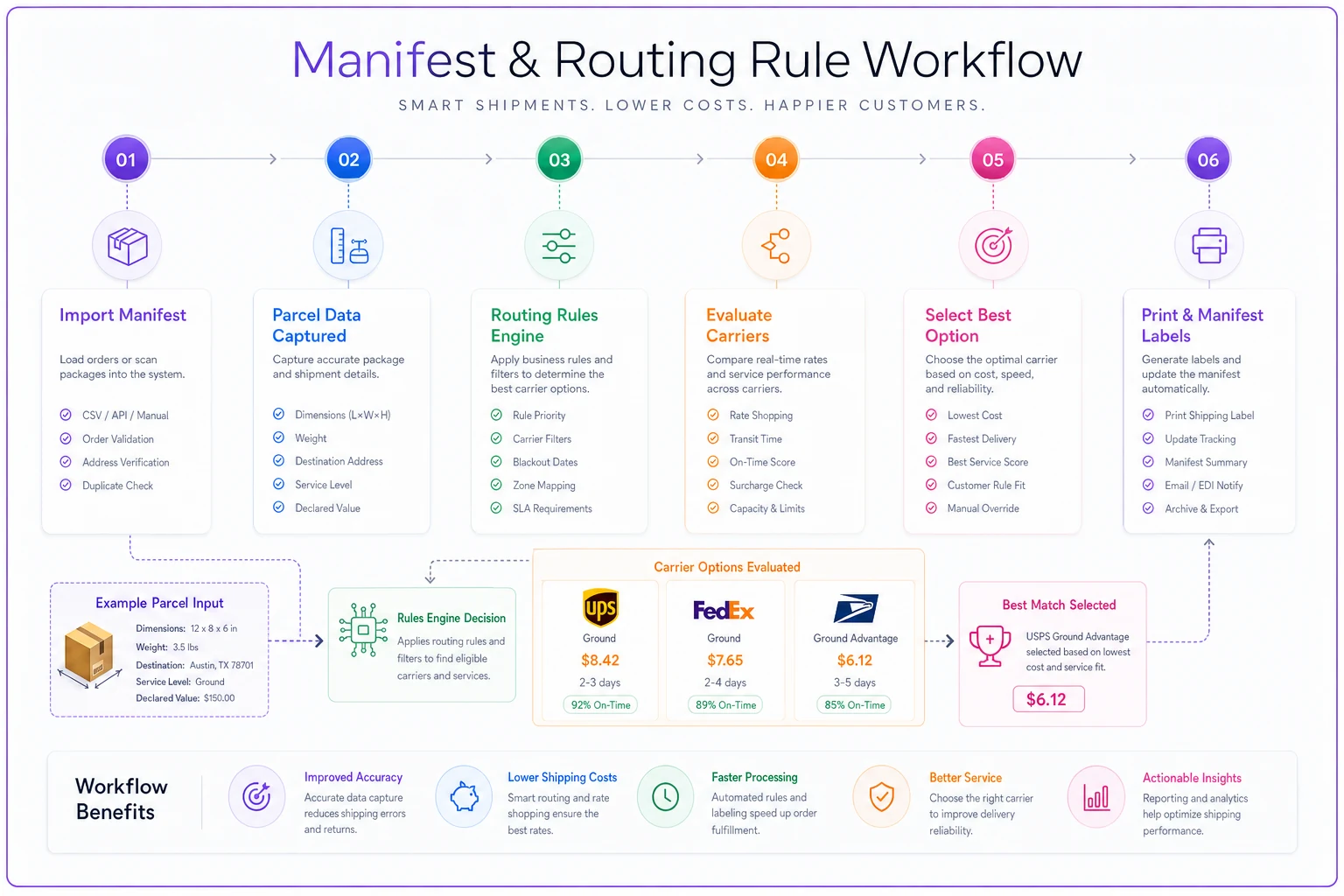
Audit the rule outcomes monthly. Pull a sample of 50 shipped labels and check whether the chosen carrier was actually the cheapest compliant option. Shops that do this regularly usually find one or two rules that drifted out of date after a rate change — which is exactly what to watch for after something like a USPS rate increase reshuffles cost rankings across your zones.
Carrier negotiation: the one-pagers and scripts that actually work
Carriers negotiate against your data. Walk in with "can I get a better rate" and you get a vague discount off list that the next rate increase eats within a year. Walk in with a clean profile of your own shipping and you negotiate on specifics they can't hand-wave away.
Build a negotiation one-pager before any call. One page, containing:
-
Total monthly and annual parcel count and spend
-
Your zone distribution (what percentage ships to zones 2–4 vs 5–8)
-
Weight distribution and your DIM-penalized percentage
-
Service mix (ground vs express)
-
Your current effective rate per parcel by service
-
Specific asks (below)
The asks that actually move the needle for print shops:
-
DIM divisor improvement. "Our product mix is paper-dense but we have a bulky-light segment. We need our divisor moved from 139 to 150." A better divisor cuts billed weight across every DIM-penalized parcel — often worth more than a headline discount.
-
Tiered discounts tied to realistic volume. Make sure the threshold for your top tier is a number you actually hit most months. Shops routinely sign tiers they rarely qualify for and never see the rate.
-
Residential and fuel surcharge caps. These accessorials quietly inflate your effective rate. Ask for caps or waivers on the ones that hit you most often.
-
Minimum-charge floor. If you ship a lot of light flats, the per-parcel minimum can exceed your calculated rate. Negotiate the floor down.
Capturing rebates and avoiding chargebacks
Service guarantee refunds. Late deliveries are refundable — but only if you claim them, usually within a 15–30 day window. Most shops never file. A simple weekly routine of flagging late deliveries and submitting claims recovers real money. Across a shop shipping a few hundred parcels a week, unclaimed late-delivery refunds can quietly run into the low thousands per year.
Chargebacks for dimension and weight corrections. Carriers re-measure parcels and bill you the difference when declared dimensions are off — plus an adjustment fee. If your packing bench enters sloppy dimensions, you eat these on a percentage of parcels indefinitely.
-
Every parcel ships in a defined packaging SKU (no random boxes)
-
Each SKU has locked, verified L×W×H on file
-
Declared weight comes from a scale, not a guess
-
Any parcel outside a known SKU's spec gets re-measured before manifest
-
Weekly audit of carrier dimension-adjustment charges, disputed within the window
The fix is measuring your standard SKUs once, locking those dimensions to the packaging SKU, and declaring them automatically. When the box is a known SKU, the declared dimensions are always right.
A real scenario
A mid-size commercial shop ran about 1,400 outbound parcels a month across flyers, booklets, and a growing large-format poster line. Everything went to a single national carrier, and poster tubes were all the same oversized 4" diameter because that's what they stocked.
Running the DIM matrix surfaced two problems fast. Posters were DIM-penalized on nearly every shipment because of the tube size, and short-zone booklet orders were going national when a regional carrier was cheaper on ground. They added a 3" tube SKU for single posters, kept the 4" only for multi-poster orders, and added a routing rule that sent sub-150-mile parcels to the regional carrier.
Smaller tubes plus smarter routing trimmed outbound spend somewhere in the 9–12% range — roughly $1,800–$2,400 a month depending on volume. Separately, starting a weekly late-delivery refund routine recovered a few hundred dollars a month that had been quietly evaporating. No price increase, no degraded service level.
When this is worth it — and when it isn't
When it makes sense: You ship more than roughly 150–200 parcels a month, you have any bulky-light products like posters or signage, or you've never actually audited a carrier invoice line by line. The DIM matrix alone usually pays for itself in the first month.
When it's overkill: If you ship a handful of dense, uniform parcels a week, building a full rule-set and SKU library is more work than it's worth. Right-size one or two boxes and move on. The negotiation one-pager still helps, but the packaging recipes won't move the needle much.
Who should skip the negotiation step for now: Shops under a certain volume won't get a rep to meaningfully improve a divisor — the leverage just isn't there yet. Focus on packaging recipes and refund claims first, which don't require any negotiating power, then revisit contract terms once volume grows.
The thing most shops get backwards
Shops chase the headline discount percentage and ignore the two levers they fully control: the cube of the box and whether anyone audits the invoice. A 2% better rate feels like a win, but a right-sized box and a divisor change can beat it several times over — and claiming refunds you're already owed costs nothing but a weekly habit.
Printing shipping cost engineering isn't a one-time project. It's a matrix you re-run when your product mix shifts, a tight set of packaging SKUs with locked dimensions, routing rules that pick carriers on cost and service, and a negotiation one-pager you refresh before every contract conversation. Keep those four things current and the air stops costing you money.
Printing shipping cost engineering isn't a one-time project. It's a matrix you re-run when your product mix shifts, a tight set of packaging SKUs with locked dimensions, routing rules that pick carriers on cost and service, and a negotiation one-pager you refresh before every contract conversation. Keep those four things current and the air stops costing you money.
Ready to simplify your print shop operations?
Join 500+ print shops using GoInkly to save time, reduce errors, and improve customer satisfaction.