



Make-ready waste is one of those costs that hides in plain sight. Every press operator knows they burn sheets dialing in registration and color. Every plant manager knows changeovers eat production time. But almost nobody in a small shop can tell you, with any confidence, how much a single job's setup actually costs in wasted paper, plates, ink, and press hours — or whether last month was better or worse than the month before.
That's the real problem. Not that waste exists — it's that it's invisible, so it never gets managed. This post is about building a make-ready reduction program that's measurable, tied to real dollars, and simple enough that operators will actually keep the logs.
Why make-ready waste stays invisible
Walk into most small offset or digital shops and ask how many sheets they spoil on a typical 4-color job setup. You'll get a shrug and a guess — "maybe 150? 200? Depends on the stock." The number is fuzzy because nobody records it at the point where it happens. The waste bin gets emptied, the job ships, and the spoilage disappears into a general "paper used" figure that never gets split between good production and make-ready.
There's a structural reason for this. Waste happens at the worst possible moment — mid-setup, when the operator is focused on hitting color and registration, not writing things down. Asking someone to stop and log a number right then feels like busywork. So it doesn't happen, and the shop runs on gut feel.
The second reason is that make-ready waste is bundled. On a job with three stock changes and two plate remakes, the waste from a bad preflight, an operator's dial-in, and a press drifting out of register all pile into the same recycle bin. Without separating causes, you can't fix anything, because you don't know what's actually driving the number.
Worth noting: shops that "feel efficient" are often the worst offenders. Fast, confident crews rarely stop to measure. The shops that eventually cut waste hard are usually the ones that got uncomfortable enough to start counting.
Start with a measurement plan, not a target
A mistake shops make constantly: they announce a waste-reduction goal ("cut spoilage 20% this quarter") before they have a baseline. Then three months later nobody can say whether they hit it, because there was never a clean number to start from.
Eliminate order confusion and delays.
GoInkly helps you manage every print order efficiently from submission to delivery.
- Centralized order tracking
- Production workflow management
- Inventory and supply monitoring
No credit card required
Build the measurement plan first. It doesn't need to be fancy — just three things:
-
A unit that means something. Sheets spoiled per job, or spoiled sheets as a percentage of total sheets run. Percentage is usually better because it normalizes across run lengths — 200 wasted sheets on a 500-sheet run is a disaster; on a 40,000-sheet run it's noise.
-
A cause code. Every logged waste event gets tagged
dial-in/color, registration, plate remake, stock defect, preflight/file error, or wash-up. Six codes is plenty. More than eight and operators stop caring.
-
A capture point. Where and when does the number get recorded? The answer should be "at the press, at the moment of changeover, in under 15 seconds."
The measurement plan is also where you decide what counts. Is the color bar band you pull for the pressman's sample "waste"? Technically yes, but if it's fixed per job, it's not worth chasing. Draw the line clearly so your data stays consistent. Inconsistent definitions ruin waste data faster than anything else — one operator counting differently than another makes month-over-month comparison meaningless.
If you don't already track production KPIs in a structured way, it's worth setting that foundation first — this ties directly into the broader system described in Stop flying blind: KPIs and a capacity model every profitable print shop should track.
The daily waste log that people will actually fill out
The log is where every reduction program lives or dies. A binder on a clipboard by the press gets filled out honestly for about nine days. Then it becomes a chore, then a fiction, then a blank page someone backfills at end of shift with round numbers that mean nothing.
What works is a log so short it's almost insulting. For each job, the operator records:
-
Job number
-
Stock type
-
Sheets spoiled at make-ready
-
Primary cause code
-
Changeover minutes (start of setup to first good sheet)
Keep the log to five fields to ensure it's filled out.
Five fields. If it takes longer than logging a delivery, operators will find a reason not to do it.
A realistic daily log entry looks like this:
| Job # | Stock | Spoiled | Cause | Changeover (min) |
|---|---|---|---|---|
| 4471 | 100# gloss cvr | 210 | dial-in/color | 34 |
| 4472 | 80# text | 45 | registration | 18 |
| 4473 | 14pt C2S | 320 | plate remake | 41 |
| 4474 | 80# text | 60 | dial-in/color | 16 |
Four jobs, and a pattern already jumps out. Job 4473's plate remake cost 320 sheets and 41 minutes on its own. If plate remakes show up two or three times a week, that's not a press problem — it's a prepress or plate-handling problem, and no amount of operator skill will fix it. This is exactly the kind of thing you cannot see until the log separates cause from raw quantity.
The other thing the log surfaces: which stocks fight you. If gloss cover consistently spoils more sheets at dial-in than uncoated text, that's real information for how you quote and schedule those jobs. Heavy coated stock genuinely takes more sheets to reach color, and pretending otherwise just means you keep underestimating make-ready on your most expensive paper.
Attacking changeovers directly
Once you have a couple weeks of logs, changeover time usually turns out to be the bigger money leak — bigger than the paper itself. Press time is your most expensive resource, and a 40-minute setup on a machine with a real hourly cost is worth far more than the 200 sheets you tossed getting there.
Changeover improvement in a print shop borrows from the SMED idea — separating what has to happen while the press is stopped from what can happen while it's still running the previous job. Most small shops have never sorted their setup tasks this way, and the wins are sitting right there.
-
Operator finishes a run, then walks to prepress to get the next plates
-
Then pulls the stock from the warehouse
-
Then looks for the ink match
-
Then starts washing up
Every one of those steps is dead press time. The plates, stock, and ink for the next job could all be staged before the current job finishes. Just moving plate retrieval and stock staging earlier can shave 8–12 minutes off a changeover without buying anything or changing anyone's skill level.
A practical changeover process worth standardizing:
-
30 minutes before job end next job's plates pulled, checked, and racked at the press
-
Stock staged at the feeder with count verified against the job ticket
-
Ink and any special colors confirmed and mixed, sitting ready
-
Job ticket and prior sample reviewed for known trouble spots on this repeat job
-
Press stops → wash-up → hang plates → dial in with everything already at hand
The insight most owners miss: the biggest changeover savings aren't at the press at all. They're in the material readiness that happens before the press ever stops. Operators get blamed for slow setups when the real problem is that the plates weren't ready and they spent nine minutes hunting for them.
Here's a simple workflow visual to show how staging tasks before press-stop shortens total changeover time.
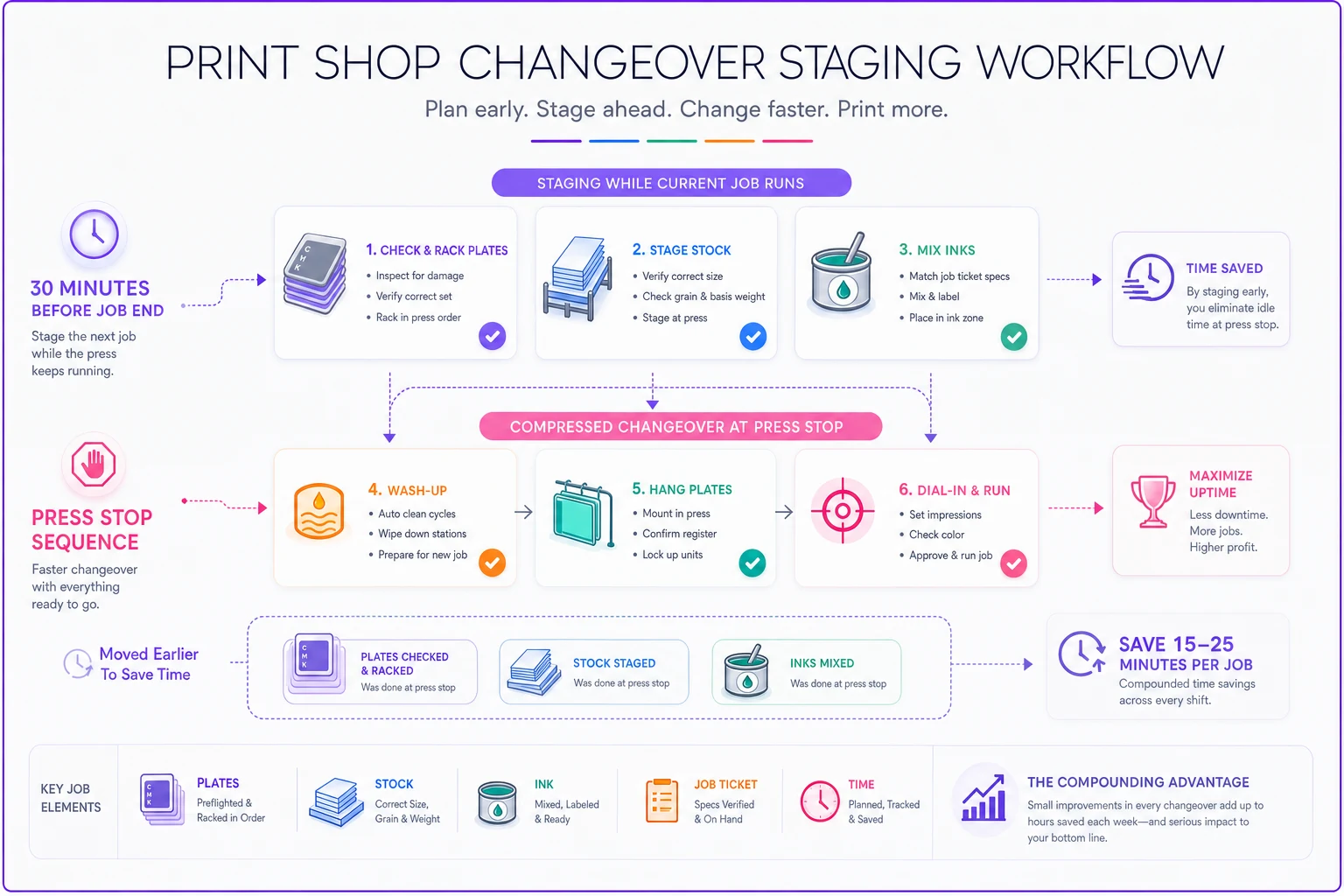
The diagram highlights that moving plate retrieval and stock staging before press-stop reduces dead press time and yields the biggest practical gains.
Turning waste into recycling and consignment recovery
Not all make-ready waste can be eliminated — some spoilage is just the physics of getting to color. So the second lever is recovering value from the waste you can't prevent.
Two options most small shops underuse:
Recycling with sorted grades. Baled, sorted white paper waste is worth meaningfully more per ton than mixed waste hauled off in a general dumpster. A lot of shops throw pristine make-ready sheets into the same bin as coffee cups and shrink wrap, then pay a hauler to take it. Separating clean white sheet waste and selling it as a sorted grade can turn a disposal cost into a small revenue line. It won't be life-changing, but on real make-ready volumes it can offset a chunk of your hauling bill.
Consignment on specialty stock. For expensive or slow-moving specialty stock, some paper merchants will hold inventory on consignment — you only pay when you pull it for a job. This doesn't reduce make-ready waste directly, but it stops you from buying stock speculatively and then eating the make-ready cost on jobs that never fully materialize. It shifts the risk of over-ordering specialty grades back to the merchant.
Shops often obsess over cutting waste but ignore recovering value from unavoidable waste. Both matter, and the recovery side usually has less operational friction because it doesn't require changing how anyone runs the press.
Simple ROI math that ties scrap to the bottom line
This is the part that makes the whole program stick — and the part most shops skip. If you can't connect "we spoiled fewer sheets" to "we made more money," the program feels like paperwork and quietly dies.
The calculation doesn't need to be complicated. For make-ready sheet waste:
Annual make-ready waste cost = (avg spoiled sheets per job) × (cost per sheet) × (jobs per year)
Say a shop runs about 2,600 jobs a year, averages roughly 180 spoiled sheets per job, and their loaded sheet cost (paper plus the ink and press seconds attached to those sheets) is around $0.11. That's:
180 × $0.11 × 2,600 ≈ $51,000 a year in make-ready paper waste alone.
Now the changeover side, which is usually larger:
Annual changeover cost = (avg changeover minutes) × (loaded press cost per minute) × (jobs per year)
If average changeover runs 32 minutes and loaded press cost is roughly $2.20/minute:
32 × $2.20 × 2,600 ≈ $183,000 a year in setup time.
Put those together and you can see why cutting average changeover from 32 to 26 minutes matters. Six minutes off, at $2.20/min across 2,600 jobs, is about $34,000 a year — for a change that mostly comes from staging plates and stock before the press stops.
A rough ROI table showing how modest, realistic improvements stack up:
| Improvement | Change | Approx. annual savings |
|---|---|---|
| Reduce avg spoilage per job | 180 → 145 sheets | ~$10,000 |
| Cut avg changeover time | 32 → 26 min | ~$34,000 |
| Eliminate 2 plate remakes/week | ~104 remakes/year | ~$4,000–$6,000 |
| Sort & sell white waste | vs. dumpster disposal | ~$2,000–$4,000 |
None of these numbers require heroics. They require measuring, staging, and holding the line. The ROI framing is what lets you set targets that actually mean something — instead of "cut waste 20%," you're saying "get average changeover under 26 minutes, worth about $34k." A crew can rally around that because the payoff is concrete and visible.
For linking these operational numbers back into pricing and capacity decisions, this connects closely to the framework in Profitability architecture for print shops: map capacity and true job cost into price bands and hire triggers.
Tie it to a real incentive — carefully
Numbers on a wall don't change behavior. A shared stake does. But incentive design in a waste program is where a lot of good intentions go sideways.
The mistake: paying a bonus purely on lowest spoilage. Operators will quietly hit that by not logging waste, or by refusing tricky jobs, or by shipping work that's slightly off color to avoid a remake. You'll cut logged waste and increase reprints and customer complaints — a worse outcome dressed up as a win.
What works better is a shop-level or crew-level pool tied to the combined metric — spoilage percentage plus average changeover time — with a floor on quality so reprint rate can't rise. Share a slice of the documented savings back with the crew quarterly. When the people doing the setups have skin in the actual dollars saved, the logs get honest and the staging discipline holds, because now it's their money too.
When this program makes sense — and when it doesn't
When it's worth it:
-
You run enough jobs that make-ready is a meaningful share of total sheets (short-run, high-changeover shops benefit most)
-
Your changeovers vary wildly job to job — variability means there's easy time to recover
-
You're quoting jobs on gut feel and suspect you're underpricing setup
When it's a bad idea to start now:
-
You're in the middle of a press move or major equipment change — wait until the process is stable, or your baseline will be garbage
-
Your shop is almost entirely long-run work where make-ready is already a rounding error against production
-
You can't get operator buy-in yet — forcing logs on a resistant crew produces fiction, and fiction is worse than no data
Who should skip the formal version: a two-person shop running mostly repeat jobs on one press probably doesn't need a coded log. They need the changeover staging discipline and a rough monthly spoilage check. The full cause-coded program pays off once you have multiple operators, multiple shifts, or enough job volume that patterns get lost in the noise.
A real scenario
A commercial shop running two mid-size offset presses, roughly 2,400 jobs a year, mostly short-to-medium runs on a mix of coated and uncoated stock. No formal waste tracking — spoilage was buried in monthly paper purchases, and setup times were "whatever they were."
They started with a five-field log at each press and ran it for three weeks to build a baseline. Two things showed up fast: plate remakes were happening about three times a week (mostly a prepress registration issue, not the pressroom), and coated cover stock was eating nearly double the make-ready sheets of everything else, but was being quoted with the same setup allowance as uncoated text.
They moved plate staging and stock verification to before press-stop, fixed the prepress step causing remakes, and started quoting coated jobs with a realistic make-ready allowance. Over the following few months, average changeover dropped from around 33 minutes to the mid-20s, and plate remakes fell to maybe two or three a month. Combined, the paper and press-time recovery landed somewhere in the $40k–$55k range annualized — not from new equipment, just from measuring, staging, and quoting honestly.
The most telling part: the biggest single fix wasn't at the press at all. It was a prepress registration setting nobody had connected to pressroom waste, because until the log tagged remakes by cause, nobody knew the two were linked.
Where the logs and math actually live
The friction in all of this is data collection and rollup. A paper log by the press works for capturing the number, but somebody still has to total it, split it by cause, and compute the ROI — and that manual step is usually where the program stalls after month two.
Pulling the log into your operational system helps. If your job tickets already live in a workflow platform, adding the spoilage count, cause code, and changeover time as fields on the job record means the rollup and ROI math happen automatically. You get the month-over-month trend without anyone rekeying a binder into a spreadsheet. AI-assisted platforms can flag patterns automatically — "plate remakes up 40% on coated stock this week" — so the cause analysis surfaces instead of sitting buried in rows nobody has time to read through.
The point isn't the software. It's that a program you don't have to hand-total is a program that survives past the first enthusiastic month. Whatever tool you use, keep the capture step brutally simple and let the analysis happen downstream.
The shops that succeed at make-ready reduction aren't the ones with the fanciest tracking — they're the ones whose operators actually keep logging because it takes fifteen seconds, and whose owners tie the results to real dollars everyone can see.
Ready to simplify your print shop operations?
Join 500+ print shops using GoInkly to save time, reduce errors, and improve customer satisfaction.