

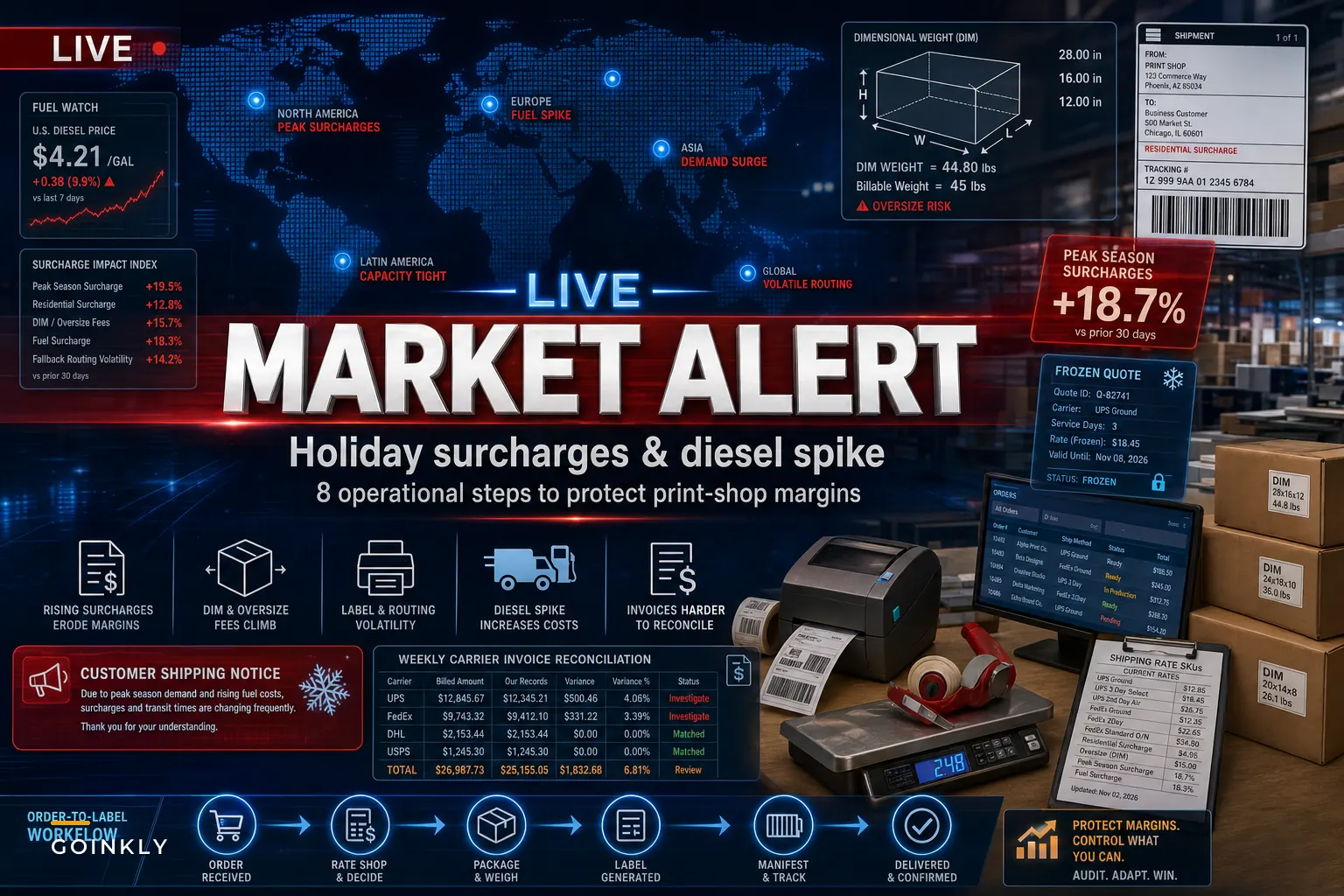

The timing couldn't be worse. Just as order volumes climb into the holiday rush, carriers are stacking peak-season fees on top of fuel surcharges that are already elevated. A recent Reuters report laid it out plainly: U.S. shippers are staring at record holiday delivery prices, with much of it driven by diesel costs feeding into fuel surcharge tables. Carriers have also published their own demand and peak surcharges, and USPS rolled out a temporary holiday price change that lands right in the middle of your busiest shipping weeks.
For most print shops, shipping isn't something you think hard about until it quietly eats a few points off every order. During peak, those few points become real money fast. This isn't a breakdown of the news cycle — it's a checklist you can run through in an afternoon to stop the bleeding before it starts.
First, understand which fees are actually hitting you
Before you touch a single quote, you need to know where the damage is coming from. Peak-season surcharges don't hit every package equally — they cluster around specific package profiles. If you don't know your own mix, you're making decisions blind.
| Fee type | What triggers it | Where print shops get burned |
|---|---|---|
| Fuel surcharge | Indexed to diesel prices, applied as a % of base + accessorials | Compounds on top of everything — heavier orders get hit hardest |
| Peak/demand surcharge | Applies during defined holiday weeks | Residential and ground shipments, often per-package |
| Oversize / additional handling | DIM weight or dimension thresholds | Rolled posters, signage tubes, large-format boxes |
| Residential delivery | Delivery to a home address | Direct-to-consumer promo orders, gift runs |
| Delivery/pickup area | Remote ZIP codes | Rural B2B clients you quoted flat-rate months ago |
The pattern worth paying attention to: large-format and tube-shipped products are the most exposed category in a print shop's catalog. A rolled 24x36 poster in a triangular tube can trip additional-handling and dimension surcharges at the same time, and then the fuel percentage stacks on top of both. What was a $14 ship cost in July can quietly become $22–$26 during peak.
Start with your oversized and tube-shipped SKUs.
If you only fix one thing after reading this, start with your oversized and tube-shipped SKUs.
The 8-step checklist
Work through these in order. The early steps stop active losses. The later ones protect you for the rest of the season.
Eliminate order confusion and delays.
GoInkly helps you manage every print order efficiently from submission to delivery.
- Centralized order tracking
- Production workflow management
- Inventory and supply monitoring
No credit card required
Here's a simple visual workflow of these steps.
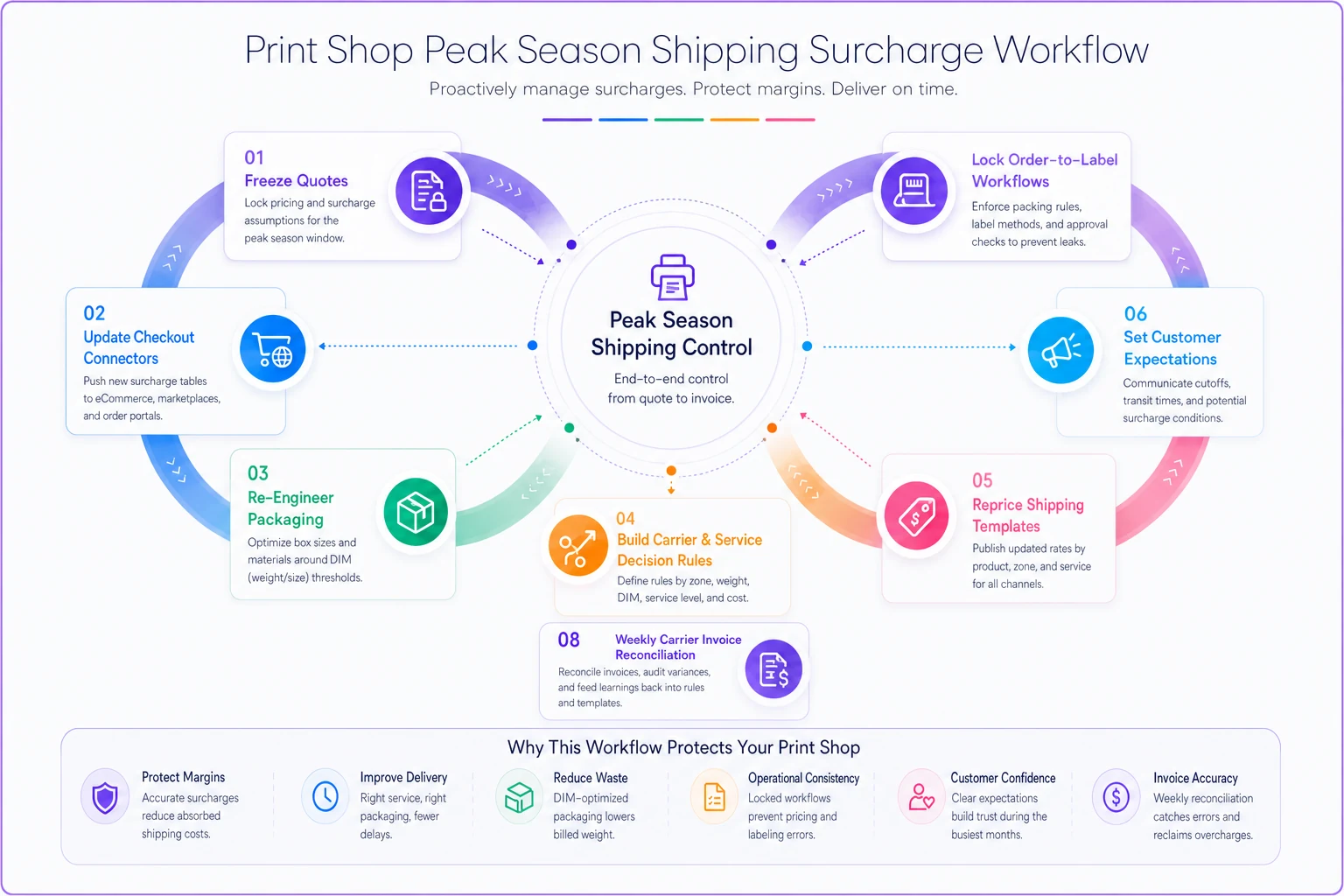
1. Freeze and re-check every active quote with shipping baked in
Any open quote or standing price sheet that includes shipping — flat-rate "we cover freight" deals especially — is now underwater or getting close. Pull every active quote with a validity window extending into peak. Recalculate the shipping component against current surcharge tables, not last quarter's.
The mistake that keeps showing up: shops quote flat shipping in September based on a slow-season rate, then honor those quotes through December while silently absorbing the surcharge difference. On a run of 40 orders, a $6 per-package gap is close to $240 gone — and nobody noticed because it never appeared on a single invoice line.
2. Update your shipping-rate SKUs and checkout connectors immediately
If you're pulling live carrier rates at checkout, confirm that the surcharge logic is actually flowing through. Carriers like FedEx have published updated rate change and surcharge notices, and if your integration caches rates or uses a stored rate table, you may be quoting old numbers to customers right now.
Test it. Run a live checkout on a tube product and an oversized box and confirm the quoted rate matches what you'd actually pay today. Stored rate tables that haven't been refreshed since summer are one of the most common silent leaks during peak season.
3. Re-engineer packaging around DIM thresholds
This is where the real margin recovery is. A lot of oversize charges are self-inflicted — a product that could ship in a smaller box or tighter tube is going out in whatever happens to be on the shelf.
-
Right-size tubes. A poster order shipped in a tube that's 4 inches longer than needed can push it over a dimension threshold. Stock tubes in two or three cut lengths instead of one catch-all size.
-
Flatten what you can. Some products quoted as "roll and tube" ship fine flat-packed in a rigid mailer at a fraction of the DIM penalty.
If you want the full approach on dimension math, carrier negotiation, and packaging decisions, we went deep on it in our guide to carrier-cost engineering for printers. Peak season is exactly when that work pays off.
4. Build a carrier/service decision rule, not a default
Most shops default to one carrier out of habit. During peak, the cheapest path changes by package profile. A small flat parcel might be cheapest via one carrier's ground service; an oversized tube might be dramatically cheaper via a different carrier or a regional option.
-
Under 1 lb, small dims → cheapest ground/economy service
-
Flat, rigid, under threshold → standard ground, default carrier
-
Tube or oversize → check alternate carrier before labeling
-
Rural/remote ZIP → compare before committing; delivery-area fees vary a lot
-
Time-sensitive gift orders → service level drives the choice, not price
The goal isn't to make shipping complicated. It's to replace "we always use X" with a five-second check that saves real money on the exact orders that cost the most.
5. Reprice your shipping templates and productized SLAs
If you sell productized jobs with set turnaround and shipping promises, those were priced before surcharges hit. Update the templates now — not order-by-order during the rush. You won't have time, and things will slip.
A clean approach is adding a visible peak-season shipping adjustment line rather than quietly inflating product prices. Customers understand seasonal freight costs far better than they understand a sudden jump in your poster price. Transparency here actually reduces pushback, not increases it.
6. Set customer expectations before they order
Peak fees are easier to pass on when customers see them coming. A short banner at checkout and a line in your order confirmation — "holiday carrier surcharges are in effect through [date]" — does more to prevent disputes than any after-the-fact explanation.
The shops that get the most chargebacks and angry emails during peak aren't necessarily the ones charging more. They're the ones who surprised the customer. The fee itself rarely causes the complaint. The surprise does.
7. Lock down your order-to-label workflow and manifest rules
When volume spikes, manual label creation is where errors multiply — wrong service selected, surcharge tier missed, residential flag forgotten. Tighten the path from order to label so the right rules apply automatically:
-
Service level maps from product type, not operator choice
-
Residential vs. commercial flag is set at order entry, not guessed at labeling
-
Oversize products trigger a packaging check before a label prints
-
Batch manifests reconcile against expected carrier charges daily
The goal is that the person printing labels at 4 p.m. on a Thursday in December can't accidentally absorb a surcharge the quote didn't account for.
8. Reconcile carrier invoices weekly, not monthly
During peak, carrier invoices are full of surprises — accessorial fees you didn't quote, dimension reclassifications, address corrections. If you reconcile monthly, you're finding out in January what you lost in December.
Pull the invoice weekly during peak. Compare charged-vs-quoted on a sample of oversized shipments. You're looking for two things: surcharges you can pass on going forward, and misclassifications you can dispute. Carriers reclassify package dimensions more aggressively during peak, and some of those reclassifications are just wrong.
A quick real scenario
A mid-size shop doing custom posters and event signage runs around 280–320 orders a month during the holiday stretch, with roughly 40% going out in tubes. They were quoting shipping off a rate table last refreshed in August and shipping everything in one long tube size.
Two problems compounded. The stale table meant they were under-collecting the fuel and peak surcharge by about $4–$5 per package. And the one-size tube was tripping an additional-handling fee on orders that didn't need it.
After refreshing the connector and stocking a shorter tube cut for smaller poster orders, their average oversized ship cost dropped by roughly $6–$9 per affected order, and the under-collection gap closed. Across a peak month, that was somewhere in the low-to-mid four figures recovered — not from charging customers more, but from stopping fees they didn't need to pay and closing a rate gap they didn't know existed.
Nothing dramatic. Just margin that was leaking and then wasn't.
When passing on costs is the wrong move
Not every surcharge should go straight to the customer. For high-volume repeat B2B clients on contract pricing, absorbing a portion of the peak differential might be smarter than risking the relationship over a few dollars per package — especially when that client's annual volume is worth protecting.
Where you should pass costs through cleanly: one-off direct-to-consumer orders, gift runs, and any residential delivery where the margin is already thin. Those customers expect holiday shipping to cost more and generally won't push back.
The shops that get this wrong tend to go to one extreme — absorbing everything and watching peak-season profit disappear, or repricing every order and losing their best accounts. The right answer is almost always segmented by customer type.
Who should skip most of this
If shipping is a trivial share of your business — primarily local pickup or bulk B2B freight on negotiated contracts — per-package surcharge noise matters a lot less. Don't burn a day re-engineering tube sizes for ten shipments a week. Focus on steps 1 and 5: just make sure your active quotes and templates aren't underwater.
The checklist above is built for shops where parcel shipping is a meaningful, recurring cost center — which during peak, covers most of them.
Final thought
Peak-season surcharges aren't a pricing problem you solve once. They're an operational one you manage across the whole window. The shops that come through December with margins intact aren't the ones who found some clever loophole — they're the ones who knew their package profile, refreshed their rates, right-sized their packaging, and reconciled invoices before the damage became permanent.
Run through the eight steps this week. The fees are already in effect, and every order that ships on a stale rate table is margin you're not getting back.
Ready to simplify your print shop operations?
Join 500+ print shops using GoInkly to save time, reduce errors, and improve customer satisfaction.