

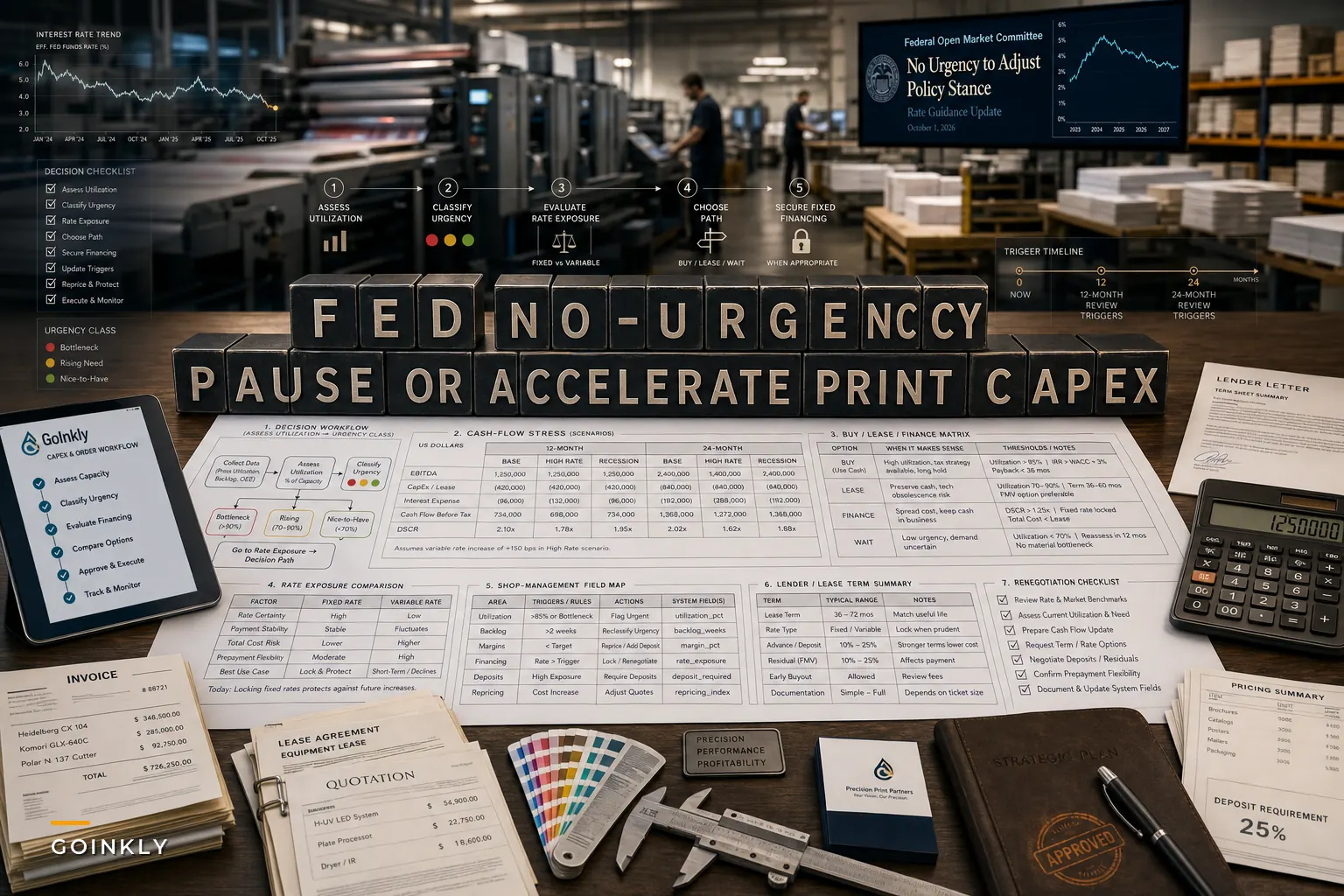

When New York Fed President John Williams said on September 29 that there's "no need for urgency" on another rate move, most print shop owners either ignored it or filed it under "stuff economists argue about." That's understandable — but it's still a mistake. Not because you need to follow macro policy, but because this specific signal changes the math on decisions you're probably already weighing: that new digital press, the finishing line you've been quoting, the credit line renewal coming up in Q1.
Here's the quick version of what happened: after the Fed's mid-September increase, Williams essentially told markets the central bank can afford to sit back and watch data before doing anything else — while keeping one more hike on the table for late this year. Reuters reported he framed it as patience, not a pivot. Bloomberg's read was that one more increase in late 2026 is still very much in play.
For a shop owner, that's the whole game in one sentence: rates aren't dropping soon, and there's still upside risk. Everything below is about what you do with that.
What "no urgency" actually means for your financing window
The part people miss: "no urgency" doesn't mean "cheap money is coming back." It means the current environment — higher borrowing costs — is the environment you should plan around for the next several quarters. The option-value of waiting for better rates has basically evaporated. If you've been sitting on an equipment decision thinking "I'll pull the trigger when financing gets cheaper," this guidance quietly tells you that bet has poor odds.
What you see across a lot of small shops is a kind of financing paralysis during uncertain-rate periods. Owners delay a purchase for six months hoping for a better quote, and in that window they either lose the deal pricing the vendor offered, burn overtime labor working around an undersized machine, or watch a competitor land the big contract because they had the capacity.
The practical reframe: stop treating the rate as the variable. Treat it as fixed-and-maybe-rising, then make the decision on utilization and cash flow instead. That flips the whole analysis back onto numbers you actually control.
The underlying problem this exposes: most shops finance on gut, not on a model
Rate guidance only matters if you have a framework to plug it into. The real issue the Williams comment surfaces isn't interest rates — it's that a lot of shops never built a repeatable buy/lease/wait model in the first place. So when something macro shifts, they have no structured way to respond. They feel anxious and do nothing.
Eliminate order confusion and delays.
GoInkly helps you manage every print order efficiently from submission to delivery.
- Centralized order tracking
- Production workflow management
- Inventory and supply monitoring
No credit card required
If you don't already have one, this is a good moment to build the decision logic. We walked through the full version of this — utilization triggers, modeled total cost of ownership, and the thresholds where buying beats leasing — in our equipment investment framework for print shops. What follows here is the rate-aware layer that sits on top of it.
The most common mistake: shops compare the monthly payment on a lease versus a loan and pick the lower number. That ignores the rate trajectory entirely. In a flat-or-rising environment, a fixed-rate loan or a lease with a locked rate becomes more valuable because you're insulating yourself against the "one more hike" scenario. A variable-rate line used to fund equipment is now the riskiest option on the board.
Buy, lease, or wait: a rate-aware decision table
Run your pending equipment decision through this. It assumes you've already confirmed the machine solves a real capacity or quality problem — not just that you want it.
| Situation | Utilization outlook | Rate exposure | Recommended move |
|---|---|---|---|
| Machine is already bottlenecking jobs (overtime, outsourcing) | High and steady | Lock it in | Buy or lease now with fixed terms — waiting costs more than the rate |
| Capacity need is real but 9–12 months out | Rising but not yet urgent | Rate could rise once more | Secure a fixed quote now, delay funding draw if lender allows |
| "Nice to have" upgrade, current gear works | Flat | Any | Wait — don't finance discretionary upgrades into a higher-for-longer rate |
| Replacement for failing equipment | Non-negotiable | Lock it in | Buy now, fixed rate — downtime risk dwarfs rate difference |
| Speculative expansion on a contract not yet signed | Unknown | High | Wait for the signed contract; don't borrow against hope |
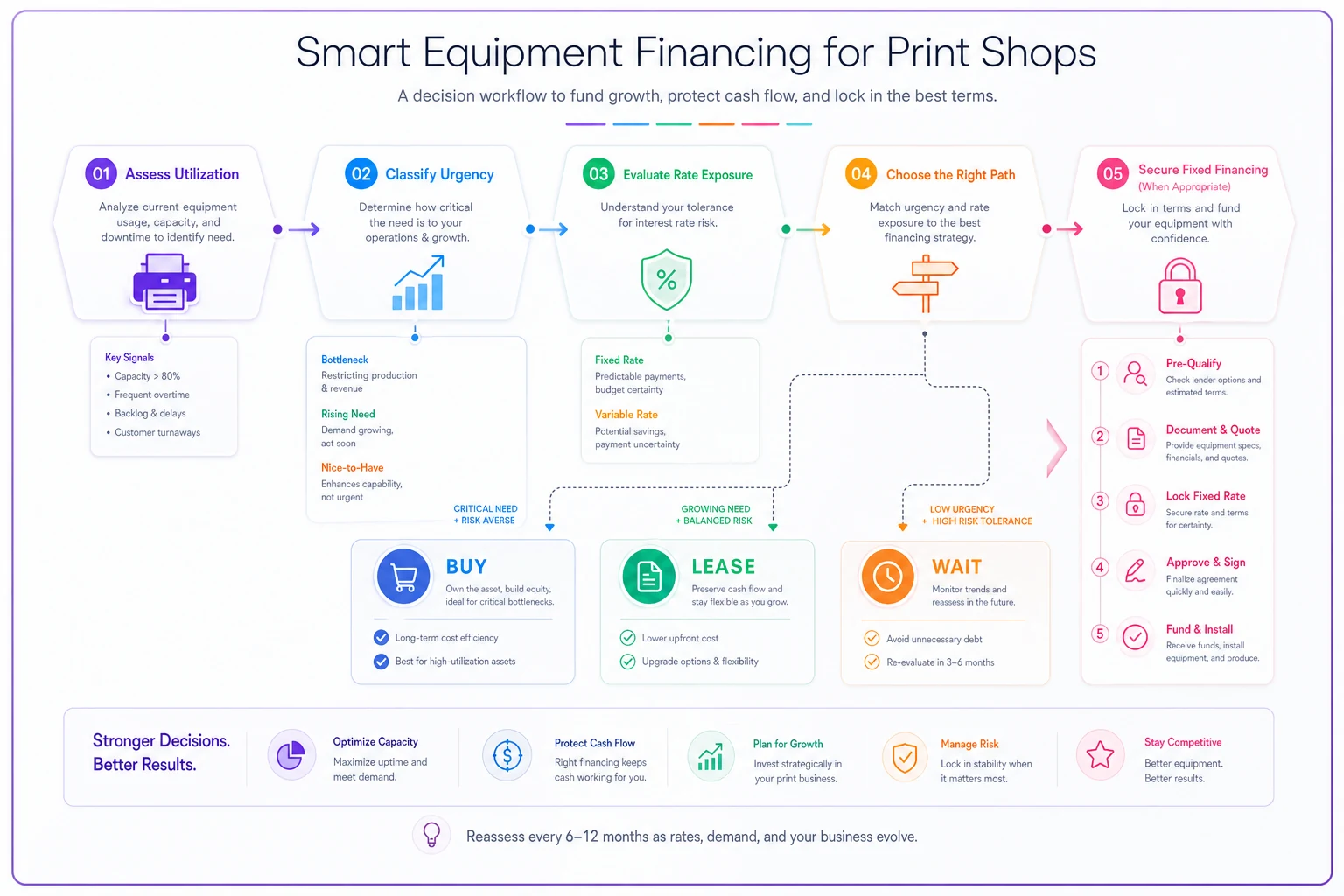
Here's a quick visual of that buy/lease/wait workflow.
The pattern underneath this table: urgency should come from your production floor, not from the Fed. The rate guidance just tells you that "waiting for cheaper money" is no longer a valid reason to delay — so your utilization numbers become the deciding factor again.
Re-running your break-even with higher-for-longer assumptions
A press that pencils out at 5% financing looks different at 7–8%, and the "one more hike" risk means you should model the worse case before signing anything.
-
Pull your realistic monthly utilization, not the vendor's. If you'll run the machine around 60% of rated capacity in year one, model 60%, not 85%.
-
Build two payment scenarios — your quoted rate, and that rate plus roughly 0.5–0.75% to simulate another hike.
-
Add the hidden carrying costs — maintenance contract, consumables ramp, operator training downtime for the first few weeks.
-
Find the break-even job volume under the higher rate scenario. That's your real safety line.
-
Compare against your actual pipeline, not your best month. If break-even needs volume you only hit in peak season, that's a problem.
A real example: a shop weighing a roughly $140k digital press got a lease quote around $2,600/month. At the higher-rate stress scenario it climbed closer to $2,800–$2,900. The gap sounds small, but it moved their break-even from about 310 jobs a month to around 345. Their trailing average was 320. On paper the machine "worked" — under stress, it didn't, until they locked in a fixed rate and confirmed two recurring contracts first.
Where this bites owners who aren't watching: quoting and deposit terms
Financing cost volatility doesn't just hit capital decisions. It leaks into pricing, and most shops never adjust for it. If your material costs and borrowing costs are both sticky-high, quotes from six months ago may be quietly underwater.
-
Quote expiration windows. If you're honoring quotes for 60–90 days in a volatile cost environment, you're absorbing risk the customer should share. Tightening to 30 days on custom work is reasonable and nobody blinks.
-
Deposit timing on long-lead equipment-dependent jobs. If you're funding a job's materials on a credit line that now costs more to carry, your deposit structure should reflect that carrying cost — especially on large runs with slow-paying clients.
In a higher-for-longer world, every day of float costs you money, because the cash you're fronting is implicitly borrowed at today's rates. Shops that tightened quote windows and nudged deposit schedules recovered margin without raising a single headline price.
A short checklist to run this month
List every equipment decision currently "on hold waiting for better rates" — reclassify each as buy/lease/wait using utilization, not rate hope
-
- [ ] List every equipment decision currently "on hold waiting for better rates" — reclassify each as buy/lease/wait using utilization, not rate hope
-
- [ ] Get fixed-rate quotes on anything you're genuinely buying; avoid funding equipment on variable lines
-
- [ ] Re-run break-even on pending purchases with a +0.5–0.75% rate stress case
-
- [ ] Review your line of credit renewal terms before year-end, while you have leverage
-
- [ ] Audit quote expiration windows on custom work
-
- [ ] Check deposit schedules on large, material-heavy jobs for carrying-cost exposure
-
- [ ] Confirm recurring contract volume covers break-even before signing speculative capacity
Confirm recurring contract volume covers break-even before signing speculative capacity
When waiting actually makes sense
Not every delay is paralysis. Waiting is the right call when the equipment is a genuine "nice to have," when your current gear has real runway, or when the capacity need depends on a contract that isn't signed yet.
Borrowing into a higher-rate environment to chase speculative work is how shops end up with an underutilized machine and a payment that eats their cushion.
When waiting is quietly costing you
If you're already paying overtime, outsourcing finishing, or turning away jobs because of capacity, the "no urgency" signal is actually telling you to move.
Every month you delay a machine that's already bottlenecking production, you're paying the premium of inefficiency plus the risk that your financing gets more expensive, not less. That's the worst combination, and it's exactly the trap the "wait for cheaper money" mindset walks you into.
The real takeaway
The Fed signal isn't the story. The story is that it removes your best excuse for indecision. "Rates might drop" is off the table for now, which means your equipment and financing calls come back down to the fundamentals: how hard will this machine actually run, does your pipeline clear break-even under a stress scenario, and are your quoting and deposit terms protecting you from the cost of carrying cash.
Shops that treat this as a prompt to finally build — or dust off — a disciplined buy/lease/wait model will make better calls than shops reacting to every headline out of the Fed. Lock your rates where the decision is real, wait where the need is soft, and let your production floor set the urgency.
Shops that treat this as a prompt to finally build — or dust off — a disciplined buy/lease/wait model will make better calls than shops reacting to every headline out of the Fed. Lock your rates where the decision is real, wait where the need is soft, and let your production floor set the urgency.
Ready to simplify your print shop operations?
Join 500+ print shops using GoInkly to save time, reduce errors, and improve customer satisfaction.