
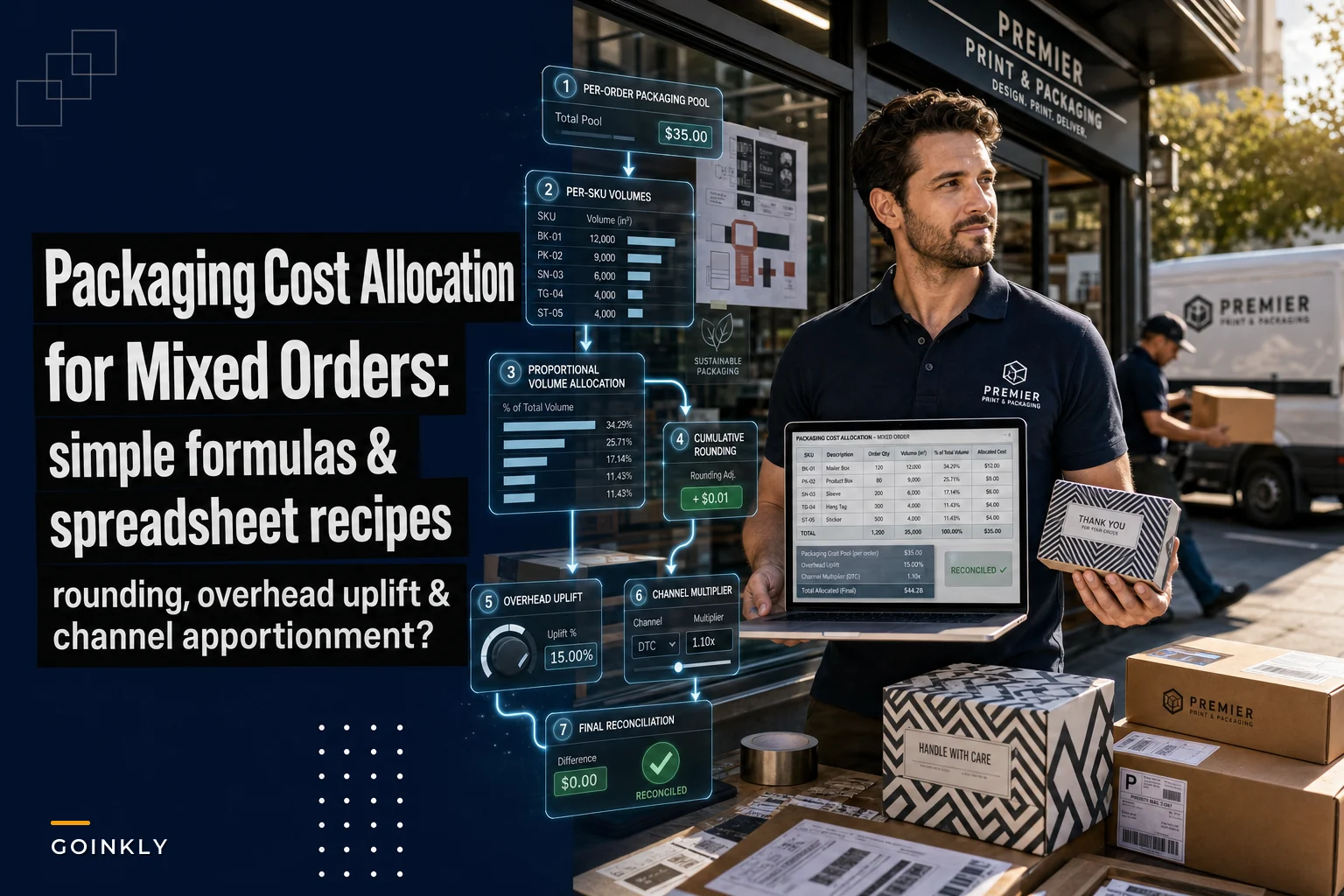

Most print shops allocate packaging costs the lazy way: dump a flat $1.50 "handling" charge on every order and call it done. That works until someone orders 4,000 business cards plus 12 foam-mounted posters plus a pack of stickers in one shipment, and now your margin math is quietly wrong on all three line items.
This post is only about one thing — how to split box, filler, and label costs fairly across the items inside a mixed order, with rounding rules and channel adjustments that don't fall apart in a spreadsheet. If you want to understand why packaging quietly eats your margin across different sales channels, there's a broader look at that in measuring channel profitability including hidden labor, returns and packaging costs. Here we're going narrow and practical.
Why packaging allocation breaks on mixed orders specifically
Single-SKU orders are easy. One product, one box, one label — the packaging cost is the packaging cost. Nothing to apportion.
The problem shows up the moment an order contains multiple SKUs that need different handling. A rigid mailer tube for posters costs very differently than a small poly mailer for stickers. When both ship together in one box with void fill, which SKU "owns" the box? Which one ate the bubble wrap?
What tends to happen across a lot of shops is that nobody actually answers that question. The packaging cost gets attached to the order, not the items, and when finance tries to figure out whether stickers are profitable, there's no clean number. Stickers look great because packaging never got charged to them — the posters in the same order silently absorbed all of it.
That's the core issue. Packaging is an order-level cost, but margin is measured at the SKU level. Allocation is the bridge between the two, and the bridge has to use a consistent rule or your contribution margins become fiction.
Pick your allocation basis before you touch a formula
There are only a few sane ways to split shared packaging across items. Picking the wrong basis is where most shops go sideways.
Eliminate order confusion and delays.
GoInkly helps you manage every print order efficiently from submission to delivery.
- Centralized order tracking
- Production workflow management
- Inventory and supply monitoring
No credit card required
| Allocation basis | How it splits cost | Best for | Weakness |
|---|---|---|---|
| By item count | Divide equally per unit | Orders where items are similar size | Punishes small, cheap items |
| By weight | Proportional to each SKU's weight | Mailer/box cost driven by shipping | Ignores bulky-but-light items |
| By cubic volume | Proportional to each SKU's volume | Box and void fill costs | Harder to track dimensions per SKU |
| By line revenue | Proportional to each line's sell price | Quick, revenue-based | Disconnects cost from physical reality |
| By handling tier | Fixed packaging cost per SKU "class" | Shops with standard pack kits | Needs upfront SKU classification |
For print shops specifically, volume-based allocation is usually the most honest because box size and void fill are driven by how much space an item takes. A flat stack of 500 postcards takes almost no room; three framed prints dominate the box. Weight works well when your real packaging driver is the shipping container and padding for fragile flat goods.
The mistake isn't picking the "wrong" basis — it's mixing bases across orders without realizing it. One quote uses count, the next uses revenue, and your margin reports become incomparable.
The core formula (volume-based, with worked numbers)
Here's the recipe. Say an order has three SKUs sharing one box.
Packaging cost pool for the order:
-
Box
$2.10
-
Void fill / filler
$0.85
-
Shipping label + packing slip
$0.40
-
Total shared packaging = $3.35
Now the per-SKU volumes (cubic inches, rough is fine):
| SKU | Qty | Volume per unit (in³) | Line volume |
|---|---|---|---|
| A — folded brochures | 250 | 0.12 | 30 |
| B — foam-mounted print | 2 | 180 | 360 |
| C — vinyl stickers | 100 | 0.05 | 5 |
Total order volume = 30 + 360 + 5 = 395 in³
Allocation formula for each SKU:
SKU packaging cost = Total packaging pool × (SKU line volume ÷ Total order volume)
Running it:
-
SKU A
$3.35 × (30 ÷ 395) = $0.254
-
SKU B
$3.35 × (360 ÷ 395) = $3.053
-
SKU C
$3.35 × (5 ÷ 395) = $0.042
The foam-mounted print rightfully eats almost all the packaging cost — it's the reason you needed the bigger box and the void fill. The stickers barely register. That's the whole point. Count-based allocation would have charged all three SKUs roughly $1.12 each, making the stickers look unprofitable and the foam print look like a steal.
Rounding rules that stop your pennies from vanishing
Here's a trap people fall into. You round each allocated cost to two decimals, sum them up, and the total no longer matches your original packaging pool. In the example above, $0.25 + $3.05 + $0.04 = $3.34, but your pool was $3.35. A penny went missing.
On one order, who cares. Across 8,000 orders a year, those orphaned pennies pull your reported packaging cost away from actual spend, and reconciliation at month-end never ties out.
Use the largest-remainder rule instead of plain rounding:
-
Allocate each SKU's cost at full precision.
-
Round each one down to two decimals.
-
Sum the rounded values and find the leftover vs. the pool.
-
Hand the leftover cents, one at a time, to the SKUs with the largest fractional remainders.
In spreadsheet form, the cleanest trick is to round the running cumulative total rather than each line independently:
Rounded SKU cost = ROUND(cumulative pool share through this SKU, 2) − ROUND(cumulative pool share through previous SKU, 2)
Use cumulative rounding in your spreadsheet to guarantee rounded line costs always sum to the exact pool without manual cent adjustments.
This guarantees the rounded line costs always sum back to the exact pool. No vanished pennies, no month-end mystery.
Overhead allocation: don't forget the cost of *doing* the packing
Box, filler, and label are direct materials. But the labor and consumables around packing are real costs too — tape, the packer's time, the printer running shipping labels. Many shops leave this out entirely, which is why their "packaging cost" looks suspiciously low.
A simple approach that doesn't require time-studying every order: add a packaging overhead rate as a percentage uplift on the direct packaging pool, or as a flat per-order adder, whichever matches your reality better.
-
If packing time scales with box complexity → percentage uplift (e.g., 35% on top of direct materials).
-
If every order takes roughly the same fixed effort to pack → flat adder (e.g., $0.90/order) allocated on the same basis as materials.
Using the earlier example with a 35% overhead uplift:
Direct pool: $3.35 Overhead: $3.35 × 0.35 = $1.17 Loaded packaging pool = $4.52
Then run the exact same volume allocation on $4.52 instead of $3.35. The method doesn't change — you just allocate a fuller cost. One nuance: if your overhead is truly per-order rather than per-item, you may want to allocate the overhead portion by item count while allocating materials by volume. Blending bases inside one order is fine as long as the rule is documented and applied consistently.
Channel-level apportionment: same box, different true cost
The same physical package costs you different amounts depending on where the order came from. A marketplace order might require a branded insert, a different label format, or a returns-prepaid slip. A wholesale order might ship in bulk with minimal packaging per unit.
So the final layer is a channel multiplier applied after SKU allocation:
| Channel | Packaging multiplier | Why |
|---|---|---|
| Direct website | 1.00 | Baseline |
| Marketplace | 1.25 | Branded insert + prepaid return label |
| Wholesale/bulk | 0.70 | Shared outer carton, minimal per-unit fill |
| Retail drop-ship | 1.40 | Retailer-mandated poly bags, barcodes, compliance labels |
Applied to SKU B from earlier ($3.05 allocated) sold through a marketplace: $3.05 × 1.25 = $3.81 true packaging cost on that line.
Worth noticing: a SKU can be comfortably profitable on your website and underwater on a retail drop-ship channel purely because of packaging compliance requirements — and you'd never see it without channel-level apportionment. This is exactly the hidden cost that distorts channel comparisons, and it compounds with the labor and returns differences covered in the channel profitability breakdown.
A full worked contribution margin, end to end
Let's put it together for SKU B (the foam-mounted print), sold on marketplace.
-
Sell price (line)
$64.00
-
Direct production + materials cost
$38.00
-
Allocated packaging (volume basis, loaded with overhead)
- Material allocation: $3.05 - Overhead portion: $1.07 - Channel multiplier (1.25) applied to packaging total: ($3.05 + $1.07) × 1.25 = $5.15
-
Shipping cost (actual postage, not packaging)
$9.20
Contribution margin:
$64.00 − $38.00 − $5.15 − $9.20 = $11.65
That $11.65 is real. Compare it to the naive version where packaging was a flat $1.50 and overhead and channel were ignored: you'd have reported roughly $15.30, overstating margin by about 31% on that line. Run that across a full catalog and your pricing decisions are built on inflated numbers.
Your spreadsheet build checklist
If you're setting this up from scratch, here's the minimum you need in the sheet:
-
- [ ] A per-SKU master table with volume (or weight) per unit
-
- [ ] An order table listing SKUs, quantities, and the channel
-
- [ ] A packaging pool input per order (box + filler + label costs)
-
- [ ] An overhead rate cell (percentage or flat), clearly labeled
-
- [ ] A channel multiplier lookup table
-
- [ ] An allocation column using the cumulative-rounding formula
-
- [ ] A reconciliation row that confirms allocated costs sum to the loaded pool
-
- [ ] A contribution-margin column per line that subtracts allocated packaging and actual shipping separately
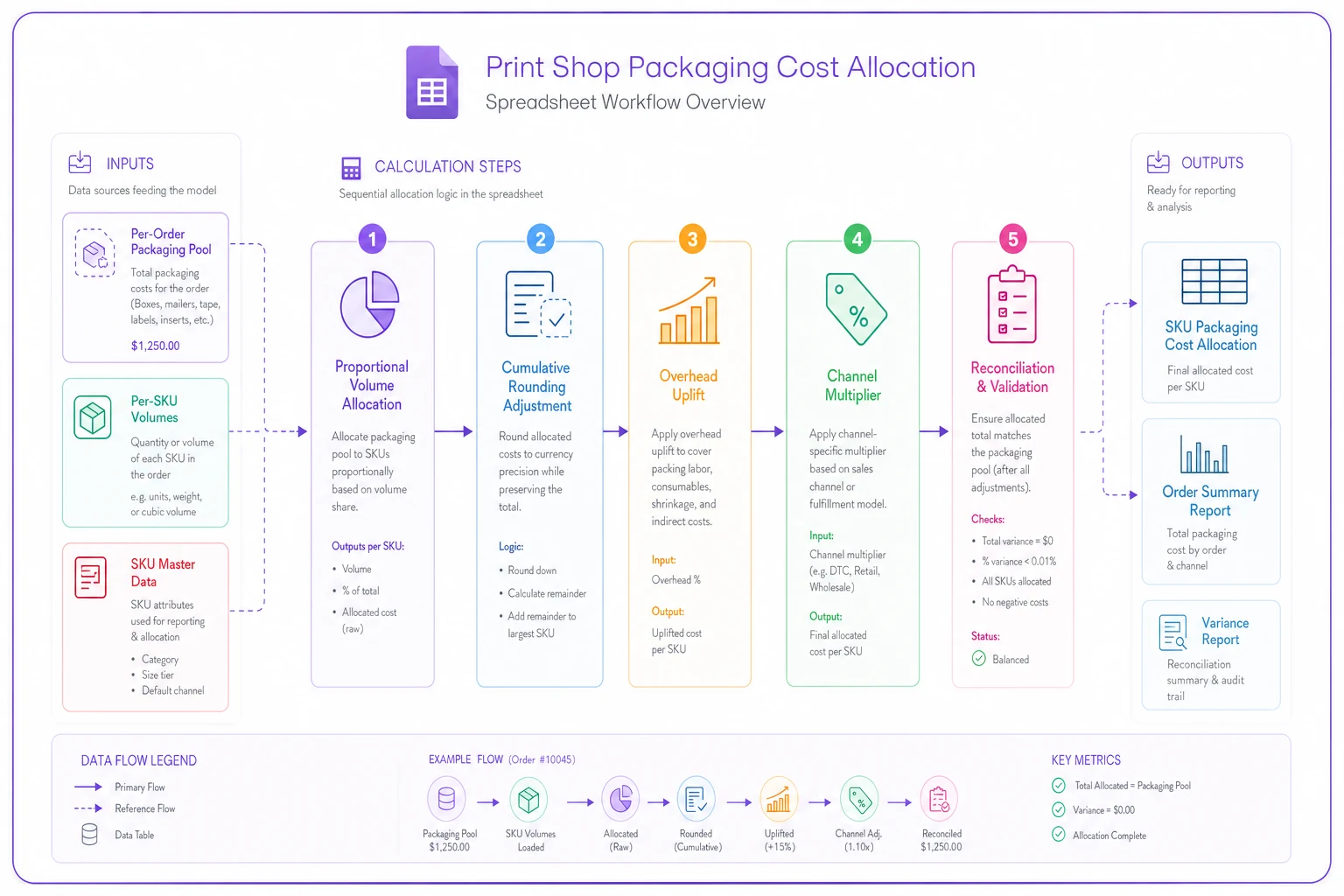
That reconciliation row is the one people skip and regret. It's your early warning that a formula drifted.
When this level of detail actually makes sense — and when it doesn't
Do this if: you ship a lot of mixed-SKU orders, you sell across multiple channels, or your products vary wildly in size (flat prints next to rigid signage). The margin distortion is largest exactly in those conditions.
-
you ship a lot of mixed-SKU orders
-
you sell across multiple channels
-
your products vary wildly in size
Skip the full model if: you ship mostly single-SKU orders, or everything you sell is roughly the same size and weight. A flat per-order packaging charge is close enough in that case, and building a volume-allocation engine is over-engineering.
-
you ship mostly single-SKU orders
-
everything you sell is roughly the same size and weight
Who should not do this yet: a shop that doesn't track per-SKU dimensions or per-order packaging spend at all. Get that raw data flowing first. Allocation math on garbage inputs just produces confident, wrong numbers. If your packing process is still manual guesswork, standardizing pack kits comes before any of this — there's a practical walkthrough in packing and shipping automation for mixed-SKU print orders.
-
a shop that doesn't track per-SKU dimensions or per-order packaging spend at all
If your packing process is still manual guesswork, standardizing pack kits comes before any of this.
Real scenario
A mid-sized shop doing signage, business cards, and promotional stickers was using a flat $1.75 packaging charge across every line. Their sticker SKUs looked terrible — reported contribution margin hovered around 8%, and they were close to discontinuing a few.
When they rebuilt allocation on a volume basis, the stickers' real packaging cost dropped to somewhere between $0.05 and $0.15 per order line, since they were riding along in boxes sized for the signage. Sticker margins jumped into the low-20s percent range — not because anything changed on the floor, but because the cost was finally sitting on the right SKU.
The flip side: two of their rigid sign SKUs, sold through a retail drop-ship channel, turned out to be nearly break-even once the channel multiplier and real box costs landed where they belonged. They repriced those two and left the stickers alone. The net effect was a real margin lift across the catalog — not dramatic, but meaningful — with the bigger win being that they stopped nearly killing a profitable product line based on bad numbers.
The one habit that keeps this honest
Pick a single allocation basis, write it down, and apply it the same way on every order. The formulas here aren't complicated — the discipline is. Shops get into trouble not because volume allocation is hard, but because they allocate by volume one week, by count the next, and forget to load overhead on half their reports.
Once your basis is locked and your reconciliation row ties out, your per-SKU contribution margins become something you can actually price against. Which products to push, which channels to trim, which items are quietly carrying the rest of the catalog — all of it gets clearer the moment packaging cost lands on the right SKU instead of getting smeared evenly across the order.
Pick a single allocation basis, write it down, and apply it the same way on every order. The formulas here aren't complicated — the discipline is.
Ready to simplify your print shop operations?
Join 500+ print shops using GoInkly to save time, reduce errors, and improve customer satisfaction.