


The jobs that hurt the most aren't the walk-in one-offs. It's the repeat customer you've had for two years who slowly stretches from net-30 to net-70, then net-90, while you keep running their work because "they always pay eventually." Meanwhile you've floated $18k in paper, ink, and press time on their behalf, and your line of credit is doing the job your deposit policy should have done.
Deposit and credit rules are the least glamorous part of running a shop, and they're usually the most inconsistent. One CSR takes 50% on a custom job, another takes nothing because the client "seemed fine." Nobody knows what the actual rule is because there isn't one — there's a vibe. This post is about replacing the vibe with a decision matrix you can actually enforce, a credit checklist that takes two minutes, and a collections sequence built around how print money actually moves.
Why print shop deposit rules are different from most businesses
Most deposit advice online is written for service businesses with almost no material cost. A consultant asking for a 50% deposit is protecting their time. You're protecting time plus a stack of substrate you already cut, plates you already burned, and ink you already laid down — none of which you can resell if the customer walks.
That's the whole reason print shop deposit rules can't be one flat number. A 5,000-piece direct mail run with variable data and a custom envelope has almost no salvage value if the client ghosts. A stock business-card reorder on house paper has some. A large-format banner with a client's logo is worthless to anyone but them. Your deposit should track how much you're out if the job dies mid-production, not some generic percentage you copied from a freelancer's contract template. The second difference: your repeat customers are also your biggest credit risk. New customers you scrutinize. The loyal accounts you extend terms to on autopilot — and those are exactly the ones whose slow drift into late payment you don't notice until it's a real number.
The deposit decision matrix
The core of it comes down to two things: how customized the work is (i.e., salvage value if cancelled) and the customer's payment history with you. Not by how nice they were on the phone.
Eliminate order confusion and delays.
GoInkly helps you manage every print order efficiently from submission to delivery.
- Centralized order tracking
- Production workflow management
- Inventory and supply monitoring
No credit card required
| Order type | Salvage value if cancelled | New / unverified customer | Established customer (good history) |
|---|---|---|---|
| Stock reorder on house paper (biz cards, standard flyers) | Moderate | 25% | 0% (on terms) |
| Custom design, standard substrate | Low | 50% | 25% |
| Variable data / personalized (direct mail, numbered tickets) | Near zero | 60–75% | 40% |
| Large-format with client branding (banners, signage) | Zero | 75% | 50% |
| Specialty substrate you had to special-order | Zero | 100% of material + 25% labor | Material cost upfront |
| Rush job jumping the queue | N/A (opportunity cost) | Standard + 15% | Standard + 10% |
A few things worth noticing here.
The deposit isn't just risk insurance — for specialty substrate it's cost recovery. If a customer asks for a paper you don't stock and you have to buy a minimum order, that material cost is real money out the door the moment you place the PO. Charging it upfront isn't aggressive; it's just not lending them your working capital.
The rush surcharge sits in the matrix on purpose. A rush deposit is different from a rush price, and shops constantly conflate the two. The surcharge covers the disruption; the deposit covers the material.
And "established customer, good history" earning a 0% deposit on stock reorders is a deliberate reward. Your deposit policy shouldn't punish your best accounts with the same friction you apply to strangers. The credit check below is what earns them that spot.
A two-minute credit-scoring checklist
You don't need Dun & Bradstreet for a $4,000 job. You need a fast, repeatable read on whether extending terms is smart. This checklist works well in shops running mostly B2B repeat business — it takes a couple of minutes and produces a simple score.
-
Payment history with you (0–3 points) 3 = always on time over 6+ orders. 2 = mostly on time. 1 = occasional 15+ day slips. 0 = no history or chronic lateness.
-
Order size vs. their normal (0–2 points) 2 = in line with past orders. 1 = 2–3x their usual. 0 = wildly larger than anything they've done.
-
Business stability signals (0–2 points) 2 = established, verifiable, been around years. 1 = newer but legit. 0 = brand new, no web presence, personal email.
-
Balance currently owed (0–2 points) 2 = zero open balance. 1 = one open invoice within terms. 0 = anything already past due.
-
Job customization (0–1 point) 1 = salvageable if cancelled. 0 = zero salvage value.
-
8–10 points Terms available. Apply the "established customer" deposit column, or net terms for stock reorders.
-
5–7 points Reduced terms — 25–40% deposit even for repeat accounts.
-
Below 5 Deposit required per the "new/unverified" column. No terms until the score improves.
The point values aren't sacred — tune them to your shop. What matters is the underlying logic: the biggest predictor of a bad debt isn't a new customer, it's a good customer placing an unusually large order while already carrying a balance. That combination turns a reliable account into a five-figure problem fast, and a scoring checklist catches it because it forces you to look at order size and open balance together instead of just thinking "oh, it's them, they're fine."
The collections flow, built for print timing
Most collections advice is a generic "send three reminders" sequence. Print shops need something tied to production and delivery, because your leverage shifts depending on where the job is. Before you release files or ship, you hold all the cards. After delivery on terms, you're an unsecured creditor chasing money.
So the flow starts before the invoice is even late.
The sequence:
-
At order confirmation
Deposit collected per matrix. Terms and late-payment policy on the order confirmation in writing — not buried, actually visible. This is where disputes get prevented, and it ties directly into a clean order and proof process. A tight customer order experience with clear SLA and dispute rules removes the "well I never approved that" excuse that fuels payment stalling.
-
At completion, before ship (for terms accounts)
Balance-due notice goes out with the "your order is ready" message. Bundling these is a small move that changes behavior — the customer associates getting their product with the invoice, not with a separate email three weeks later.
-
Day 0 (invoice issued)
Clean invoice, due date bolded, payment link included. Sounds obvious. A surprising number of past-due invoices are just invoices the client couldn't figure out how to pay quickly.
-
Due date + 3
Friendly nudge. "Just making sure this didn't slip through — invoice #### was due Tuesday." No threat, no fee talk yet.
-
Due date + 10
Firmer, references the late-payment terms they agreed to. Mention that new orders require deposit until the balance clears. This is your real lever — you're not threatening collections, you're gating future work.
-
Due date + 21
Final notice before hold. New orders paused, existing WIP for that client paused. Phone call, not email.
-
Due date + 45
Escalation — payment plan offered in writing or handed to collections/small claims depending on the amount.
Here's a simple workflow illustrating when to gate orders and when to escalate.
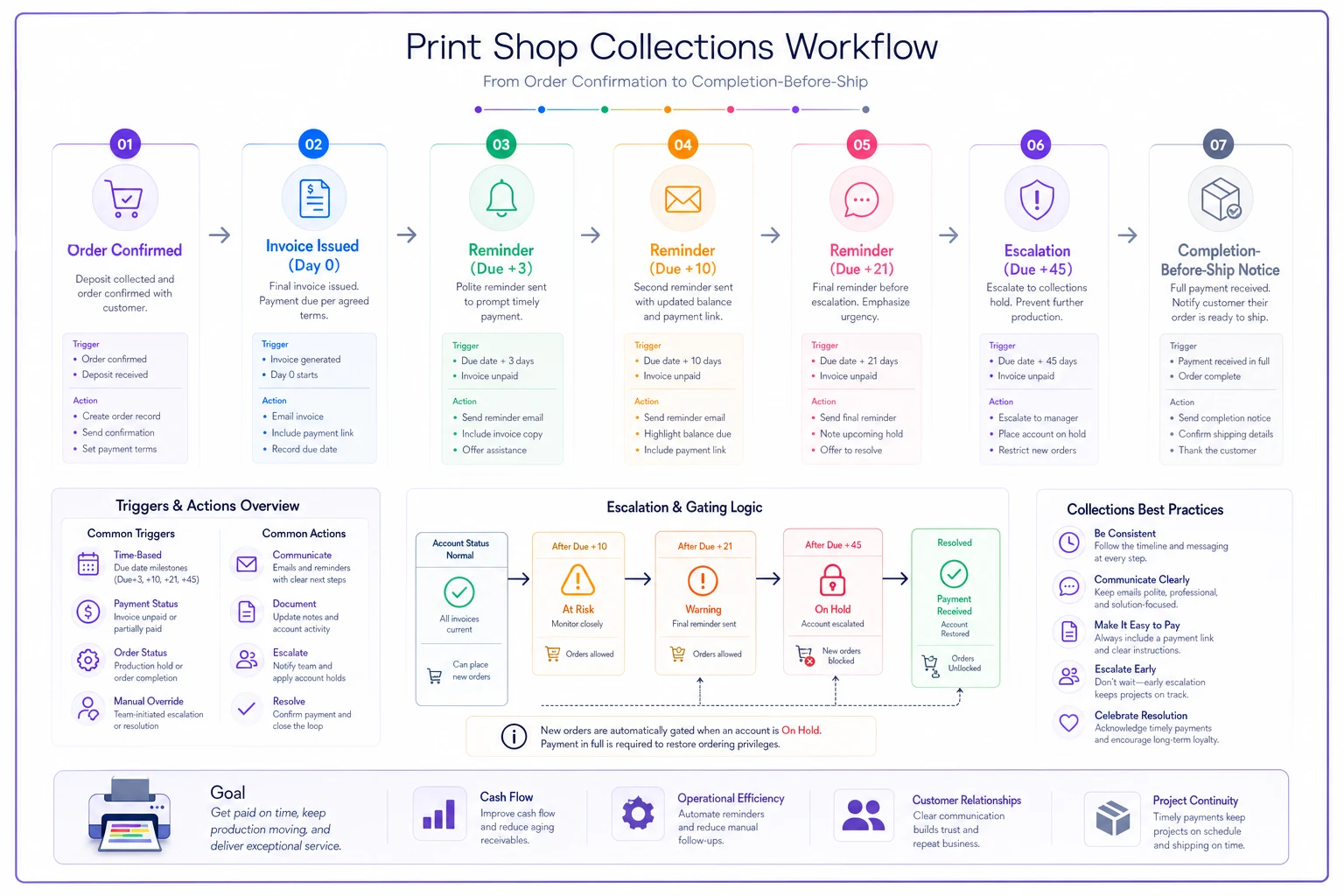
The step that does the most work is #5. Gating new orders is far more effective than late fees for repeat B2B customers, because they need you more than they care about the $40 late fee. A customer who owes you $6k and wants to place another $3k order will find the checkbook fast when the new job is on hold.
Sample templates
Keep these short. Long dunning emails get skimmed.
> Hi [Name] — quick note that invoice #[###] for [job] came due on [date]. If it's already on the way, ignore this. If not, here's the payment link: [link]. Thanks!
> Hi [Name] — invoice #[###] ([$amount]) is now 10 days past due. Per our order terms, balances over 10 days late put new orders on deposit-required status. We'd rather keep things moving normally, so please settle when you get a chance: [link]. Happy to talk if there's an issue on your end.
> Hi [Name] — invoice #[###] is now 3 weeks past due and I need to flag that we've placed [next job / any WIP] on hold until the balance clears. Give me a call at [number] today and we'll sort it out.
When to skip deposits entirely (and when not to)
When skipping deposits makes sense: high-frequency stock reorder accounts with a spotless multi-year history and small individual order sizes. Chasing a deposit on a $180 recurring business-card order from a client who's placed 40 orders is friction that costs you goodwill for no real risk protection.
When zero-deposit is a trap: any large-format, variable-data, or specialty-substrate job — regardless of relationship. The salvage value is zero. A ten-year client who suddenly cancels a $12k personalized mailing leaves you holding the exact same worthless inventory as a stranger would. Relationship reduces credit risk; it does not change salvage value. Keep those two ideas separate.
Who should not run loose terms at all: shops with thin margins and no working-capital cushion. If your net margin is in the 8–12% range, one $10k write-off wipes out the profit from roughly $80k–$100k of other work. You cannot afford to be anyone's bank. Understanding where your real margins sit — and which jobs actually carry the shop — is its own exercise; mapping true job cost into price bands will show you exactly how much a bad debt really costs you.
A short real scenario
A commercial shop doing mostly B2B work — somewhere in the $90k–$110k a month range — had no formal deposit rule. CSRs used judgment. Their accounts receivable over 60 days was sitting around $34k, most of it from four "good" repeat customers who'd slowly stretched their terms.
They did three things: put the matrix above on a laminated card at the counter, added the two-minute credit score to their intake process, and switched their collections language from apologetic to the gated-new-order approach. No fancy tools, just consistency.
Within about four months, over-60 AR dropped to somewhere near $11k. The interesting part wasn't the write-offs recovered — it was that two of the four slow-payers went back to paying inside terms once new orders started getting held. They weren't broke. They were just paying whoever chased them, and the shop had never really chased.
Making it actually stick
The hard part isn't designing these rules — it's applying them the same way every time, especially when the customer is standing at the counter being friendly. This is where a lot of shops fall down: the policy exists in a binder and gets overridden by whoever's working that day.
Automate the day +3, +10, and +21 reminders so follow-up happens consistently.
The practical fix is baking the rules into the order-entry step rather than relying on memory. When your order system flags the required deposit based on order type and pulls up the customer's payment history and open balance automatically, the CSR isn't guessing — the number is just there. Same with the collections sequence: reminders that trigger on their own at day +3, +10, and +21 do the follow-up that busy shops always let slide, and they do it in the same firm tone every time instead of depending on whoever remembers to send them. Automating the triggers while keeping judgment for the edge cases is the balance that actually holds up under a busy Monday.
None of this requires being aggressive with customers. It requires being consistent — because inconsistency is what teaches your best accounts that your deadlines are optional. Set the matrix, score before you extend terms, and let the collections flow gate future work instead of begging for past-due money. The margin you protect is almost always your own.
Ready to simplify your print shop operations?
Join 500+ print shops using GoInkly to save time, reduce errors, and improve customer satisfaction.