



The jump from one shop to two (or three, or six) is where a lot of print businesses quietly lose the margin they worked years to build. Not because demand dries up—usually the opposite. It's because the systems that worked fine when the owner could physically see everything suddenly can't tell you where a job actually got printed, which location ate the cost of the specialty stock, or why your "combined" P&L looks great while one site is bleeding.
Multi-site print shop operations aren't just "the same shop, twice." The moment you add a second location, you're running a small internal economy. Jobs move between sites. Inventory gets borrowed. One location quotes work another one produces. And if you don't build explicit rules for how those things happen—and how they get settled financially—you end up with a very common outcome: the network is profitable in aggregate, but you have no idea which parts are dragging and which parts are carrying.
This is a systems piece, not a tips list. The goal is to give you a working mental model for what should live at HQ, what should stay at each site, how data should flow, and how to reconcile the money so per-site profit is actually trustworthy.
The core tension: centralize for consistency, localize for speed
Every decision in a networked print operation comes down to one trade-off. Centralizing gives you consistency, buying power, and cleaner reporting. Localizing gives you speed, ownership, and responsiveness to the local customer base. Nobody wins by picking one extreme.
What breaks most first-time multi-site owners is treating this as a single decision instead of a per-function decision. Quoting, inventory, spare parts, scheduling, purchasing—each one has a different right answer, and that answer changes as you scale.
The pattern worth internalizing: centralize the things where inconsistency costs you money or trust; localize the things where latency costs you a job.
A function-by-function decision framework
Below is how the trade-off tends to shake out across the functions that matter most. Treat the "default" column as a starting position, not gospel—your equipment mix and geography will shift things.
Eliminate order confusion and delays.
GoInkly helps you manage every print order efficiently from submission to delivery.
- Centralized order tracking
- Production workflow management
- Inventory and supply monitoring
No credit card required
| Function | Centralize | Localize | Sensible default |
|---|---|---|---|
| Quoting logic / pricing bands | Rules, price bands, margin floors | Local adjustments within guardrails | Central rules, local discretion within a band |
| Finished-goods inventory | Slow-moving, specialty stock | Fast-moving, high-turn stock | Hybrid: fast local, specialty pooled |
| Spare parts | Expensive, rarely-used parts | Consumable wear parts | Critical-path parts local, long-tail central |
| Raw material purchasing | Contracts & vendor negotiation | Emergency top-ups | Central contracts, local emergency buys |
| Production scheduling | Cross-site load balancing | Day-to-day sequencing | Local scheduling, central overflow routing |
| Customer data & order history | Always | Never fully siloed | Central, with local access |
The one row people get wrong most often is spare parts. There's a strong instinct to centralize all spares to "save money" by not stocking duplicates. But the cost of a duplicated $80 fuser roller is nothing compared to a press sitting idle while a part ships between locations. Stock the parts that live on your critical path at every site. Pool only the expensive, long-tail items that rarely fail.
Quoting: the case for central rules, local hands
Quoting is where centralize-vs-localize gets emotional, because your senior estimators at each site have opinions and, often, decades of experience. The mistake is either fully centralizing quoting into a bottleneck at HQ, or letting each site freelance and produce three different prices for the same job.
The workable middle: centralize the logic—your setup, run, and finishing bands, your margin floors, your material markups—and let each site apply local judgment inside those guardrails. If your pricing framework says a job's floor is $0.14/unit, a local estimator can quote $0.16 to win a relationship customer, but can't quietly go to $0.11 because they "wanted the volume."
The reason this matters more at scale: when a customer gets quoted by two of your locations and sees a 30% gap, you don't look like a company with flexibility—you look like a company that doesn't know its own costs. That's a trust problem, and trust problems in print are expensive because so much work is repeat.
Inventory: the federated model
"Federated inventory" just means each site holds its own stock but the network sees all of it. The value shows up when Site B is out of a 100lb gloss cover that Site A has forty sheets of sitting idle. Without visibility, Site B places a rush order—premium pricing, expedited freight—while identical stock gathers dust twenty miles away.
The failure mode isn't lack of stock, it's lack of shared visibility into stock. Most two-and-three-location shops run each location on its own spreadsheet or its own instance of the MIS, and the only way to know what another site has is to call and ask. That phone call doesn't happen when things are busy, which is exactly when you need it.
-
Each site owns and counts its own inventory
-
All sites can see network-wide availability in real time
-
Transfers between sites are logged as transfers, not as consumption or new purchases
-
Slow-moving specialty stock is deliberately concentrated to reduce total carrying cost
That last point is the quiet win. When you have visibility across sites, you can stop stocking the same rarely-used specialty substrate at all three locations and instead hold it at one, because you know you can transfer it in a day. Carrying cost drops without stockout risk climbing.
Require transfers to be logged at the moment stock leaves the sending site to avoid reconciliation headaches later.
When you have visibility across sites, you can stop stocking the same rarely-used specialty substrate at all three locations and instead hold it at one, because you know you can transfer it in a day. Carrying cost drops without stockout risk climbing.
Data replication: what to sync, and what to leave alone
This is the part that gets skipped, and it quietly determines whether everything above actually works. You cannot make good centralize/localize decisions if your data model can't support them.
There are three broad patterns for how data flows in a multi-site setup, and picking the wrong one creates chaos that looks like a "people problem" but is actually an architecture problem.
1. Full central (single database, all sites connected). Everything lives in one place. Clean reporting, no reconciliation headaches, one source of truth. The risk: if connectivity drops at a site, they're dead in the water. For print shops with reliable internet this is usually the right call, and it's dramatically simpler than the alternatives.
2. Local-primary with central roll-up. Each site runs its own system, and data replicates upward on a schedule—nightly, hourly—for consolidated reporting. This is common in shops that grew by acquisition, where each location already had its own MIS. It works, but you inherit reconciliation problems. Two sites can assign the same job number, inventory counts drift, and your "network view" is always a few hours stale.
3. Hybrid: central master data, local transactional data. Customers, pricing rules, part numbers, and product definitions live centrally and push down to every site. Orders, production events, and inventory movements happen locally and roll up. This is the pattern that scales best for a growing network because it enforces consistency where you need it—everyone uses the same part numbers and price bands—while keeping day-to-day operations fast and local.
A concrete example of why master-data centralization matters: if Site A calls a substrate "12pt C2S" and Site B calls it "12pt Coated 2 Side" and Site C uses SKU "SUB-0412," you cannot build a network inventory view. You'll spend more time reconciling naming than actually managing stock. Central master data kills that problem at the source.
The rule of thumb: replicate definitions downward, replicate transactions upward, and never let two sites be authoritative over the same record.
This diagram summarizes the recommended data-flow patterns for master data and transactional data in a multi-site setup.
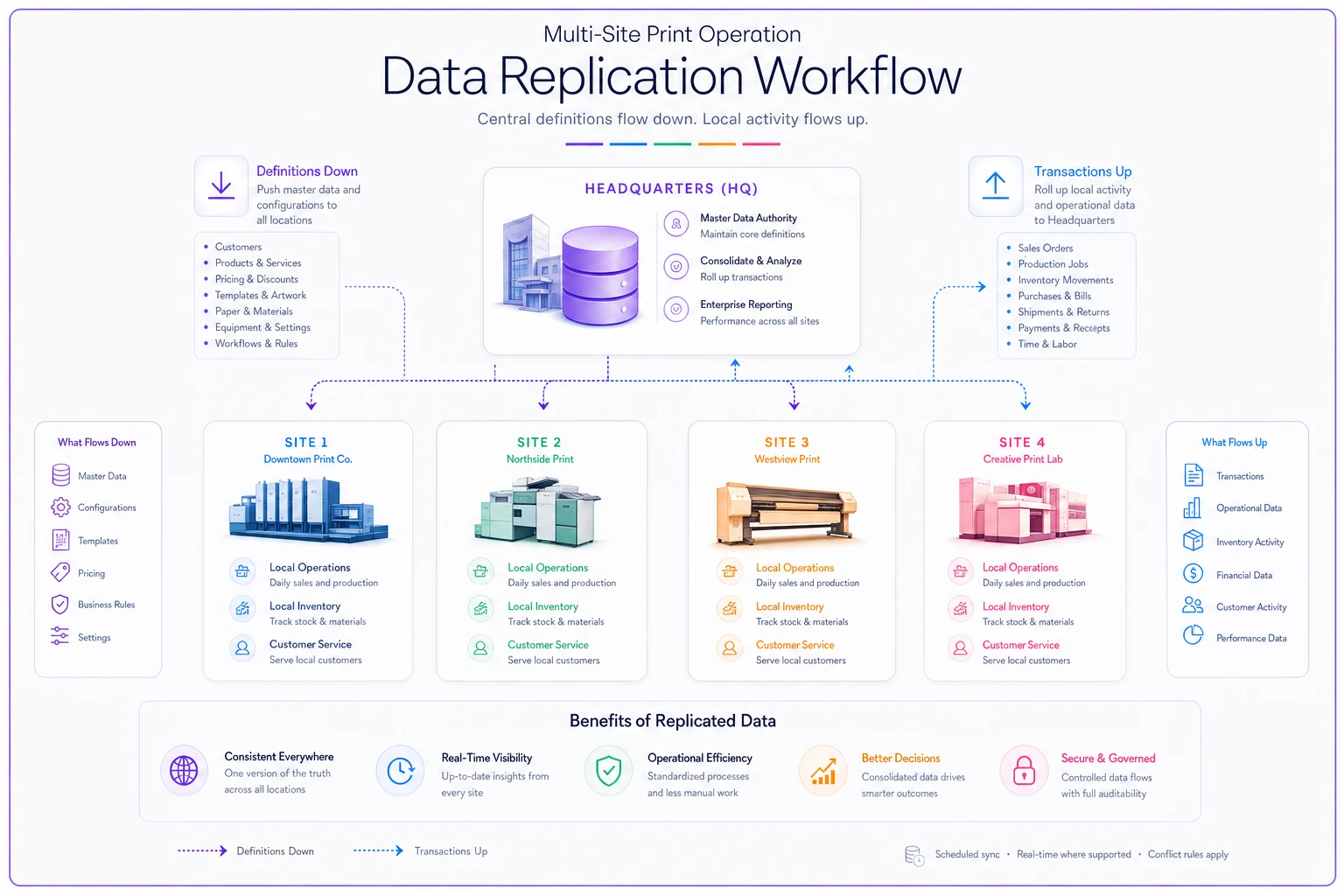
It shows master-data down, transactions up, and the three patterns described above.
The money: transfer pricing and settlement between sites
This is where multi-site operations get genuinely hard, and where most owners just... don't. They let costs and revenue pool into a combined P&L and hope. The result is a network that's profitable overall while one location quietly loses money every month, invisibly subsidized by the others.
To measure per-site profitability honestly, you need to decide how value moves between sites when they work together. Three flows need explicit rules.
Inventory transfers. When Site A ships stock to Site B, at what price? Options: at cost (simplest, keeps it clean), at cost plus a small handling charge, or at a "network price." For most shops, transfer at cost is the right answer. It keeps the transaction neutral and avoids one site profiting off another's shortage. Log it, don't mark it up.
Production transfers (one site quotes, another prints). This is the big one. Say your downtown location wins a 5,000-piece booklet job but doesn't have the right binder—it goes to your production site. Who books the revenue? Who books the cost? Without a rule, you get double-counting or, worse, both sites claiming the margin.
The clean approach is an internal transfer price. The selling site keeps the customer relationship and a sales margin; the producing site gets credited for the production work at an agreed internal rate. Something like: producing site is credited its standard production cost plus a modest internal margin (say 10–15%), and the selling site keeps the difference between customer price and that internal transfer price.
Shared overhead. Central functions—shared purchasing, a central prepress team, corporate admin—cost money that has to land somewhere. Allocate it by a driver that reflects usage: revenue share, job count, or production hours. Pick one, document it, and don't change it mid-year or your trend data becomes meaningless.
A worked reconciliation example
Downtown (selling site) wins a job. Production site prints it.
| Line | Downtown (selling) | Production site |
|---|---|---|
| Revenue booked | $4,200 | — |
| Internal transfer charge (paid to production) | –$2,912 | +$2,912 (internal revenue) |
| Production cost | — | –$2,600 |
| Net margin | $1,288 | $312 |
Downtown keeps $1,288 for the relationship, the sale, and the risk. The production site clears $312 for the physical work. Combined network margin: $1,600—which matches the real economics ($4,200 − $2,600). No double-counting, both sites are fairly credited.
The point isn't the exact 12%. It's that you pick a rule and apply it every time, so at month-end you can look at each site and know whether it's actually making money on its own book of work.
Reconciling at month-end without losing a weekend
A process that keeps multi-site reconciliation to a few hours rather than a multi-day forensic exercise:
-
Pull each site's transaction log for the period—orders, production events, inventory movements, transfers.
-
Match every inter-site transfer to its counterpart. Every "shipped from A" must have a "received at B." Unmatched transfers are your first red flag—usually stock that moved physically but never got logged.
-
Apply transfer pricing to all production transfers using your fixed rule. Confirm the selling-site charge equals the producing-site credit for each job.
-
Reconcile inventory counts against the ledger. Physical count minus (opening + received − consumed − transferred out) should be near zero. Persistent gaps at one site point to a logging discipline problem.
-
Allocate shared overhead by your chosen driver.
-
Produce a per-site P&L and compare against the network total. The sum of site nets, minus central overhead, should tie to the consolidated number. If it doesn't, you have an unmatched transfer or a double-booked job somewhere in steps 2–3.
The reason this stays fast is that all the hard decisions—transfer price, overhead driver, part numbering—were made upstream. Reconciliation should be mechanical. If it turns into a debate every month, that's a signal your rules aren't actually fixed.
KPIs to track per site (not just per network)
Network-level numbers hide problems. A 22% combined net margin can mask one site at 31% and another at 9%. You want per-site visibility on:
-
Net margin per site (after transfer pricing and allocated overhead—this is the number that reveals the subsidized location)
-
Revenue mix
self-produced vs. transferred-out vs. transferred-in
(a site that transfers out most of its wins might be a great sales office but a weak production floor, or vice versa) -
Inventory turns per site (slow turns at one location often mean it's over-stocking things it could pull from the network)
-
Spare-parts-driven downtime hours (tells you whether your centralize/localize call on parts is actually working)
-
Quote consistency variance (spread between sites on comparable jobs—rising variance means your central pricing rules are being ignored)
-
Transfer cycle time (how long from "requested" to "received" between sites—this number quietly caps how aggressively you can centralize inventory)
If you're building this from scratch, it's worth grounding the per-site view in the same capacity and cost logic you'd use for a single shop. The thinking in mapping capacity and true job cost into price bands and hire triggers applies per location before you roll anything up, and the broader KPIs and capacity model every profitable print shop should track give you the single-site foundation these network metrics sit on top of.
When to centralize more (and when to stop)
Centralize more when:
-
You're seeing pricing inconsistency across sites that's costing you customer trust
-
The same specialty stock is sitting at multiple locations, dead
-
Purchasing volume is fragmented and you're leaving vendor discounts on the table
-
Reporting takes days because every site formats data differently
Keep it local when:
-
Centralizing a function adds latency to a customer-facing decision
-
A site has genuinely different local demand that central rules can't capture
-
The critical-path spare part would sit hours away from a downed press
-
The overhead of coordination exceeds the savings (very common at exactly two locations)
Who should probably not centralize aggressively: shops at two locations that grew organically and still have the owner involved daily in both. At that scale, heavy central infrastructure is often more overhead than it's worth. Centralize pricing rules and part numbering—the cheap, high-leverage stuff—and leave the rest local until a third or fourth site forces the issue.
A real scenario
A commercial shop running three locations across a metro area—two storefront/quick-turn sites and one larger production plant—had a combined net margin that looked healthy, somewhere in the low 20s. On paper, fine.
The problem: no transfer pricing. When a storefront won a big job it couldn't run, it pushed the work to the plant and both sites informally "counted" it. Inventory moved between locations by text message. Nobody could say which site actually made money.
They did three things. First, they set master data centrally—one part list, one price-band structure—so the three sites stopped speaking different languages. Second, they set a transfer price for production work: producing site credited at cost plus roughly 12%. Third, they started matching every inter-site transfer at month-end instead of trusting memory.
The per-site P&L that fell out was uncomfortable. One storefront that everyone assumed was the star turned out to be running close to break-even on its own book—it was winning work and shipping almost all of it to the plant, keeping thin margin. Its real value was as a sales front, not a producer. The plant, quietly, was carrying most of the network's actual profit.
Nothing about the business changed physically. But once they could see it, they repriced the storefront's transferred work, tightened its local inventory (it had been stocking substrate it always ended up shipping to the plant anyway), and pushed more self-produced quick-turn work through it. Within a couple of quarters that location's standalone margin moved from near-zero into the double digits, and the combined number ticked up a few points—not from new revenue, but from finally understanding where the money was already being made.
The takeaway
Running multiple print locations well isn't about copying your best shop three times. It's about deciding, function by function, where consistency beats speed—and then building the data flows and settlement rules that let you see the truth per site.
Centralize the definitions and the pricing logic. Localize the things that touch a customer or a downed press. Replicate definitions down and transactions up. And whatever you do, put an actual transfer price on the work that moves between locations, because a network you can't reconcile is a network that's quietly subsidizing its weakest site with the profits of its strongest—and you'll never fix what you can't see.
Running multiple print locations well isn't about copying your best shop three times. It's about deciding, function by function, where consistency beats speed—and then building the data flows and settlement rules that let you see the truth per site. Centralize the definitions and the pricing logic. Localize the things that touch a customer or a downed press. Replicate definitions down and transactions up. And whatever you do, put an actual transfer price on the work that moves between locations, because a network you can't reconcile is a network that's quietly subsidizing its weakest site with the profits of its strongest—and you'll never fix what you can't see.
Ready to simplify your print shop operations?
Join 500+ print shops using GoInkly to save time, reduce errors, and improve customer satisfaction.