



Most print shops don't lose money on the press floor. They lose it in the gaps — the space between when a customer says "yes," when the job ships, and when the cash finally clears. That whole stretch is your order-to-cash cycle, and in print specifically it's a minefield because almost every job is custom, half of them get changed mid-production, and a stubborn slice of customers treat "I didn't approve that" as a legitimate reason to call their bank.
If you run a shop, you already know the symptoms. Quotes that don't match the invoice. Deposits nobody collected. A $4,800 wide-format order that shipped six weeks ago and still shows "partially paid." And then the worst one — the chargeback that lands 40 days later, after the ink is dry, the substrate is spent, and the customer is unreachable.
Order to cash for print shops isn't one process. It's five or six connected controls that either reinforce each other or fail together. When one link is loose, the failure shows up somewhere downstream and looks like a totally different problem. What follows is a walk through how the whole chain works, where it breaks, and how the pieces need to connect so disputes stop turning into losses.
Start with the quote, because that's where disputes are actually born
A chargeback almost never starts at the payment. It starts at the quote — specifically, at the moment your quote and your final invoice stop agreeing with each other.
The pattern is extremely common: a shop quotes flexibly. The estimator eyeballs a job, gives a "ballpark," maybe writes it on a proof or says it over the phone. Then production reality kicks in — the customer wanted a heavier stock, added a bleed, bumped quantity from 250 to 400 — and the invoice comes out different. To you, that's obvious. To the customer's memory (and to their credit card company), it looks like you charged more than agreed.
The fix is boring but it works: price bands instead of freehand quoting. You define tiers where pricing is fixed and documented, and any move between tiers is an explicit, logged change — not a surprise on the invoice.
A simple band structure for a business-card or flyer product might look like this:
| Quantity band | Unit price | Setup fee | Deposit required | Change re-quote trigger |
|---|---|---|---|---|
| 100–499 | $0.42 | $35 | 50% | Any stock or size change |
| 500–999 | $0.31 | $35 | 50% | Stock, size, or +100 qty |
| 1,000–2,499 | $0.24 | $0 | 30% | Stock, size, or finish |
| 2,500+ | Custom quote | Custom | 30% | Any spec change |
The exact numbers will differ by equipment and market. The point is that when a customer jumps from 400 to 600 pieces, your system knows they crossed a band, re-prices automatically, and records that the change happened and was accepted. That paper trail is your entire defense when a dispute lands later.
If you want to go deeper on how these bands should tie back to your real capacity and job cost, that connection is the whole subject of mapping capacity and true job cost into price bands. Bands built on gut feel instead of costed data cause a different, slower kind of bleed — you win the dispute but the job was never profitable to begin with.
Deposits and credit rules: your first and cheapest form of dispute insurance
A deposit does two things at once. It funds your materials, and it psychologically commits the customer to the order. A customer who's paid 50% up front almost never files a frivolous chargeback — they've got skin in the game and they want their product.
Eliminate order confusion and delays.
GoInkly helps you manage every print order efficiently from submission to delivery.
- Centralized order tracking
- Production workflow management
- Inventory and supply monitoring
No credit card required
The mistake most shops make is treating deposit rules as something they extend or withhold based on how the conversation is going. "Oh, they seem nice, I'll waive it." That inconsistency is exactly what burns you, because the customers who feel comfortable skipping a deposit are disproportionately the ones who'll dispute later.
-
New customer, custom job → deposit non-negotiable, 50% for anything below your setup-fee threshold, 30% above it.
-
Repeat customer, good history → deposit can drop or convert to net terms once they've cleared, say, three clean invoices.
-
Any rush job → deposit regardless of history, because rush work eats capacity you can't easily resell if they walk.
-
Reorders of an existing approved file → lower risk, deposit optional.
The deeper mechanics of who gets credit, how to run a lightweight check, and how collections should flow are worth their own read — we covered that in the piece on deposit and credit rules that protect margins. What matters at the systems level is this: the deposit rule and the credit rule have to know about each other. A customer on net-30 terms shouldn't also be getting hit with a deposit demand, and a first-timer shouldn't be able to slide onto terms because someone at the counter liked them.
When those two rules live in different heads or different spreadsheets, you get a classic contradiction — a customer who's simultaneously "trusted enough for terms" and "risky enough for a deposit." That confuses everyone and makes your shop look disorganized right at the money moment.
Invoice timing is a control, not an afterthought
Something that surprises a lot of owners: when you invoice affects whether you get disputed at all.
Invoice too early — before the customer has the product in hand — and you're inviting a "this isn't what I ordered" argument while they can still change their mind. Invoice too late — weeks after delivery — and you've handed them time to forget the details, lose the proof, and question the total. Both extremes raise dispute risk.
-
Deposit invoice goes out the moment the quote is accepted and the job enters the queue. No deposit, no queue slot.
-
Progress invoice (for large or long-run jobs) triggers at a defined production stage — plates made, or first article approved.
-
Balance invoice goes out at shipment or pickup, not before and not a week after. It references the approved proof and the accepted quote by number.
-
Statement consolidates open balances for net-terms accounts on a fixed cycle, not randomly.
Each invoice should land at a moment when the customer's own actions confirm the charge. They approved the proof, so the balance invoice referencing that proof is hard to argue with. Timing your invoice to a customer confirmation event is one of the quietest chargeback controls there is — and almost nobody sets it up deliberately.
Invoice the balance at pickup/shipping and reference the approved proof number — that moment is hard to dispute.
The tighter approach ties invoice events to production milestones:
What breaks when you scale
At a couple thousand dollars a month in disputes, sloppy O2C is annoying. At scale, it becomes structural.
A shop doing 30 orders a month can hold the whole thing together with a sharp counter person who remembers everything. Push that to 200+ orders across multiple estimators, a couple of production shifts, and an online storefront feeding jobs in automatically, and the informal memory system collapses. Nobody can remember whether a deposit was collected on order #4471. The proof that would win a dispute is in someone's email, not attached to the job. Two estimators quote the same repeat customer differently and now your "price band" is effectively a suggestion.
The specific things that break, in rough order of how much they cost:
-
Proof-to-invoice linkage snaps. The approval and the charge live in separate systems, so when a chargeback hits you're digging through email to prove approval — and the clock on your bank's response window is already running.
-
Deposit collection becomes optional in practice. Not by policy, but because at volume nobody's checking that every queued job has its deposit. Jobs enter production unfunded.
-
Change orders stop getting re-quoted. The customer adds scope, the floor just does it to keep things moving, and the invoice quietly grows past what was ever agreed.
-
Aging invoices lose their story. By the time you chase a 60-day balance, the person who took the order is gone or doesn't remember, and you can't defend the amount.
None of these are new problems at scale — they exist at 30 orders too. They're just survivable when one person holds all the context. Growth doesn't create the weakness; it removes the human patch that was hiding it.
The dispute defense file: what you actually need when a chargeback lands
When a chargeback comes in, you usually have a short window — often 7 to 10 business days depending on the processor — to respond with evidence. Shops lose winnable disputes purely because they can't assemble the file fast enough.
For print, a strong evidence package is remarkably consistent. Keep these five things attached to every job, automatically, not manually:
-
The accepted quote, timestamped, with the price band and specs shown.
-
The approved proof, with the customer's approval action and time recorded.
-
The change log, showing any spec or quantity changes and that they were accepted.
-
The deposit and payment record, showing what was charged and when.
-
Proof of delivery — tracking, pickup signature, or a dated fulfillment record.
If those five live together and can be exported in one click, you win most disputes. If they're scattered across email, a POS, a proofing tool, and a shipping account, you'll lose winnable ones on speed alone.
This is the operational reason a lot of shops move O2C onto a single platform — not for the buzz, but because a dispute response is a coordination problem, and coordination is exactly what separate tools destroy. AI-assisted operational platforms help here not by doing anything flashy, but by keeping these records linked automatically so there's nothing to hunt for when the clock is running.
The customer-experience side of this — how proofs and SLAs are structured to prevent the dispute in the first place — connects directly to the order experience blueprint we covered on proofs, SLA rules and dispute workflows. The cleanest chargeback is the one that never gets filed because the customer had zero ambiguity about what they approved.
Ledger mappings managers actually need
This is the part that gets skipped, and it's the part your accountant quietly resents. Every event in the O2C cycle should map to a specific ledger treatment, or your books drift out of sync with reality and you can't trust your own margin numbers.
The mappings that matter most in a print shop:
| O2C event | Ledger treatment | Why it matters |
|---|---|---|
| Deposit received | Liability (unearned revenue) | It's not revenue yet — the job isn't done |
| Job completed / shipped | Recognize revenue, clear deposit liability | Revenue lands when you've earned it |
| Balance invoiced | Accounts receivable | Tracks what's actually owed |
| Materials consumed | COGS against the job | Ties true cost to the specific order |
| Chargeback filed | Contra-revenue / dispute reserve | Keeps a loss from silently vanishing into "sales" |
| Chargeback won | Reverse the reserve | Restores the revenue cleanly |
The most common error here is booking deposits straight to revenue. It feels good — the sales number looks bigger — but it overstates income, messes up your tax picture, and hides the fact that you're carrying obligations you haven't fulfilled. Deposits are a liability until the job ships. Treating them that way also makes your dispute reserve honest, so you can actually see what chargebacks are costing you over a quarter instead of finding out at year-end.
A short real-world scenario
A mid-sized shop running signage and wide-format — roughly 180 to 220 orders a month, three estimators, a web storefront — was eating somewhere around $2,500 to $3,500 a month in chargebacks and unrecovered write-offs. Not catastrophic, but enough to notice, and climbing.
When they traced it, almost none of it was fraud. It was structural. About half the disputed jobs had no deposit on file. A big chunk had proof approvals sitting in email that took days to locate. And a handful were legitimate re-price situations where a change order never got documented, so the customer genuinely didn't recognize the final total.
They didn't do anything exotic. They made deposits mandatory before a job could enter the production queue, forced every proof approval to attach to the job record, and set the balance invoice to fire at shipment referencing both. Within a couple of months, disputes didn't vanish — but the ones that came in were winnable, because the evidence was already assembled. Monthly losses dropped to a few hundred dollars, mostly genuine service issues rather than "he-said-she-said" gaps.
The interesting part wasn't the money saved. It was that estimators stopped spending afternoons hunting for old proofs, and end-of-month reconciliation stopped being a surprise.
When tightening O2C is worth it — and when it isn't
Not every shop needs the full apparatus tomorrow.
This is worth doing seriously when:
-
You're past roughly 50 orders a month and no single person can hold every job's status in their head.
-
More than one person quotes, so consistency isn't automatic.
-
You have an online storefront feeding jobs in without a human gatekeeper.
-
Chargebacks or write-offs are a recurring line item, not a rare event.
It's overkill when:
-
You're a one- or two-person shop with a handful of long-term repeat clients who pay reliably. Formalizing everything just slows you down.
-
Your work is nearly all reorders of pre-approved files, where dispute risk is genuinely low.
Who should NOT do this halfway: a shop that adds mandatory deposits but doesn't connect them to the production queue. If the rule exists on paper but jobs still enter production unfunded because nobody enforces it, you've added friction with none of the protection. Half a control is often worse than no control — it creates the illusion of a system while the leak keeps running.
Pulling it together
Order-to-cash in a print shop isn't a billing task. It's a chain: the quote sets the terms, the deposit funds and commits the customer, the invoice timing ties the charge to a moment the customer confirmed, the evidence file protects you when things go sideways, and the ledger keeps the whole thing honest.
Loosen any one link and the failure shows up two steps downstream wearing a disguise. The shops that stop losing money to chargebacks aren't the ones with better customers — they're the ones where these controls actually talk to each other. A proof approval, a balance invoice, and a deposit record all pointing back to the same job automatically means that when a dispute lands, the answer is already sitting there instead of scattered across four inboxes. Build the connections once, and most of the fights simply stop happening.
Here's a simple visual of the ideal workflow to help teams understand where each control sits and how they connect.
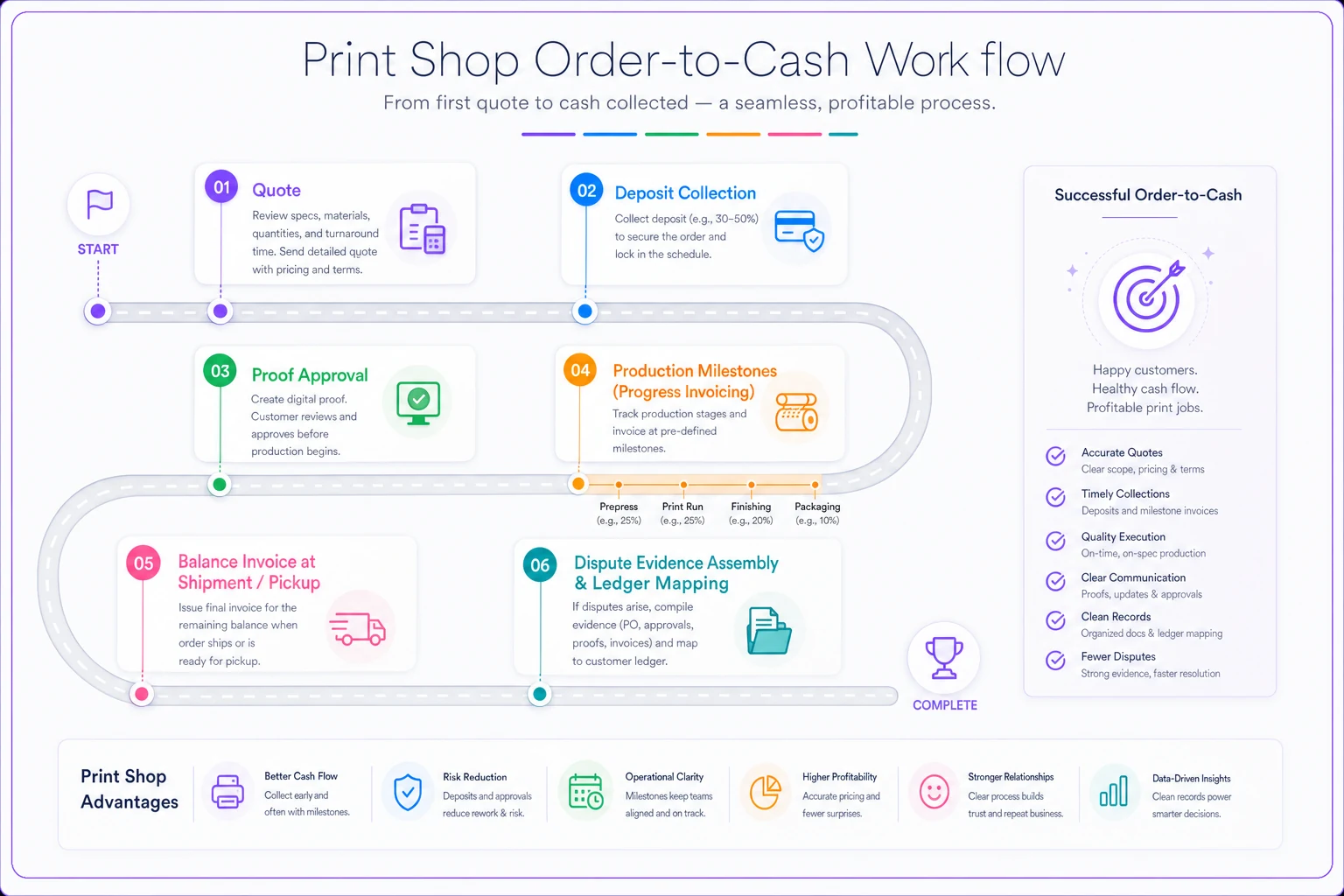
Use this as a reference when you map responsibilities — who collects deposits, who attaches proofs, who triggers invoices, and who owns the ledger entries.
Order-to-cash controls don't need to be flashy to work. They need to be consistent, linked, and automated where possible. That's how you stop chargebacks from turning into losses.
Ready to simplify your print shop operations?
Join 500+ print shops using GoInkly to save time, reduce errors, and improve customer satisfaction.