

Most print shops treat sustainability as a marketing afterthought — a recycling bin near the guillotine, a line on the website, maybe a badge someone downloaded. That's not a program. That's decoration. And when a customer's procurement team actually asks you to substantiate a "30% recycled content" claim, decoration falls apart fast.
The shops that actually get value out of sustainability treat it like job costing or scheduling: as a connected operational system. Scrap becomes an input, not just a cost. Substrate sourcing gets a documented playbook. Environmental numbers flow into the same reports managers already read every week. Built that way, sustainability stops being a cost center and starts protecting margin — and, increasingly, winning bids you'd otherwise lose on an RFP checkbox.
This is the full walkthrough of how that system fits together, where it breaks, and how to report it so the claims actually hold up.
Where the money is actually sitting
Before anything else, it helps to see scrap the way a materials engineer would, not the way an accountant does. Accounting treats waste as a sunk cost. Operationally, a lot of that waste still has value — it's just value you're throwing into a dumpster and, in many regions, paying a hauler to remove.
-
Makeready and setup sheets — perfectly good substrate, printed with garbage
-
Trim and offcuts — clean, unprinted or lightly printed stock cut away during finishing
-
Obsolete and misprint inventory — jobs that got rejected, versioned out, or over-ordered
A mid-size commercial shop running sheetfed offset and a couple of wide-format machines typically generates three broad waste streams:
The first stream is a process problem worth attacking directly. The mechanics of cutting make-ready waste with daily logs and changeover fixes are a whole discipline on their own, and this article assumes you're already working on that. The circular-economy piece is about what happens to the scrap you can't eliminate.
That's where most shops leave money sitting. Clean trim from a house sheet has a second life. So do misprints, once you stop thinking of them as failures and start thinking of them as raw material.
Scrap-to-product flows: the part almost nobody builds
The idea of turning scrap into sellable product sounds reasonable until you try to run it as a repeatable flow. The shops that succeed define the product first, then route scrap toward it. The shops that fail collect random scrap hoping to figure out a use later. That pile just becomes a different kind of clutter.
Eliminate order confusion and delays.
GoInkly helps you manage every print order efficiently from submission to delivery.
- Centralized order tracking
- Production workflow management
- Inventory and supply monitoring
No credit card required
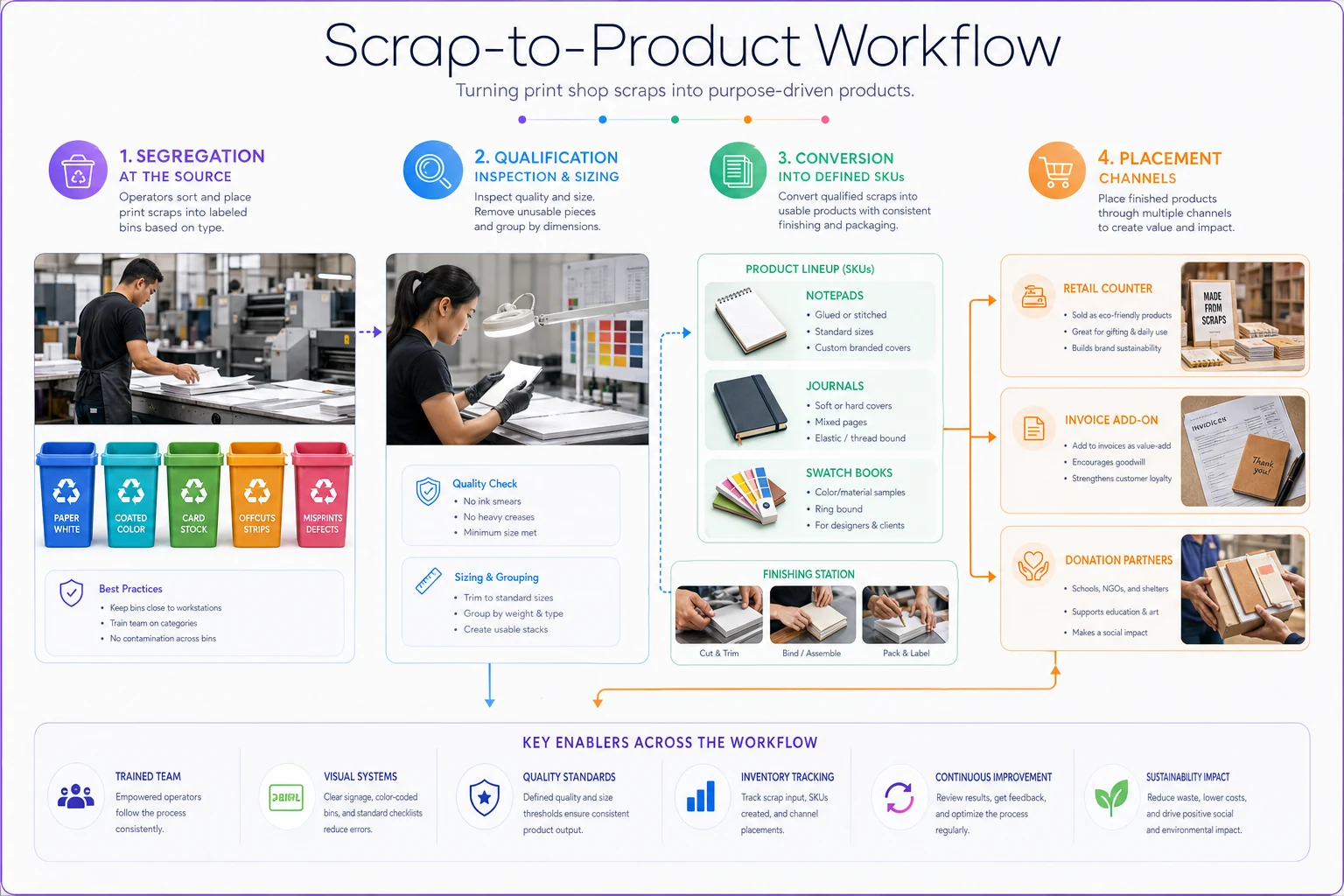
A workable scrap-to-product flow has four defined stages:
-
Segregation at the source. The operator who creates the offcut sorts it at that moment into labeled bins by stock type and size band. If sorting happens later, it never happens. This is the single biggest failure point.
-
Qualification. Someone checks the segregated stock against a spec — minimum usable dimension, acceptable print coverage, no coatings that break the downstream product. Trim smaller than your smallest product doesn't enter the flow; it goes to the recycler.
-
Conversion. Qualified scrap gets turned into a defined SKU. Common ones that actually sell: notepads and scratch pads from clean trim, small journals from misprint signatures, sample swatch books, gift tags, packaging inserts, kraft mailers cut from oversheet.
-
Placement. The finished product needs a home — a retail rack at the counter, an add-on line item on invoices, or a donation channel to schools and nonprofits. Donations generate a documented environmental and community claim even when they don't generate revenue.
Here's a quick visual of that flow.
A typical example: a shop pulls roughly 200–300 lbs of clean cover-weight trim a month. Converted into padded notepads sold at the front counter and bundled as freebies into larger orders, that stream generates something like $400–$700 in monthly revenue plus a credible "we don't waste stock" story. Not life-changing money. But it flipped a disposal cost into a small profit line, and the hauling cost itself dropped.
When this makes sense: you have consistent, predictable trim from house sheets and some finishing capacity during slow hours. When it's a bad idea: your scrap is wildly heterogeneous — dozens of stocks, coatings everywhere, no real volume in any single stream. Forcing a conversion program onto chaotic scrap just burns labor. In that case, focus on source reduction and clean recycling instead.
Sourcing reclaimed substrates without getting burned
The other half of circularity is buying recycled and reclaimed stock on the input side. This is where good intentions run into supply reality. Recycled substrates used to have serious consistency issues — runnability, color shift, dust, fiber variation batch to batch. That's improved a lot, but it hasn't disappeared, and it interacts directly with everything downstream in your shop.
A substrate change is never just a substrate change. A more absorbent recycled sheet shifts your color management targets, changes drying behavior, and can alter finishing. If your color SOPs and press profiles aren't updated when the stock changes, you'll blame the ink or the operator for problems that came from the paper.
-
Qualification runs before commitment. Never switch a house sheet to a recycled equivalent based on a swatch. Run a real qualification job at production speed, on your actual equipment, and log runnability, waste rate, and color deltas.
-
Batch consistency requirements written into the relationship, not assumed.
-
A defined fallback stock so a recycled-supply hiccup doesn't stop a job. Recycled and reclaimed streams are inherently less stable than virgin supply — treat lead-time and stockout risk seriously. The same discipline you'd apply in a supplier scorecard for consumables applies double here, because reclaimed supply is bumpier.
-
Certification chain documentation — you can only claim what you can trace.
That last point is where claims live or die. If you want to tell a customer a job is 100% post-consumer recycled, you need the paper mill's certification, the distributor's chain-of-custody, and your own internal records tying that stock to that job. No paper trail, no claim.
Supplier clauses that make recycled content real
Verbal assurances from a sales rep mean nothing when a customer's sustainability auditor shows up. The recycled-content story needs to be contractual. You don't need a lawyer to draft twelve pages — just a handful of clauses in your purchase terms that suppliers actually acknowledge.
The clauses that matter:
| Clause | What it locks down | Why it matters operationally |
|---|---|---|
| Recycled content minimum | Stated % post-consumer / pre-consumer content per batch | This is the number you'll pass to customers — it must be guaranteed, not typical |
| Certification provision | Supplier provides FSC/PCF/recycled certs with each shipment | Your claim is only as good as the doc trail behind it |
| Batch traceability | Lot numbers tied to certs | Lets you connect a specific job to specific certified stock |
| Substitution notice | Supplier must notify before swapping mill or grade | Prevents silent changes that break your color profile and your claims |
| Nonconformance remedy | What happens when content or quality misses spec | Turns a vague complaint into an enforceable fix |
The substitution-notice clause is the one shops forget and then regret. Distributors swap mills quietly all the time when supply tightens. If your "recycled" sheet quietly becomes a different grade mid-contract, your customer claims are now inaccurate and you didn't even know. One clause prevents that entire category of problem.
Simple environmental accounting that a manager can actually run
This is where most sustainability programs collapse: measurement is either nonexistent or so elaborate that nobody keeps it up. You don't need a life-cycle-assessment consultant to start. You need a few tracked quantities and consistent capture.
-
Waste diverted from landfill (lbs/month) — recycled + reused + donated
-
Recycled-content substrate purchased (as % of total substrate spend or weight)
-
Scrap-to-product revenue ($ and lbs converted)
-
Disposal cost avoided (hauling fees you no longer pay)
-
Energy or consumable reductions if you're tracking them
Keep the capture where the data already lives. Diverted weight comes off the same scales and bins your finishing team already touches. Recycled-content percentage comes straight off purchase records. Disposal-cost-avoided comes off your hauler invoices — compare tonnage this quarter versus last.
Net program value = (scrap-to-product revenue + disposal cost avoided + deals won attributable to claims) − (added labor + recycled substrate premium + program admin time)
A worked example. A shop invests roughly 6–8 labor hours a week converting trim and managing the recycling flow — call it $9k–$12k a year loaded. Against that: about $500/month in scrap-product revenue (~$6k), roughly $200/month in reduced hauling (~$2.4k), and a recycled-substrate premium that costs maybe $3k more a year than virgin stock. On hard numbers, that's close to breakeven. The real return shows up in the deals column: even one or two contracts won or retained because you could document sustainability credentials swamps everything else in the calculation.
Keep diverted-weight capture and recycled-content logging in the systems your finishing and purchasing teams already use to avoid extra admin work.
Don't sell the internal team on scrap notepads paying the bills. Sell them on breakeven operations plus a genuine competitive edge on bids.
Where this breaks as the shop scales
At a single-shift, owner-involved shop, a sustainability program survives on the owner caring about it. That doesn't scale. Three failure points show up reliably as volume and headcount grow:
Segregation discipline decays. New operators, night shift, temp help — nobody sorts scrap at the source unless it's built into standard work and someone checks. Within a couple months of slipping, your clean trim stream is contaminated and the conversion program silently dies.
Claims drift from reality. Marketing keeps saying "30% recycled" while purchasing quietly switched to a cheaper grade during a price spike. Now your public claim is false and nobody connected the two departments. That's a compliance and reputation problem waiting to surface.
Reporting becomes guesswork. Managers get asked for impact numbers, can't find them, and reconstruct estimates from memory the night before a review. Estimated sustainability numbers are worse than none — they collapse under one pointed question.
The fix for all three is the same: sustainability data has to live in the same operational system as everything else, not in a separate spreadsheet someone owns as a side project. When diverted-weight capture, substrate purchase records, and job-level material sourcing are part of your normal production and inventory workflow, the reporting builds itself and claims stay tied to reality. This is the same principle behind why finished-goods handling works better when it's systematized — the way structured packing and shipping workflows capture data as a byproduct of the work rather than as an extra step. Sustainability tracking should work the same way: a byproduct of production, not a separate chore.
AI-assisted operational platforms help here in a quiet, unglamorous way — flagging when purchased recycled content drifts below what your active customer claims require, rolling up diverted-weight logs into a monthly figure without someone re-keying it, and warning a manager when a substrate substitution affects an open job with a stated recycled-content commitment. Not the exciting part. The part that keeps the program honest at scale.
Customer-facing claims: the checklist that keeps you honest
Sustainability claims are getting scrutinized harder every year, and vague green language now does more harm than good. A claim you can't back up isn't just useless — it's a liability. Before any environmental claim goes on a quote, a proof, a website, or a case study, run it through this:
-
[ ] The claim states a specific, measurable attribute (not "eco-friendly" but "printed on 100% post-consumer recycled stock")
-
[ ] You hold supplier certification documents supporting it
-
[ ] The claim is tied to a specific job or product, not the whole shop vaguely
-
[ ] Batch/lot traceability connects the certified material to the delivered order
-
[ ] Any percentage is the guaranteed minimum, not the typical value
-
[ ] The claim distinguishes post-consumer vs pre-consumer content where relevant
-
[ ] Someone can produce the paper trail within a day if a customer's auditor asks
-
[ ] The claim gets re-verified whenever the substrate or supplier changes
That last box is the one that fails silently. A claim that was true in January quietly becomes false in June when purchasing switched grades. Tie claim re-verification to substrate changes and you close the biggest gap.
Reporting templates managers can actually communicate with
Internal tracking and external communication are two different reports, and mixing them up weakens both. Your manager's monthly ops report needs raw operational truth. Your customer-facing impact summary needs clean, defensible highlights.
Internal monthly rollup should carry: total diverted weight, breakdown by stream (recycled/reused/donated), recycled-content purchase %, scrap-product revenue and volume, disposal cost trend, and any nonconformance events with suppliers. This is the working document — messy is fine.
Customer-facing impact summary — whether it's a line on an invoice, an annual review deck, or a website figure — should carry only what you can fully defend: "This year we diverted approximately X lbs from landfill" or "Roughly Y% of substrate purchased was certified recycled content." Ranges and approximations are fine and actually read as more credible than suspiciously round figures. What matters is that every number traces back to the internal rollup, which traces back to source records.
A simple cadence that works: capture continuously at the source, roll up monthly for management, publish quarterly or annually for customers. Don't publish faster than you can verify.
A real scenario
A regional shop doing commercial and short-run book work — roughly 14 people, two shifts — kept losing bids to a larger competitor with a polished sustainability page. Their scrap went straight to a single mixed dumpster, and they had no way to answer procurement questionnaires asking about recycled content and waste diversion.
They didn't do anything dramatic. They set up source segregation at three finishing stations, qualified a recycled house sheet through an actual production run, added recycled-content and substitution-notice clauses to their two main paper suppliers' terms, and started logging diverted weight off a scale they already had. Conversion was limited to one product — padded notepads from cover trim — sold at the counter and bundled into orders.
Over the first year, they diverted somewhere around 3,000–3,500 lbs from landfill, trimmed hauling costs modestly, and generated maybe $5k–$6k in notepad revenue. On pure hard numbers, the program roughly covered its added labor — essentially a wash. The real return came from being able to answer procurement questionnaires with documented figures and certification chains. They credited that capability with landing two contracts they'd previously been screened out of entirely. The program paid for itself operationally and earned its keep on the sales side.
Making the pieces work together
The reason so many print-shop sustainability efforts fizzle is that each piece gets built in isolation — a recycling bin here, a green claim there, a substrate swap nobody documented. As a connected system, the pieces reinforce each other: source segregation feeds the scrap-to-product flow, supplier clauses make claims defensible, environmental accounting proves the ROI, and clean reporting turns all of it into something a customer can trust and a manager can stand behind.
Start where the data already flows and the scrap is already predictable. Build segregation into standard work before you build conversion products. Get the supplier clauses in writing before you make public claims. Keep the reporting close to the operation so it stays accurate as you grow.
Done that way, a sustainability program stops being a cost you tolerate and becomes an operational advantage you can actually measure — and defend.
Ready to simplify your print shop operations?
Join 500+ print shops using GoInkly to save time, reduce errors, and improve customer satisfaction.