
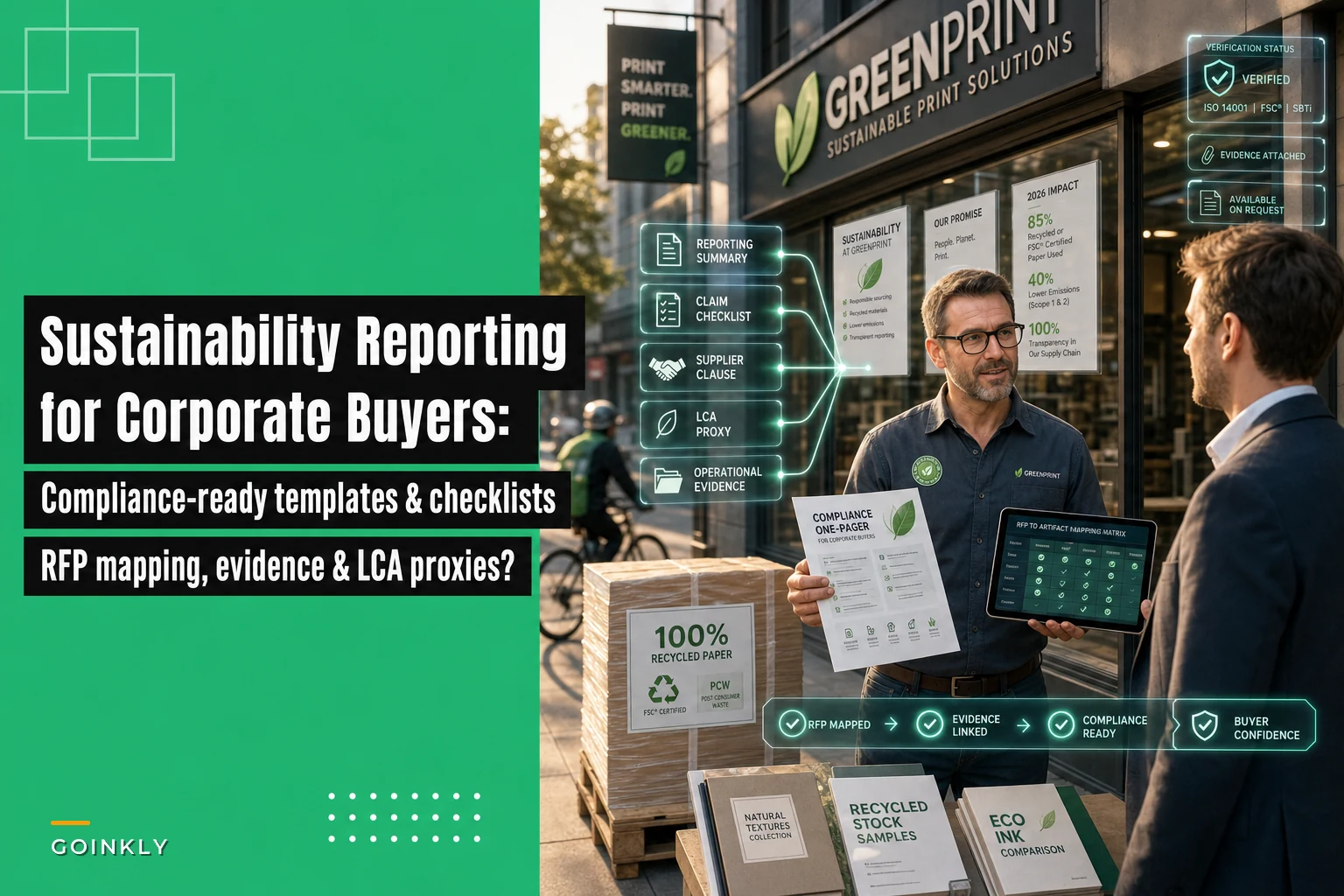

The moment a print shop starts chasing contracts with hospitals, universities, banks, or any company with an ESG team, the game changes. You're no longer competing on turnaround and price alone. Somewhere in the RFP there's a section — usually buried around question 40-something — that asks about your environmental practices, written in a language most shops have never spoken.
The frustrating part isn't that the questions are hard. It's that they're vague on purpose, and the buyer's compliance team will reject anything that reads like marketing. "We use eco-friendly inks" gets you nowhere. "FSC-certified stock available on request" gets you nowhere. What they want is a verifiable claim, mapped to their own scoring rubric, with evidence attached.
This post is about building that evidence package once, so you stop scrambling every time a procurement portal spits out a sustainability questionnaire. Not a broad green playbook — if you want the operational waste-reduction side, we covered that in the print shop sustainability playbook. This is specifically about the paperwork that wins eco-conscious contracts.
Why your "green" answers keep getting marked incomplete
A shop fills out the RFP environmental section honestly, using the language they'd use with a walk-in customer. The procurement reviewer isn't a printer — they're scoring against a checklist that assigns points for substantiated claims only. An unsubstantiated claim scores zero, sometimes worse, because some procurement rubrics actively penalize vague environmental language as a greenwashing risk.
So you lose points not because you're not sustainable, but because you can't prove it in their format.
A common example: a shop answers "we recycle paper waste" on a municipal bid. The reviewer needs a diversion rate, a waste hauler name, and ideally a tonnage figure for the last 12 months. The shop has none of that documented, so the answer is scored as "claim without evidence." Meanwhile a competitor attaches a one-page waste summary with actual numbers and wins the two points that break the tie.
The core problem is a mismatch between how printers talk about sustainability and how buyers audit it. Buyers think in claims, evidence, and verification. You need to translate your real operations into that structure.
The three documents procurement actually scores
Across the RFPs that touch sustainability, the requests collapse into three artifact types. Build these three and you'll cover the vast majority of what gets asked.
Eliminate order confusion and delays.
GoInkly helps you manage every print order efficiently from submission to delivery.
- Centralized order tracking
- Production workflow management
- Inventory and supply monitoring
No credit card required
| Artifact | What the buyer uses it for | What kills the score |
|---|---|---|
| Environmental reporting summary | Scoring your operational footprint and waste practices | Round numbers with no source, no time period |
| Verified-claim checklist | Confirming each green claim is backed by proof | Claims like "sustainable" with no certification or method |
| Buyer-facing one-pager | Attaching to the bid as a quick-reference credential | Marketing tone, logos instead of data |
The mistake most shops make is treating these as one document. They write a single "sustainability statement" and paste it into every bid. Procurement teams can spot a generic statement instantly, and it rarely maps to their specific questions. The reporting summary, the claim checklist, and the one-pager each serve a different reader inside the buyer's org — operations, compliance, and the evaluator doing the scoring.
Start with the verified-claim checklist
Before you write anything buyer-facing, inventory every environmental claim your shop might make and attach a verification method to each one. If a claim can't be verified, you either drop it or go get the proof.
A workable claim gets three columns: the claim, the evidence source, and the verification level. Verification levels matter because buyers weight them differently — a third-party certification outscores a self-declared number every time.
Claim checklist (build this in a spreadsheet first):
-
FSC / SFI certified stock — evidence
chain-of-custody certificate number, invoices showing certified stock — verification: third-party
-
Recycled-content paper — evidence
supplier spec sheet showing post-consumer waste (PCW) percentage — verification: supplier-documented
-
Vegetable/soy-based inks — evidence
SDS sheets and supplier product data — verification: supplier-documented
-
Waste diversion rate — evidence
hauler reports, recycling pickup logs — verification: self-measured with records
-
Energy practices — evidence
utility bills, LED retrofit invoices — verification: self-measured
-
Chemistry reduction — evidence
processless/low-chem plate purchase records — verification: self-measured
The discipline here is brutal and useful. The first time a shop builds this, they usually find two or three claims they've been making casually that they can't actually back up. Better to find that in your own spreadsheet than in a procurement audit after you've won the contract and they ask for records you don't have.
One thing worth flagging: recycled-content claims collapse constantly because shops conflate "recyclable" with "recycled content." These are completely different claims. Recyclable means the product can be recycled after use. Recycled content means a measured percentage of the paper came from recovered fiber. A buyer asking for recycled content wants a PCW percentage on the spec sheet, not a reassurance that the brochure can go in a blue bin.
Lock down recycled-content with supplier clauses
The claim checklist exposes your weakest link fast: you're only as verifiable as your suppliers' documentation. If your paper rep can't hand you a spec sheet with a stated PCW percentage, you can't make the claim, period.
Fix this at the purchasing level by writing recycled-content requirements into how you buy. You don't need a lawyer for most of this — you need a standing requirement that certain SKUs come with documentation, and a place to file it. This ties directly into how you evaluate and track vendors, which we broke down in the supplier scorecard for print consumables. Add a sustainability-documentation column to that same scorecard.
Practical clause language to request from paper and ink suppliers:
-
Supplier shall provide, per SKU, the post-consumer recycled content percentage and any FSC/SFI/PCF certification numbers.
-
Supplier shall furnish current chain-of-custody certificates on request and notify within 30 days if certification lapses.
-
Supplier shall provide SDS and product data sheets for all inks and coatings supplied.
-
Documentation shall accompany the invoice or be retrievable by lot/order number.
The operational benefit goes beyond bids. When a buyer does a mid-contract audit — and the larger institutional buyers do — you can pull certification by order number instead of calling your rep in a panic. Shops that skip this step end up recreating documentation retroactively, which is exactly where fake-looking records and greenwashing accusations come from.
Simple LCA proxies when you can't afford a real one
A full life-cycle assessment costs more than most small shops will ever justify for a single bid. The good news: most RFPs don't actually require a certified LCA. They want directional evidence that you understand and can estimate your impact. That's where proxies come in.
A proxy is a defensible estimate using published emission factors instead of a commissioned study. The key is showing your method and citing your source, so the number reads as an honest estimate rather than a made-up figure.
Usable proxies for a print job:
-
Paper footprint — use published kg CO₂e per tonne of paper (virgin vs. recycled factors differ significantly; recycled is typically lower). Multiply by job weight.
-
Energy — pull kWh from your utility bills, apply your regional grid emission factor (your utility publishes this).
-
Waste diversion — tonnes diverted ÷ total waste tonnes, from hauler reports. This one's easy because it's just a ratio.
-
Transport — for delivered jobs, distance × a freight emission factor per tonne-km.
The framing matters enormously. Label these as "estimated using published emission factors" and name the source. Procurement teams are far more comfortable with a transparent estimate than a suspiciously precise number with no methodology. A shop that writes "estimated 0.9 tonnes CO₂e for this order, calculated from paper weight and published factors (source listed)" looks more credible than one claiming an exact carbon figure out of nowhere.
When LCA proxies make sense — and when they don't
When they make sense: mid-size institutional and government bids that ask for environmental impact "information" or "estimates." A clean proxy with stated methodology scores full or near-full points.
When it's a bad idea: if the RFP explicitly requires a third-party verified LCA or an EPD (Environmental Product Declaration). Submitting a proxy where a verified study is mandated gets you disqualified. Read the requirement carefully — "provide impact estimates" and "provide verified LCA" are different asks.
Who should skip this entirely: shops bidding only small commercial work where no sustainability section exists. Don't build artifacts for buyers who aren't asking. This whole exercise pays off specifically when you're targeting buyers with procurement sustainability scoring.
Mapping your artifacts to the RFP, question by question
Build a reusable map so that when a new RFP arrives, you're matching questions to evidence you already have — not writing from scratch.
The mapping workflow:
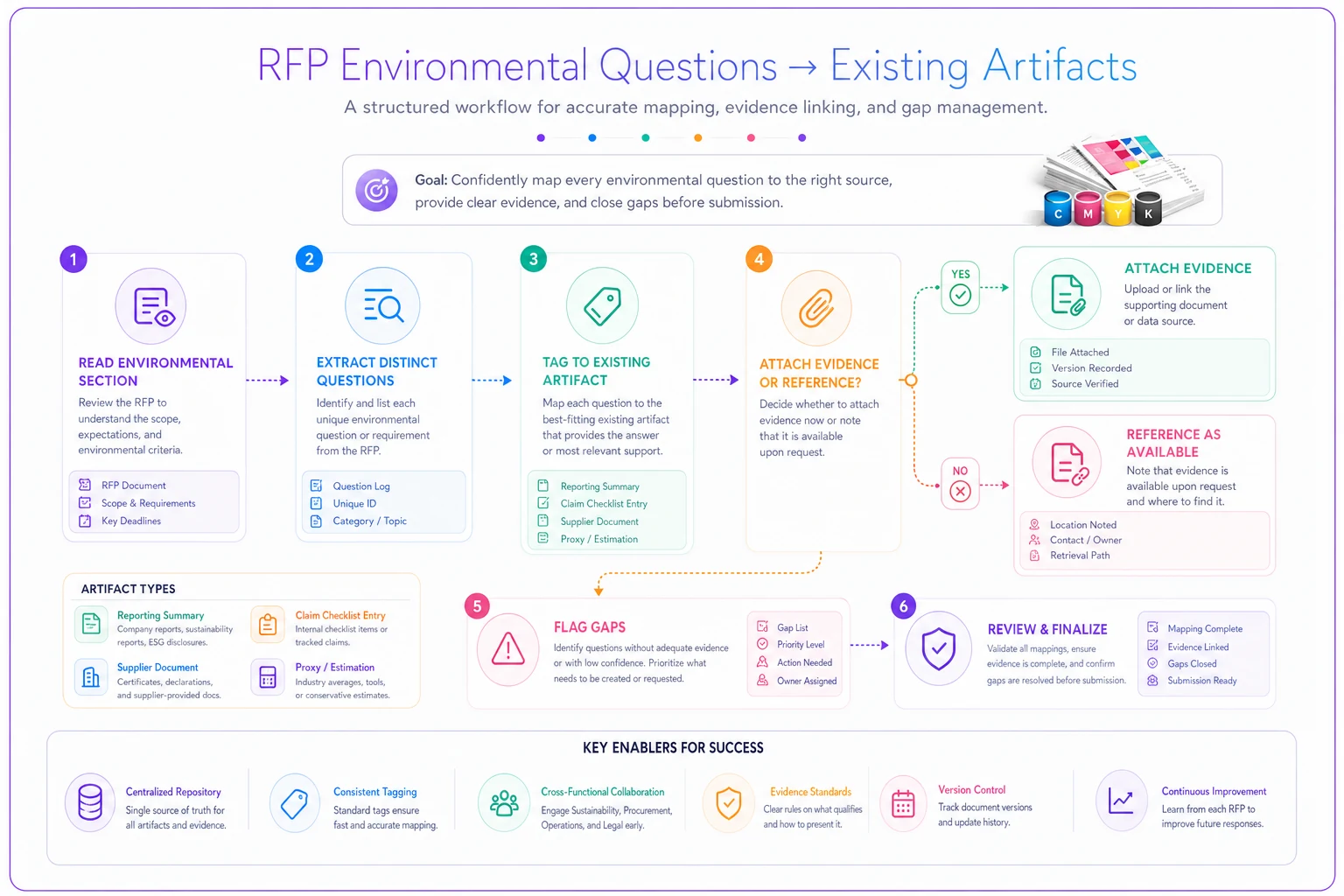
First, read the environmental section and extract each distinct question. Second, tag each question with the artifact that answers it — reporting summary, claim checklist entry, supplier doc, or proxy. Third, for each, decide whether you attach the evidence directly or reference it as available on request. Fourth, fill any gaps before submission — if a question has no matching evidence, that's a flag to either gather proof or answer honestly that the practice isn't yet in place.
That last point is underrated. Answering "not currently, but planned for Q3" honestly scores better on many rubrics than overclaiming, and it protects you from the much bigger penalty of a false statement surfacing during contract performance.
The buyer-facing one-pager
Once the underlying artifacts exist, the one-pager is almost mechanical to produce. It's a single sheet the evaluator can skim: certifications held, recycled-content options with PCW ranges, waste diversion rate, ink and chemistry practices, and one honest impact estimate with its method noted.
Keep it data-forward. Resist the urge to fill it with leaf icons and green gradients. The reviewer scoring your bid wants numbers and certification references they can tick against their rubric, not a brochure. A plain one-pager that reads like a spec sheet consistently outperforms a designed one that reads like an ad — which is a slightly painful thing for a shop full of designers to accept.
A real scenario
A commercial shop — around 14 people, heavy on marketing collateral and signage — kept making the shortlist on university and healthcare bids but losing on final score. Looking at three losing scorecards, the sustainability section was the consistent gap: full marks on price and capability, near-zero on environmental because every green answer was an unsubstantiated statement.
They spent roughly two weeks building the three artifacts. The claim checklist surfaced four claims they'd been making casually with no backing documentation, which they either dropped or fixed by getting supplier spec sheets. They added recycled-content and certification requirements to their top two paper suppliers, built a one-tonne-of-paper CO₂e proxy with cited factors, and assembled a plain one-pager.
Over the next two bidding cycles, their environmental scores moved from near-zero to the upper range on the rubrics they could see. They didn't win every bid — price still matters — but they stopped being eliminated on the sustainability line, and they closed at least one institutional contract where the scorecard showed the environmental section as the deciding margin. The operations hadn't changed much; they were already reasonably green. What changed was that they could finally prove it in the buyer's language.
Where to keep this stuff so it's actually usable
The artifacts only help if you can find them under deadline pressure. A bid portal closing in 48 hours is not the time to be digging through email for a chain-of-custody certificate. Keep the claim checklist, supplier documentation, proxies with their methods, and the master one-pager in one place, versioned, with a last-reviewed date on each claim. Certifications expire; a one-pager citing a lapsed FSC number is worse than no claim at all.
Review the whole package on a set cadence — quarterly is reasonable — and re-pull supplier documentation whenever you change paper or ink vendors. The shops that stay ready win more of these contracts simply because readiness is rare. Most competitors are still typing "we care about the environment" into the free-text box and losing the two points that decide the bid.
Build it once, keep it current, and the sustainability section stops being the question that knocks you out of contention.
Build it once, keep it current, and the sustainability section stops being the question that knocks you out of contention.
Ready to simplify your print shop operations?
Join 500+ print shops using GoInkly to save time, reduce errors, and improve customer satisfaction.