


Most print shops don't fail because they're bad at printing. They fail because the operation around the printing stops keeping up with the work coming in. A shop that could handle 40 orders a week on gut instinct suddenly chokes at 90, and nobody can pin down exactly why margins slipped or why rush jobs started blowing up.
The frustrating part is that growth feels like the reward, but it's also the thing that exposes every weak joint in your operation at once. Quoting, scheduling, prepress, inventory, invoicing — they all break at slightly different thresholds, and they break in an order that's surprisingly consistent across shops.
That's what a print shop operational maturity model is really for. Not as a report-card exercise, but as a way to figure out what breaks next and what you should spend money on before it does. This article lays out a four-stage model, maps SOPs and KPIs to each stage, and gives you investment triggers and rough cost/benefit checkpoints so you're not guessing.
Why maturity, not size, is the right lens
Two shops can both do $1.2M a year and be in completely different operational shape. One runs everything through a proper job-tracking system with clean handoffs. The other runs on the owner's memory, three whiteboards, and a shared drive nobody trusts. Revenue tells you almost nothing about whether the operation will survive its next growth spurt.
Maturity is about how predictable your operation is. Can you quote a job the same way twice? Do you know your true capacity next Tuesday? When a customer calls asking where their order is, can anyone answer in under a minute? Those are the questions that separate stages.
What we've seen across a lot of shops is that people invest in the wrong things at the wrong time — a fancy new press when the real bottleneck is that prepress is a black hole, or an expensive MIS when the shop hasn't even standardized how it writes up a job. The maturity model exists to stop that mismatch.
The four stages at a glance
Here's the whole model before we dig into each stage. Most shops straddle two stages, which is completely normal — the point isn't to slot yourself perfectly.
Eliminate order confusion and delays.
GoInkly helps you manage every print order efficiently from submission to delivery.
- Centralized order tracking
- Production workflow management
- Inventory and supply monitoring
No credit card required
| Stage | What it feels like | Primary SOP focus | Core KPIs tracked | Digitization level | Typical investment trigger |
|---|---|---|---|---|---|
| 1 — Reactive | Owner is the system | Basic job intake, verbal handoffs | Almost none (maybe monthly revenue) | Spreadsheets + email | Owner becomes the bottleneck |
| 2 — Documented | Written SOPs exist, inconsistently followed | Quoting, proofing, order entry | On-time %, rework rate | Shared drive + a quoting tool | Repeated same mistakes / missed dates |
| 3 — Connected | Systems talk to each other | Scheduling, inventory, costing | Capacity utilization, true job cost, margin by job | Integrated MIS / job tracking | Data lives in silos, can't see the whole floor |
| 4 — Optimized | Decisions driven by data | Continuous improvement, exception handling | Throughput, contribution margin, forecast accuracy | Automated data flow + dashboards | Growth outpacing management attention |
Notice the through-line: SOPs mature before KPIs, and KPIs mature before deep digitization pays off. You can't measure a process you haven't defined, and you can't automate a process you can't measure. Shops that skip steps almost always end up ripping out expensive software because it was measuring chaos.
Stage 1 — Reactive: the owner *is* the operating system
Every shop starts here and there's nothing wrong with it at the beginning. The owner knows every job, every customer, every quirk of the equipment. Coordination happens because one person holds it all in their head.
The problem is that this stage has a hard ceiling, and it's a person, not a machine. The bottleneck is human memory and human hours. What breaks first is usually quoting consistency — the same business card job gets quoted at $180 one week and $145 the next depending on mood and how busy things are.
KPI reality at Stage 1: you probably track revenue and maybe cash in the bank. That's it. And honestly, that's fine for now — but flying on those two numbers alone is exactly what gets shops in trouble the moment they grow. If you want to understand which numbers actually matter before you scale, the Stop flying blind: KPIs and a capacity model every profitable print shop should track breakdown is the right starting point.
Investment trigger to move to Stage 2: you notice the owner is turning down work not because there's no capacity, but because there's no time to manage the work. When the person who quotes, schedules, and troubleshoots becomes the single point of failure, it's time to document.
Cost/benefit checkpoint: the spend here is mostly time, not money — maybe a few hundred dollars for a decent quoting tool and a couple of weekends writing things down. The benefit is that a second person can suddenly do things that only the owner could do before. That alone can free up somewhere around 8–12 hours of the owner's week.
Stage 2 — Documented: the SOPs exist, but do people follow them?
This is where most struggling shops actually live. They have SOPs — there's a Google Doc somewhere explaining how to enter an order — but the docs and reality have quietly drifted apart. The written process says "confirm paper stock before sending to proof," and half the team does it and half doesn't.
Stage 2 is the messiest stage because you get the overhead of documentation without the full payoff of consistency. Failure points cluster around handoffs: a job goes from CSR to prepress to the floor, and something falls through the crack at every boundary.
A typical example looks like this: a shop doing around 70–80 orders a week has an on-time rate hovering at 82%. When they finally start logging why jobs are late, roughly two-thirds trace back to incomplete order intake — missing dimensions, unconfirmed proofs, wrong file formats. The presses were never the problem. The intake was.
KPIs that matter at Stage 2:
-
On-time completion rate (start here — it's the single most honest measure of whether your process holds)
-
Rework/reprint rate as a % of jobs
-
Quote-to-order conversion
-
First-pass proof approval rate
Use a single, required intake checklist to reduce missing fields and cut rework.
What to actually fix first: don't try to document everything at once. Pick the two or three SOPs where mistakes cost the most — usually intake, proofing, and how a job gets scheduled — and make those airtight before touching anything else.
Investment trigger to move to Stage 3: you've got the SOPs, you're tracking a few KPIs, and now the pain is that all your data lives in disconnected places. The quoting tool doesn't know about the inventory sheet, which doesn't know about the schedule. You're spending hours re-keying the same order into three systems.
When Stage 2 is the wrong place to over-invest: if you're doing under roughly 50 orders a week and they're mostly repeat work, don't rush into an integrated MIS. The ROI won't be there yet. Tighten the SOPs, get your KPIs honest, and let volume justify the next spend.
Stage 3 — Connected: making the systems talk
This is where digitization starts genuinely paying back, because now the pieces connect instead of sitting in silos. An order entered once flows into scheduling, pulls the right inventory, and feeds costing automatically. That single change — enter once, use everywhere — removes an enormous amount of re-keying and the errors that come with it.
The prerequisite people skip is data structure. If your order data, inventory data, and customer data don't share a consistent shape, "connecting" them just spreads your inconsistencies faster. Getting the underlying model right first is what makes everything else work — the Print-shop operational data architecture: a practical single-source data model for orders, inventory and customers guide is worth working through before you connect anything.
At Stage 3, your KPIs get predictive instead of just historical. You stop asking "were we on time last month" and start asking "can we take this rush order without blowing up Thursday's schedule." That's the shift from reporting to actually running the shop.
Core Stage 3 KPIs:
-
Capacity utilization by work center (press, finishing, bindery)
-
True job cost including setup, run, finishing and hidden labor
-
Contribution margin by job type
-
Schedule adherence / buffer consumption
Here's a workflow to sanity-check whether you're actually at Stage 3 or just have expensive software sitting on top of Stage 2 habits:
-
A customer places a repeat order online or by email.
-
The order populates your job system without anyone re-typing it.
-
The system checks stock and flags if paper needs reordering.
-
The job lands in the schedule against real, known capacity.
-
As it moves through production, status updates without someone manually posting them.
-
When it ships, invoicing triggers off the same record.
If any of those steps still require someone copying data from one place to another, you're paying Stage 3 money for Stage 2 results.
A quick visual of that workflow can help teams align on the "enter once, use everywhere" flow.

Investment trigger to move to Stage 4: the operation runs well, but growth is outrunning your ability to watch it. You can't personally look at every exception anymore, and you need the system to surface the handful of things that actually need a human decision.
Stage 4 — Optimized: managing by exception
Stage 4 shops aren't necessarily bigger — they're calmer. The data flows on its own, dashboards show the real state of the floor, and management spends its attention on the exceptions the system flags rather than chasing down status all day.
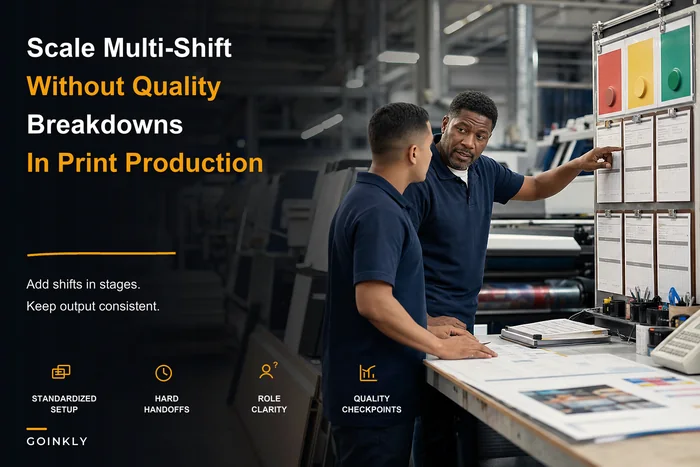
The defining trait is that the shop can add volume without adding chaos. When you're scaling up shifts or capacity, the operational discipline has to be in place first — the Scale to multi-shift production without losing print quality: a staged operations roadmap shows why shops that skip that groundwork tend to lose quality exactly when they can least afford it.
Stage 4 KPIs lean forward:
-
Throughput and constraint utilization (where's the real bottleneck right now)
-
Forecast accuracy vs. actual demand
-
Contribution margin trend by channel and customer
-
Exception rate and time-to-resolve
A realistic caution: very few small shops need to be fully Stage 4, and pushing there prematurely burns money. If you're a five-person shop, chasing forecast-accuracy dashboards is a distraction. Stage 4 makes sense when management attention has genuinely become the scarce resource — when the owner's judgment is worth more spent on strategy than on tracking where job #4471 is.
Who should NOT jump ahead
A few honest guardrails, because the most expensive mistakes come from buying a stage you haven't earned:
-
If your SOPs aren't followed consistently, don't buy integration software. You'll automate the inconsistency.
-
If you can't state your true job cost within reason, don't build margin dashboards yet. Garbage in, confident-looking garbage out.
-
If the owner is still the only person who knows how anything works, fix that before spending on tooling. Software doesn't transfer knowledge; documentation does.
-
If volume is flat and mostly repeat work, stay put and optimize where you are. Not every shop needs to reach Stage 4, and that's completely fine.
Not every shop needs to reach Stage 4, and that's completely fine.
A real scenario: a mid-sized commercial shop stuck between stages
A commercial shop running around 300–340 jobs a month had all the hallmarks of a stalled Stage 2. They had SOPs, they had a quoting tool, and they were tracking on-time rate — which sat around 80%. But quoting lived in one place, scheduling on a whiteboard, and inventory in a spreadsheet updated "when someone remembered."
The owner assumed the fix was a faster press. When they actually mapped where jobs stalled, the press was idle more than expected — the real drag was re-keying orders across three systems and the mistakes that created. Roughly 15% of jobs needed some form of rework, and a meaningful chunk of that traced back to transcription errors between the quote and the production ticket.
They held off on the press. Instead, they moved deliberately into Stage 3 over about four months: cleaned up their data structure, connected quoting to scheduling to inventory, and made the order enter the system once. On-time rate climbed into the low 90s over the following two quarters, rework dropped to around 6–7%, and — the part that surprised the owner — actual press utilization went up, because the floor was no longer waiting on corrected tickets. The press they almost bought would've sat mostly idle.
The lesson wasn't "software fixed it." The lesson was that they finally spent money on the actual bottleneck instead of the obvious-looking one, because the maturity lens told them where they really were.
How to use this model without overthinking it
Read back through the four stages and find the one where the pain descriptions match your daily reality — not where you wish you were. Most shops are honestly a stage lower than they think, because having SOPs and actually following them are two very different things.
Then look at the single investment trigger for your current stage. Not all of them. The one that matches the pain you're feeling this quarter. Spend against that trigger, let the operation stabilize, and only then look at what comes next.
The shops that grow smoothly aren't the ones with the most equipment or the fanciest systems. They're the ones that added structure just ahead of the volume that would've broken them. That's the whole game: staying one step ahead of your own growth, and knowing which step comes next.
The shops that grow smoothly aren't the ones with the most equipment or the fanciest systems. They're the ones that added structure just ahead of the volume that would've broken them. That's the whole game: staying one step ahead of your own growth, and knowing which step comes next.
Ready to simplify your print shop operations?
Join 500+ print shops using GoInkly to save time, reduce errors, and improve customer satisfaction.