


Most print shops don't realize they have an API governance problem until the third time a carrier rate change silently broke their shipping quotes, or a storefront vendor renamed a field and suddenly half the incoming orders landed in production with blank paper stock.
The symptoms always look like something else. Operators blame "the software." Production blames order entry. Order entry blames the web guy. But when you trace it back, the actual cause is almost always the same: there was never an agreed-upon contract for what data looks like as it moves between systems, who owns it, and what happens when one side changes it.
This is the part of integration work nobody wants to do because it feels like paperwork. And then it quietly costs you reprints, missed ship dates, and hours of "why did this order come through wrong" detective work every week.
So treat print shop API governance like the operational discipline it actually is — closer to how you'd run color management or make-ready SOPs than how you'd think about IT. Same idea: define the standard, write it down, monitor for drift, and have a recovery plan when something goes sideways.
Why integrations rot over time (and it's not the code)
When a shop first wires up its storefront to its MIS, everything works. The developer tests a few orders, they flow through clean, everybody moves on.
Integrations don't fail at launch. They rot. And they rot because of changes that nobody treated as a change.
A typical example: your web storefront vendor ships an update that changes quantity from an integer to a string ("500" instead of 500). Your MIS doesn't throw an error — it just interprets the string oddly, and a 500-piece job gets scheduled as a 5-piece job. Nobody notices until a customer calls asking where the rest of their order is.
-
Storefront → order intake (field renames, new optional fields, changed data types)
-
Order → production/MIS (job spec mapping, finishing codes, imposition flags)
-
Shop → carrier adapters (rate structures, service codes, address formats)
-
Shop → finishing/trade partners (outsourced binding, laminating, large-format)
Each of these is a third party you don't fully control. And each one will, eventually, change something without telling you in a way you understand. The composable approach we've written about in our composable API strategy piece makes shops more flexible — but flexibility without governance just means more places things can silently drift.
The governance layer is what turns "we have a lot of integrations" into "we have integrations we can trust."
The core idea: canonical contracts, not point-to-point mappings
Most shops integrate point-to-point. The storefront speaks directly to the MIS. The MIS speaks directly to the carrier. Every connection has its own custom field mapping buried in some script. When you have three systems, that's manageable. When you have a storefront, two sales channels, an MIS, a shipping platform, and two trade partners, you're maintaining something like a dozen fragile translations — and each one has to be updated whenever anything changes.
Eliminate order confusion and delays.
GoInkly helps you manage every print order efficiently from submission to delivery.
- Centralized order tracking
- Production workflow management
- Inventory and supply monitoring
No credit card required
The better model is a canonical contract: one internal definition of what an "order," a "job," a "shipment," and a "customer" look like in your shop. Every external system maps to and from that canonical shape, not to each other.
This connects directly to having a real single-source operational data model. The data model is the nouns. The contracts are the agreements about how those nouns move and change.
A canonical order-event contract (template)
{ "event": "order.created", "eventversion": "2.1.0", "eventid": "evt8841aa", "occurredat": "2026-03-14T15:22:08Z", "source": "storefrontweb", "idempotencykey": "ord55120created", "data": { "orderid": "ORD-55120", "customerid": "CUST-2041", "channel": "web", "currency": "USD", "lineitems": [ { "lineid": "L1", "sku": "BC-16PT-MATTE", "description": "16pt matte business cards", "quantity": 500, "spec": { "stock": "16ptc2s", "finish": "matte", "sides": 2, "finishing": ["roundcorner"] }, "pricecents": 4900 } ], "totals": { "subtotalcents": 4900, "taxcents": 404, "totalcents": 5304 } } }
-
event_versionis explicit and on the envelope, not buried. -
quantityis an integer, and the contract says so — any adapter sending a string is violating the contract and should be rejected loudly, not silently coerced. -
idempotency_keyso a retried webhook doesn't create a duplicate job. This alone prevents a surprising number of "why do we have two of the same order" problems. -
Money is in integer cents. Floating-point dollars in JSON cause rounding drift that shows up weeks later in reconciliation.
The point isn't this exact schema. The point is that you define it, you write it down, and every integration either conforms or gets rejected at the door.
Semantic versioning rules that actually fit a print shop
Use three-part versions — MAJOR.MINOR.PATCH — on every contract:
| Change type | Version bump | Example | Breaks consumers? |
|---|---|---|---|
| Add a new optional field | MINOR (2.1.0 → 2.2.0) | Add gift_message to orders | No |
| Fix a typo, clarify docs, no shape change | PATCH (2.1.0 → 2.1.1) | Clarify date format in spec | No |
| Rename/remove a field, change a data type, change required fields | MAJOR (2.1.0 → 3.0.0) | quantity string → integer, rename stock | Yes |
The one rule that saves the most pain: a MAJOR change always requires running both versions in parallel for a defined window. You never flip everyone over at once. Stand up v3, let a few orders flow through it, verify, then migrate adapters one at a time. The old version stays alive until every consumer has moved and you've confirmed it in monitoring.
A mistake shops make constantly: treating a "small" field rename as a quick fix. There's no such thing as a quick field rename across systems. Renaming finishing to finishing_ops is a MAJOR change even though it feels tiny, because a downstream system reading the old name now gets nothing — and "nothing" usually means a job runs without the UV coating the customer paid for.
The ownership matrix: who gets paged when it breaks
Integrations break on weekends. They break on the day your one tech-savvy person is on vacation. The difference between a 20-minute fix and a two-day scramble is whether anyone knows who owns what.
Most shops have never written this down. So here's the one artifact that pays for itself the first time something fails: an ownership matrix.
| Contract / Adapter | Internal owner | External owner | Change-notice SLA | Monitoring owner |
|---|---|---|---|---|
order.created (storefront) | Ops manager | Storefront vendor | 14 days before MAJOR | Ops manager |
job.spec (MIS) | Production lead | MIS vendor | 30 days | Production lead |
| Carrier rate adapter | Shipping lead | Carrier API | Per carrier terms | Shipping lead |
| Trade-partner handoff | CSR lead | Partner shop | Email + confirm | CSR lead |
A few things this forces into the open:
-
Every contract has exactly one internal owner. Not a team. A person. Shared ownership means no ownership.
-
You negotiate change-notice SLAs with vendors. When you sign with a storefront or MIS vendor, ask: how much notice do you give before breaking changes? If the answer is "we push updates whenever," that's a risk you now get to price in.
-
Monitoring owner is separate from the fixer sometimes, and that's fine — the point is someone is watching the specific thing.
Monitoring owner is separate from the fixer sometimes, and that's fine — the point is someone is watching the specific thing.
Monitoring gates: catch drift before customers do
Governance without monitoring is just a document in a drawer. The goal is to detect a broken contract before a reprint happens, not after.
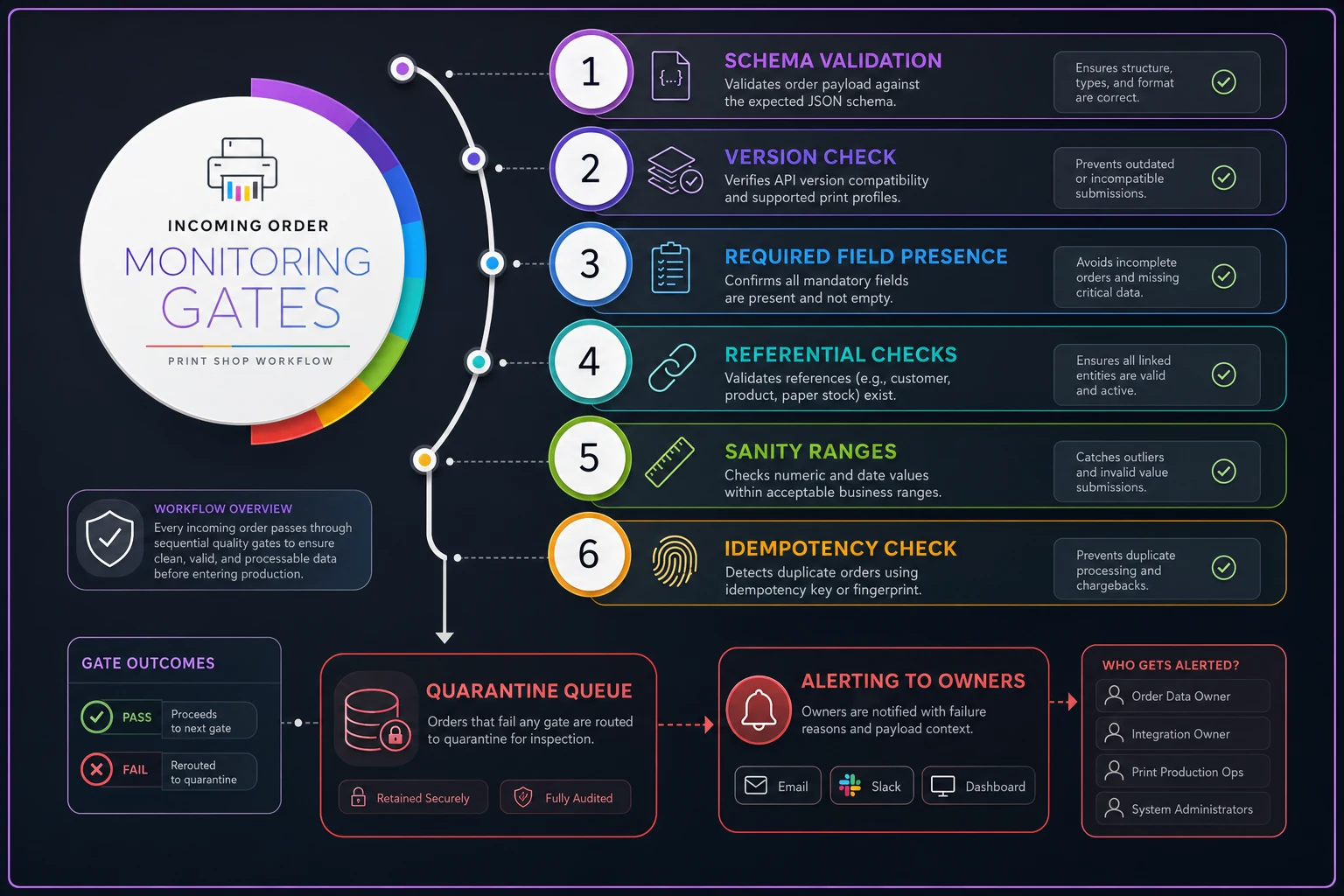
Think of monitoring as a set of gates that order and job data has to pass through. Each gate checks one thing and either passes the data or quarantines it.
Gate checklist for incoming orders
-
[ ] Schema validation — does the payload match the current contract version exactly? Reject on type mismatches (string where integer expected).
-
[ ] Version check — is the
event_versionone we currently support? Unknown version → quarantine, alert owner. -
[ ] Required-field presence — stock, quantity, sides, finishing all present where required.
-
[ ] Referential checks — does
customer_idexist? Does theskumap to a real production spec? -
[ ] Sanity ranges — quantity between 1 and your max (a 50,000-piece order on a channel that never exceeds 2,000 is probably a data error, not a whale customer).
-
[ ] Idempotency — have we already processed this
idempotency_key?
Anything that fails a gate shouldn't silently drop. It should land in a quarantine queue a human reviews — the same way a preflight failure holds a file instead of printing garbage.
Monitoring thresholds worth setting
-
Validation failure rate jumps above roughly 2% of incoming orders in an hour → someone probably shipped a schema change.
-
Zero orders from a channel for longer than its normal quiet window → the integration likely died, not business.
-
Carrier quote latency over a few seconds, or rate responses outside expected bands → carrier adapter drift.
-
Duplicate idempotency hits climbing → a retry storm or a misbehaving webhook.
Alert by channel and by contract version so you can tell a vendor rollout from a channel outage immediately.
This diagram shows the gate workflow and how alerts and quarantine queues connect to owners.
The shops that get burned are the ones watching revenue dashboards but not integration-health dashboards. By the time a revenue dip shows up, the damage is already in production. This is the same discipline that makes automated ecommerce-to-production flows trustworthy instead of a new source of silent errors — automation only helps if you can tell when it's quietly doing the wrong thing.
Rollback playbooks for third-party adapters
When an adapter breaks, the instinct is to start editing code live, in production, while orders pile up. That's how a one-field problem becomes a two-day outage.
A rollback playbook removes the panic. It's a short, written sequence anyone can follow.
-
Detect and confirm. Monitoring trips. Confirm it's a real contract break (validation failures, not just a traffic spike).
-
Quarantine, don't drop. Flip the affected adapter to quarantine mode — failing payloads go to a holding queue, nothing gets lost.
-
Revert to last-known-good version. If a vendor pushed a change, pin your adapter back to the prior contract version if you still run it in parallel (this is why parallel-running MAJOR versions matters).
-
Notify the ownership-matrix contact. Internal owner pings the external owner with the specific payload that's failing.
-
Replay from quarantine. Once fixed, reprocess the held orders through the corrected adapter — idempotency keys prevent duplicates.
-
Write the one-paragraph postmortem. What changed, who changed it, what gate should have caught it, and whether a new gate is needed.
That last step is the one shops skip, and it's the one that compounds. Every postmortem that adds a new gate makes the next break smaller.
A real scenario: the carrier adapter that cost a week of margin
A mid-sized commercial shop running roughly 300–400 shipments a week had its carrier integration quietly change how it returned residential surcharges. The field was still there — it just started coming back nested one level deeper in the response.
Their adapter read the old path, found nothing, and defaulted the surcharge to zero. Quotes went out slightly low. Nothing errored. Nothing alerted.
It ran like that for about nine days before accounting noticed shipping cost was running higher than quoted on residential orders. Best estimate on the bleed was somewhere in the $1,400–$1,800 range of under-recovered shipping, plus an afternoon spent figuring out why.
Two governance pieces would have caught it: a sanity-range gate (residential orders suddenly showing $0 surcharge where they normally showed $4–$12) and a contract test that pinned the exact response path. They added both. The next time that carrier moved a field — about four months later — the gate tripped within an hour, the shipping lead got pinged, and it was fixed before a single quote went out wrong.
The lesson wasn't "carriers are unreliable." Carriers change things constantly; that's just normal. The lesson was that silent defaults are more dangerous than loud errors. A field that errors gets fixed in an hour. A field that quietly defaults to zero bleeds for a week.
When this level of governance makes sense (and when it's overkill)
Not every shop needs a formal contract registry. Be honest about where you are.
This makes sense when:
-
You run three or more integrated systems (storefront, MIS, carrier, finishing partners).
-
Multiple sales channels feed one production floor.
-
You've been burned at least once by a silent integration break.
-
You're planning to add channels or trade partners — governance before growth is far cheaper than after.
This is probably overkill when:
-
You have a single storefront feeding a single MIS, both from vendors who give solid change notices.
-
Order volume is low enough that a human eyes every order anyway.
Who should NOT try to do all of this at once: a two-person shop with one integration. Start with just two artifacts — the ownership matrix and schema validation on incoming orders. Those two alone catch most of the damage. Add versioning rules and rollback playbooks when you add your second or third integration, not before.
Where operational software fits
Most of what's above can be run with a spreadsheet for the ownership matrix and some validation logic at your intake point. But as the number of contracts grows, keeping versions, gates, and quarantine queues straight by hand gets fragile fast.
A proper operations platform earns its keep here — not by being magic, but by giving you one place where contracts are defined, incoming payloads are validated against the current version, failures land in a reviewable queue instead of production, and AI-assisted monitoring can flag anomalies (a sudden spike in validation failures, a channel going quiet, surcharges dropping to zero) before they reach the floor. The value isn't automation for its own sake. It's that the drift gets noticed automatically, and the right owner gets told, so a human can act while it's still a small problem.
Treat the software as the enforcement layer for the governance you've already designed — not a replacement for designing it.
Print shop integrations don't fail because the technology is bad. They fail because the agreements between systems were never written down, versioned, owned, or watched. The code was fine on day one and nobody noticed when the ground shifted underneath it.
Governance is just the discipline of making those agreements explicit: canonical contracts so systems map to one shape, versioning rules so changes are visible, an ownership matrix so someone's accountable, monitoring gates so drift gets caught early, and rollback playbooks so a break stays small.
You already run this kind of discipline on your presses — tolerances, SOPs, maintenance schedules. Your integrations deserve the same treatment. The shops that get this right stop losing afternoons to "why did this order come through wrong," and start treating their data connections as infrastructure they can actually trust.
Ready to simplify your print shop operations?
Join 500+ print shops using GoInkly to save time, reduce errors, and improve customer satisfaction.